
Ruiner got me thinking about incentivized mayhem.
A futuristic factory. Its cold steel interior bathed in crimson. Crimson light. A synth-laced beat begins to swell, steady and foreboding. A mechanized door opens automatically. Out rushes a band of armed thugs. Their fingers rest against the triggers of their firearms. Your fingers tighten around the menacing metal pipe in your hand. The fight begins. The sounds of gunfire and the unmistakable impact of metal against flesh echo throughout the factory. Its cold steel interior bathed in crimson. Crimson blood.
Developed by Reikon Games, Ruiner is an isometric, twin-stick shooter that delivers a series of ever-escalating battles where death is certain, and resurrection is instantaneous. At its core, Ruiner is committed to two things: carnage and momentum. There are several elements that coalesce to strengthen Ruiner’s gravitational pull over the player as they maniacally adhere to the simple philosophy of breakneck bloodletting. I was hooked from the introduction, and even when I became somewhat frustrated upon repeated failure, I was continuously crowd-surfing toward the finish on the shoulders of an industrial, synth-wave soundtrack, gleefully gory executions, cracked knuckles and the color red.
When you first start Ruiner, it’s clear you’ve been hacked. The nameless protagonist wears a cybernetic mask that seems permanently attached to his face, leaving him exposed to an invasive voice periodically urging him to “KILL BOSS.” As you learn the basic structure of the game, which is going from room to room, killing waves of enemies as efficiently as possible to earn the best rank, dying, then rapidly respawning at the start of the most recent room you’ve entered, another voice demands that the man in the mask “WAKE UP.” I was already on board at this point. I didn’t know who the hell Boss was or why I was killing him, but Reikon skillfully and stylistically sets the tone of the game in a way that made me not want to bother asking questions. A buzzy bass begins to surge as the protagonist rides an elevator toward an undisclosed destination. “KILL BOSS.” The elevator doors open and the title of the level, HEAVEN, is displayed in bold red letters over a black background for only a moment. Then it’s time to get to work.
The opening of Ruiner is just as direct and mysterious as Hotline Miami’s, another bloody rampage of a game (developed by Dennaton Games) that isn’t afraid to punish unfocused players and must have inspired Ruiner to some degree. In both games, you take control of a character who is summoned to eliminate targets for reasons unknown. Each character wears a mask that covers up their identity. It’s also worth noting that they both don cool bomber jackets and are willing to mercilessly murder many, many people by way of blunt force and buckshot. Hotline Miami’s “KILL BOSS” incentive is delivered in the form of phony voicemails requesting the protagonist’s services for various odd errands like picking up a cookie delivery from a nearby bakery or fixing a power outage. These are all code for “kick down the door of a seedy house and throw a brick at the first person you see.” The who, what and why don’t matter, because you’re driven by the immersive environment full of lurid color and sleazy criminals, a rotation of rhythmic tracks like “Knock Knock” by Scattle and the promise of addictively savage violence. This same successful formula is followed gracefully by Ruiner, except replace “Knock Knock” with something like “Duel 35” by Zamilska.
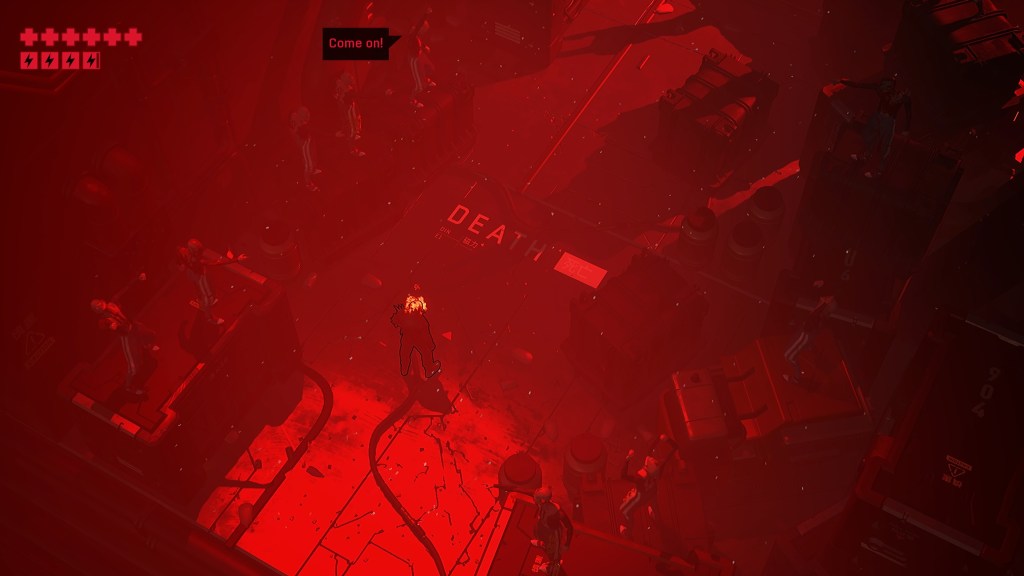
If the atmosphere of Ruiner is what sparked my curiosity, then the combat is what caused my curiosity to catch flame. At the start of the game, you’re equipped with a trusty metal pipe that can satisfyingly ragdoll your enemies. Movement is smooth, but you’ve got to pay close attention to which way you’re facing, because it can be easy to lose precision with the right analog stick and whiff an attack when there’s multiple enemies and projectiles sliding across the screen at once. As you progress through the opening area, you’ll come across the titular ruiner gun that offers unlimited ammunition but suffers from low damage output. You’ll also need to reload it after a burst of fire, so make sure you’re always moving. This initial loadout is only a tease of the potential combinations available to the player (though upgrades are available to bolster the standard weapons’ utility) as they encounter tougher, more heavily armed opponents. There are shotguns, miniguns, railguns, flamethrowers, plasma rifles and more. Combine these with a sledgehammer or a deadly sword and the level of speed and ferocity with which you can clear a room significantly rises. The feedback every time an enemy is smashed or blasted into smithereens is very well done, between the noises made and the blood that’s sprayed. I also enjoy performing finishers, which temporarily shield the player from taking damage during the time it takes to play out a sadistically glorious animation, ending in the total obliteration of whatever unlucky soul happened to get themselves dazed and confused. One of the main indicators that an enemy is stunned (other than a thin yellow ring appearing around their feet) are stars orbiting around their head like a Bugs Bunny cartoon. The juxtaposition of a Looney Toons style cue to savagely stomp someone into bits is a subtly funny inclusion that put a smile on my face.
Leveling up combat abilities further incentivizes the player to continue their headhunt by providing an easily alterable skill tree where several different playstyles are possible. Earning enough karma (by racking up kills and making quick detours from the beaten path to open boxes) will award points that can be used to experiment with a list of skills like extra dashing, grenades, powerfully charged melee strikes, hacking, and either mobile or static shields. I at first used the mobile shield that I had trouble timing correctly when things got too hectic. Had I been locked into using that shield for the duration of my experience, I’m sure I would have gotten the hang of it. However, the fact that I could go into the skill tree at any time, remove the points I invested into the mobile shield and instead spend them on a static shield barrier that allowed me to be much more comfortable using and defending against ranged weaponry is very liberating design. The skill tree isn’t too big, so it’s not as if there are endless ways to play, but that’s a good thing. Ruiner doesn’t need to be overly complicated. Remember, its core is made of carnage and momentum.
My only issue with the skill tree is that having to spend points on my health felt a bit wasteful. Once I got better at the game, I was able to remove those points and put them elsewhere, but in the time it took me to become confident enough to do so, I was left more skeptical of the health bar’s functionality in general. I understand the need for an energy bar that determines how many consecutive skills you can activate, because throwing endless grenades and/or deploying unlimited shields would obviously trivialize the entire experience. Though when it comes to the health bar (which appears segmented into separate boxes but behaves the same way as one solid meter), something’s off. In Hotline Miami, you get one chance to clear each floor of whatever house or disco club you’re invading. One stab, gunshot, or dog bite and you’re dead. This forces you to learn the enemy layout and plan your violent route accordingly. Ruiner is designed differently. Multiple waves of enemies will fill the same room on repeat until they’re all eliminated, so the same one-hit-kill principle would quickly get tiresome. Still, I couldn’t help wondering if a compromise between both ideas would improve the game. Maybe it’s because the health bar often drains so fast that it feels like a one-hit-kill anyway, but starting each encounter with a set number of hits you can take might have been easier to keep track of. Then, if the player can reach a high enough combo, they’re rewarded with an extra hit point. This may seem like the system that’s already established, since enemies will randomly drop health pickups mid-battle, but while the player’s attacks give good feedback, the same can’t be said for damage received. Seeing one of three nodes shatter at the top of my screen, indicating I can only be hit twice more before the end of a fight, may have been a better way for the game to communicate with me and raise the stakes regarding the achievement of consistent combos. I also wouldn’t have minded some way to tell how much health the enemies have, especially as the game progresses and their resistance is raised. It can be annoying to hit one enemy type with the same force it took to kill another, only for them to tank the damage while backpedaling and blasting lead into my face until I die. I found myself thinking just die already! several times, but I can also see how enemy health bars could get in the way of the action. Keep in mind that my hang-up with the health bar was only present during my first playthrough. Once I learned how to move, shoot and strike optimally on my second, I wasn’t really paying attention to anything other than dealing death.
Some of Ruiner’s best incentives are little touches. Whenever you manage to earn an S rank by conquering waves of foes with a vengeance, the female hacker who so badly wanted you to wake up at the start of the game will celebratorily say, “Domination!” to which you’ll inevitably respond, “You’re damn right domination” under your breath. To be clear, the character himself says nothing. But that’s another fun component of the game. During brief sequences of dialogue, you’ll get the option to nonverbally respond to whoever’s speaking (via text boxes). Typically, the only two options are to nod or shrug, which doesn’t seem to make any difference. However, you can occasionally choose to “crack knuckles” which also doesn’t make any difference but did get my oddly fired up for the fight to follow. And yes, in case you’re wondering, I actually cracked my own knuckles a couple of times when this prompt appeared. That just goes to show how good Ruiner is at setting the tone and throwing you into the protagonist’s shoes.
Ruiner’s gameplay would work well with any aesthetic, yet the red-soaked world of steel that Reikon builds around that gameplay is what makes the game itself stand out. It’s brutal, mysterious, brooding, exciting and persistently intense. The player is constantly immersed and driven forward in their quest to kill(boss), kill(boss) and kill(boss) some more. So, if you’re up for an addictive challenge, then wake up and check it out.
 GotMeThinkingGames
Leave a comment