
- Quake 2 Remastered
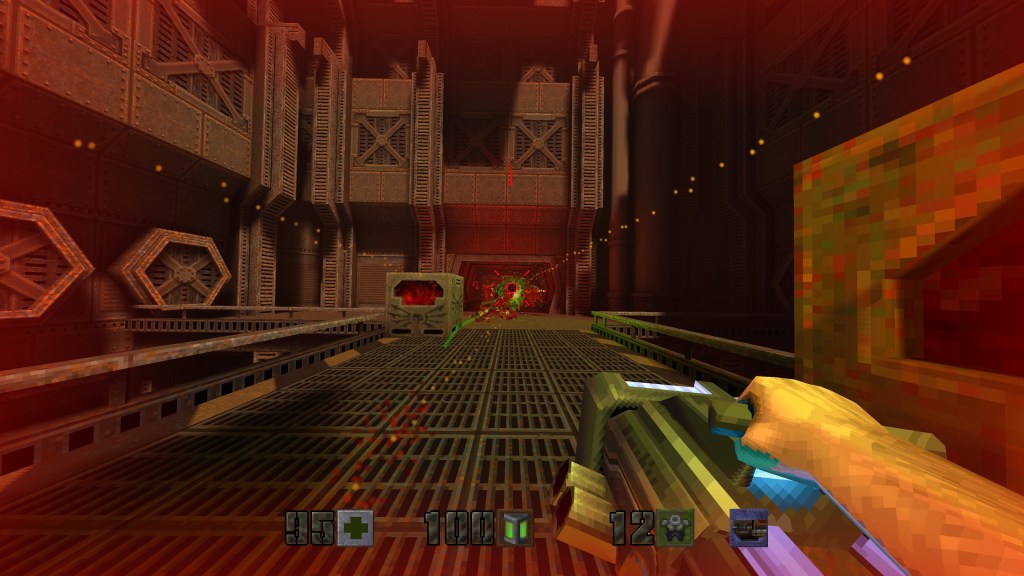
Nightdive Studios has become known for their ability to freshen up classic retro titles (especially first-person shooters) with modern sensibilities. Rectifying omissions that were either impossible to include, undiscovered or simply not commonplace at the time of the original release goes a long way in reintroducing old titles with a bang. One of Nightdive’s projects that allowed me to discover a game I’d never played before, and probably wouldn’t have played if not for its widely accessible resurrection and promotion alongside Doom Eternal, was Doom 64, which I appreciated for its dusky, medieval atmosphere full of alternate Doom monster designs and eerie backdrops. By the time I played the Quake remaster, I felt I had already experienced enough of blasting through moody stone castles full of demons and was therefore never as captivated by it. I’m not saying Doom 64 is objectively better than Quake; both games are so different (given Quake’s fascinating jump to full 3D) that a direct comparison is unnecessary, but maybe since I am retroactively experiencing these games for the first time, Quake’s 3D conversion and modernized movement lacked the impact it certainly had back in 1996 (the year I was born). I wanted more to grab onto than a small monster lineup and environments that bleed together.
Enter Nightdive’s Quake 2 remaster. I didn’t know what to expect from this game after seeing the original release get deemed generic and unfaithful to its predecessor, but after blazing right through the base campaign, the Nintendo 64 version and the Call of the Machine expansion that was created by MachineGames specifically for the remaster, it’s safe to say I really enjoyed this sequel. The level design of the base campaign hinges on corridors where enemies repeatedly ambush you, which attach to larger rooms where bigger battles break out. If not for Nightdive’s addition of a compass that temporarily shows green arrows pointing toward the goal, I surely would have had trouble navigating each level, especially since I was tasked with backtracking several times through the same areas. Fortunately, the compass worked wonders, so I was able to appreciate the interconnected design where backtracking added to a sense of progression and immersion. I didn’t need to constantly depend on the compass, but it prevents occasionally confusing level structure from becoming an issue.
The space marine arsenal at hand brings every id Software staple back to the table. The chaingun is a big, bulky hunk of steel that revs up to hyper speed and can mow down brutes like the railgun-wielding Gladiator with relative ease. The powerful pump-action Super Shotgun will continue to hold your attention from the moment you first pick it up and will erase any and all memory of the starting shotgun, as any proper Super Shotgun should. While most of the weapons’ functionalities are typical, they look cool and are satisfying to use, which is all I can ask for. Enemies also look cool. The Strogg are an alien race that have merged themselves with advanced technology, resulting in cybernetic abominations capable of constant firepower. Each enemy has their own auditory tell, including the Berserker, a creature with a blade for one arm and a hammer for the other that will yell “Trespasser!” before leaping across the map to knock you around (sometimes into a pit of lava if you’re not careful). Apparently, the leap attack was experimented with during the original production of the game but ultimately cut. Here it has been revived. The attack can be tedious to deal with since there’s no go-to method of dodging it, but at the same time it was shocking and charmingly hilarious when I first witnessed a Berserker come stiffly hurling through the air, so I’ve come to terms with it. Besides, there are ways to discourage Berserkers from ever using it. Stay close, baiting out basic melee attacks, and stun them with the Super Shotgun. Every enemy can be stunned. Sometimes they’ll simply stagger backwards, sometimes they’ll take a knee to recover and sometimes they’ll flop to the floor. These are crucial openings during battle that either allow you to, for example, pour more bullets into a Gunner before he recommences filling the room with grenades, or pick off a few surrounding enemies to buy yourself more space for circle-strafing. If you’re too late and an enemy exits their stun animation, relying on a good ol’ game of hide and peek is an ever-reliable (though admittedly less than riveting) strategy that I often used to stay alive. With the remaster’s addition of hitmarkers, you’ll never have to question whether your bullet landed before darting back behind cover to avoid an incoming missile barrage.
Overall, I see why the game is labeled as more generic than the first, because it certainly lacks the kind of look that immediately stands out (especially by today’s standards), but when I was coasting smoothly through large levels, rocking out to Sonic Mayhem’s metal soundtrack and pumping an entire belt of chaingun bullets into a giant mechanized tank monster, that didn’t matter. Also, the game does have a a very id-like personality of its own. When it’s time to shut down the Strogg’s processing plant piece by piece, you’ll be treated to such mission objective message updates as “Emulsifying flesh press unit deactivated.” Later, an attempt to open a locked door will trigger a concise prompt saying, “You need the commander’s head.” These over-the-top descriptions and tasks feel tongue in cheek in the same way that the Doom reboot handled its story beats. I was also reminded of Doom during the Call of the Machine expansion, which feels almost like an anachronistic prototype of Doom Eternal as each level becomes a bloodbath where movement is key and ammunition is endless. Well, ammo isn’t literally endless, Call of the Machine includes so much of it that you’ll never have trouble decimating droves of Strogg that come pouring out of monster closets. You’ll also be running across a red planet that I think is supposed to be the Strogg version of Mars rather than Mars itself, picking up several quad damage power-ups and bounding towards enemies as you light them up with double-barrel boomstick, so the channel between Doom and Quake games is very clearly open.
Quake 2 and its Call of the Machine expansion were totally worth playing. Given the lukewarm reception of the original sequel for its diversions from Quake and lacking identity, I was simply hoping for a decent FPS to kill some time with. What I got was an experience that kept me thoroughly entertained from start to finish, with Nightdive deserving a lot of credit for the polish they added. Before I move on to the next game, I should note that the N64 version, while not bad, felt more claustrophobic and a bit cheap regarding sudden enemy spawns. The lighting was beautiful and it’s commendable that the levels weren’t just copied and pasted from the original. Still, I was burnt out on “classic” Quake 2 by the time I finished the N64 version and was grateful for Call of the Machine’s excitingly destructive approach.
- Rollerdrome
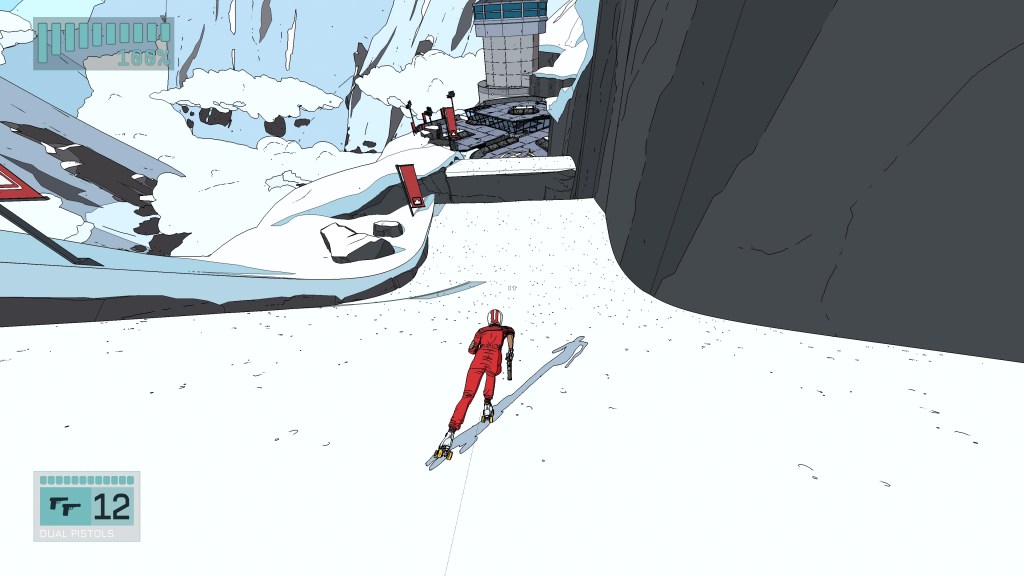
Kara Hassan. Match Victory. Those words, spoken in the subdued, semi-militaristic tone of a woman employed by tyrannical corporations who supply a neutered public with deadly live entertainment (à la Running Man), have been stuck in my head for days. They’re announced at the end of every arena in Rollerdrome, a game developed by Roll7 that blends the tricks of Tony Hawk with arcade style combo kills. I never got into skating games before, and I never knew why . . . until now. They didn’t have guns! Dual pistols, to be exact. As well as a shotgun, railgun and grenade launcher. Other than that, our protagonist, Kara Hassan, is geared up with a helmet, a red jumpsuit and a pair of vintage roller skates as she makes her debut in Rollerdrome, a sport sponsored by the dominate Matterhorn corporation where each contestant must kill an arena full of grounded enemies wielding spiked baseball bats, sniper rifles, riot shields, rocket launchers and plasma cannons. Oh yeah, there’s also flame-spewing, mine-deploying mechs to make things interesting once Kara Hassan has climbed the ranks. The aesthetic is 80’s dystopia. The music is groovy synthwave from Electric Dragon that kicks in as soon as you ramp into each arena (my favorite track is “New Action Army”) and the incentive is to become champion.
Before playing the game, I figured the tricks would get old quick. Sure, I can do a flashy heel grab for hollow points but why would I continue to do so if that’s not even the purpose of the game? To answer my own question, Rollerdrome ties its catalog of cool tricks directly to the gameplay by stocking you full of valuable ammunition each time you perform one. This is brilliant. You’ll begin by doing tricks out of necessity (since ammo burns up quick) but will eventually become so immersed in the rhythm of this unique gem that you’ll be pulling off the 360-pretzel backflip into a toe grind while at full capacity in all your weapons, just because that’s what Kara would do. She’s a crowd pleaser, damn it!
Enemy spawns are consistent, so replaying arenas for the highest score becomes incredibly addictive as you both plan your attacks and inevitably improvise. Depending on enemy placement and your own ability to navigate the obstacles presented, you’ll have to decide which targets to prioritize for the best shot at the S-rank, achievable only with an uninterrupted combo including collecting all five bonus tokens that can keep your combos alive in a pinch. On top of this, there are various challenges tied to each arena. Completing a certain number of them is required to progress to Rollerdrome’s quarter and semi-finals; the rest are optional. Many of the mandatory challenges are quite basic, like dodging a certain enemy’s attack multiple times or nailing a totally rad mid-air murder. Others will ask you to pull off a specific trick while grabbing a specific bonus token that’s particularly awkward to obtain. Challenge progress is immediately saved, so you don’t have to complete them all at once.
Because the cinematic buildup works so well, you’ll want to shoot from rookie to pro in the blink of an eye, pulling off ludicrous maneuvers one after the other, but that takes time. Once I finished the first few areas and was introduced to tougher enemies filling more complex stages, I found my momentum hindered as I became overwhelmed with constant projectiles and radial attacks. I almost blamed something other than myself for not being able to maintain an unbroken combo, but the game does everything it can to push you forward, so it’s just a matter of learning how to keep your streak alive. If you miss a half-pipe on your way down, Kara doesn’t fall to the ground and get reset, she rolls through the bad landing and keeps on . . . uh . . . rolling (no pun intended, I swear). If you’re spinning out of control and accidentally land backwards, Kara will reorient herself with a swift 180-degree turn so that you don’t have to execute a clumsy U-turn on your own. A bullet-time mechanic, here called reflex time, slows everything down whenever you aim your weapon, allowing you to briefly survey your surroundings, though you can also fire from the hip. If you enter reflex time after a perfect dodge-roll, get ready to take advantage of the extra damage provided by an enhanced form of slo-mo. It’s fun to pop in and out of reflex as you cruise around the rim of a bowl, lighting up a Warhead with the dual pistols, entering a grind for more ammo, perfect dodging a sniper bullet and then re-entering reflex to obliterate a Grunt with the shotgun.
Overall, I can’t think of any worthwhile complaints about what turned out to be one of the most replayable experiences I’ve ever had. Rollerdrome is one of those short and sweet games that I’ll be revisiting indefinitely. You never know when it’s time to lace up some skates and undermine the overbearing authority of Matterhorn.
- Sifu
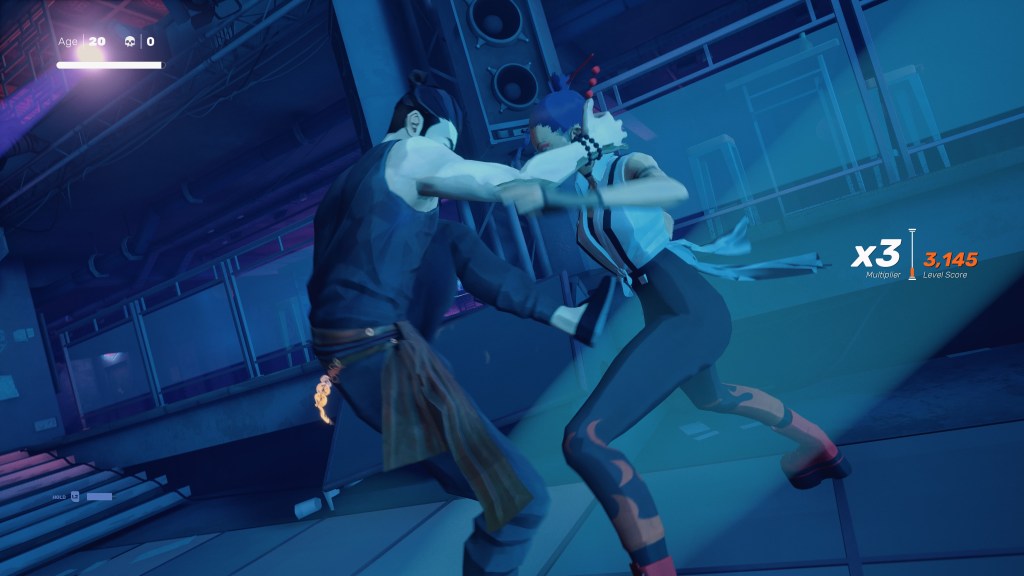
After every session of Sifu, I find myself punching, kicking and chopping the air as I make my way to the refrigerator for a snack. Sloclap has created a game full of such exciting martial arts showdowns that you’ll regret not dedicating your life to the dojo. You take control of a martial arts mentor’s son who, as a child, witnessed the murder of his father at the hands of five former pupils. Years later, the 20-year-old nameless protagonist is prepared to begin a methodical revenge tour, plotting his plans and progress on a bulletin board like an obsessed detective.
While I was somewhat skeptical of Sifu before jumping in, due entirely to my personal pickiness when it comes to the roguelike genre, the story and gameplay tie together in a way that prevents repeat playthroughs of each stage from ever feeling like a drag. The aging mechanic, a fun twist that adds years onto the protagonist’s life each time they die and resurrect (thanks to a convenient magical pendant), visually reflects how skilled you’ve become at the game while also providing the plot with alternate timelines. Did it cost this grieving son ten years of his life to quench the thirst for vengeance? Fifteen? Twenty-five? Forty? You’ll struggle at first, so the sad tale of an elderly man falling to the first killer on his list is highly likely. If you’ve reached the final stage with only a bit of beard stubble, it’s clear you’ve gotten the hang of things. The aging system also allows you to die several times in a row before being forced to replay a stage. While each death causes the counter to consecutively increase by larger intervals, thus potentially reaching the maximum age of 79 quite quickly, there’s still a lot of opportunity to learn enemy layouts and movesets before officially failing. I experienced many middle-aged moments when, given the way things were going and the guaranteed difficulty spike provided by (almost) every boss, I knew I wouldn’t make it out alive. However, I never restarted. I always wanted to at least get a good look at what was coming next, that way I could hope to absorb enough knowledge to give myself a shot at success on my next attempt, rather than going into a difficult room or boss fight totally blind and hopeless.
The combat of this game is fantastically frustrating. At first glance it’s a remix on the Arkham series’ approach to Batman’s fighting style, complete with last-second parries and ostentatious finishing moves activated by a simultaneous push of triangle and circle. Sifu roundhouse kicks things up a notch, providing a list of combos and special moves that detract players from mashing square. They’re easy to use and hard to master. Timing matters more than anything else during combat, so closely observing the behavior and proximity of the enemies surrounding you to deduce when and how to chain together specific attacks and evasive maneuvers is important in keeping momentum on your side. While the parry is effective when it comes to breaking an enemy’s structure and opening them up to a flurry of stabbing punches, no colorful visual cues assist the player with timing one correctly, which keeps things grounded but also more demanding. The window feels very small and attacks are often delivered at an unpredictable tempo, so the parry ended up becoming a technique that I put on the backburner until I was able to make consistently accurate reads. Meanwhile, I preferred to use the dodge, which is one of the most unique elements of the game. When holding block, the player can flick the right analog stick in any direction to narrowly avoid taking damage. To make things easier on myself, I thought it would be a good idea to only dodge in one direction for the duration of the game. When I used this strategy, the dodge didn’t feel responsive enough. Once I settled on flicking the stick in a different direction each time a fist came soaring toward my face, the delay I’d been experiencing disappeared and I was able to appreciate the seamless nature of Sifu’s animations. Speaking of which, the sleek and varied knockout flourishes will continue to get you fired up each time an enemy’s structure is broken, indicating that they’re ready for bedtime. Just like glory kills in Doom, the player can enjoy a brief display of brutality while quickly considering their next best move before the intense battle resumes. You can even unlock a passive ability which refills a portion of your health whenever a finisher is performed.
Sifu is at its best when you’re backhanding a thug, ducking a beer bottle, scooping a baseball bat into the air with your foot and smashing it over someone’s head, chucking the broken handle at another guy closing in, then kicking an ottoman at somebody else’s shins, causing them to topple to the floor where you can finally follow-up with a ground-pound series of punches. Eventually, more spongey and aggressive enemies will be introduced that put your rhythm at risk and potentially slow things down to a crawl, mainly due to just how resistant they are to attacks and also how long their own combo-strings last. While the game obviously wants to continue challenging players, I can’t help but sigh when I see one or two of these late-game enemy types get thrown into the mix, even after becoming extremely comfortable with the combat system. They’re a hassle to deal with. Faceoffs with bosses also force the player to take things slow while they analyze the tougher and more durable threat before them, but since these are one-on-one situations, I see boss fights as a deliberate and welcome change of pace. I like the tense back and forth exchanges between the protagonist and his greatest rivals, all culminating in surprisingly violent executions that are left in part to the imagination as they’re cut short by a black screen.
Sifu is one of the better roguelikes I’ve played. Becoming a martial arts master was a difficult but rewarding journey that felt unique in its tweaks to the roguelike tenets and layered combat. The game’s cinematic flair also kept me immersed in its tale of revenge. Moments like the hallway fight from the very first level are awesome instances of the camera angle adding a lot of personality to the game. I think there needed to be more of this, since Sifu is clearly so inspired by classic martial arts films that it basically is one. In some of the arena challenges things get more experimental, like when a camera follows the player up the stairwell of an apartment building, which, aside from a few pillars getting in the way, is also so engaging that it should’ve earned a spot in the story mode. Still, it seems Sloclap is aware of the dynamic potential of their game’s presentation and simply didn’t want to confuse players by continuously changing camera angles like classic Resident Evil, which is understandable. All things considered, Sifu is a roguelike I’m sure to return to as I age into an old and gray gamer.
- Onimusha: Warlords
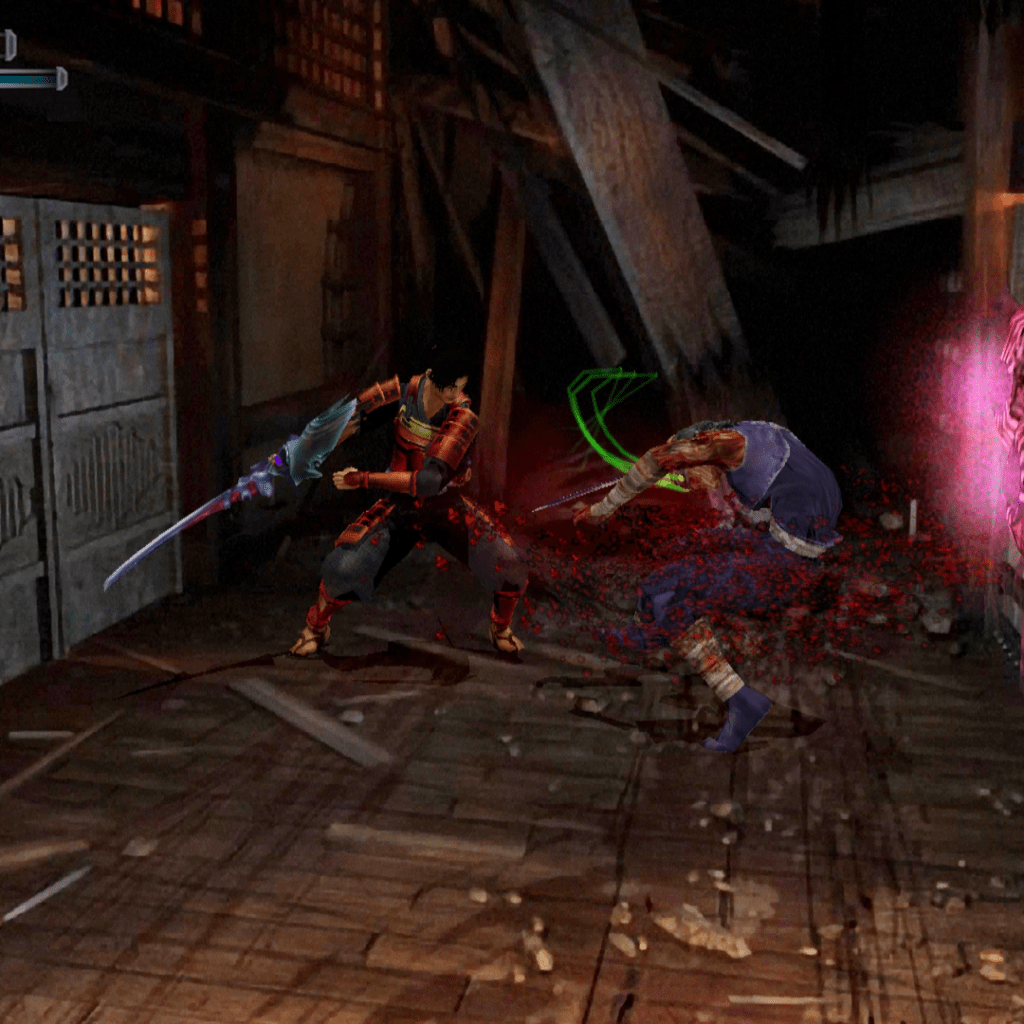
Onimusha: Warlord’s 2001 release coincided with the long-running success of Resident Evil, meaning Capcom couldn’t resist injecting their demon-slaying samurai game with some of the same survival horror elements that had been working so well for them, even if the subject matter wasn’t as much of a match. As a huge fan of Resident Evil and someone who completely missed the Onimusha memo, I decided to download the remastered version of the first game from the PlayStation Store at a discount price. It’s only been a couple of years since I completed another Resident Evil-inspired title from 2001 that was too difficult for me to comprehend as a kid. Unfortunately, Devil May Cry left me less than engaged with its combination of clunky melee combat and confusingly alternating camera angles. A visually curated melee-based game wasn’t an automatically failing formula, as proven by the impressive Devil May Cry 3 and the rest of that series from then on, but the gameplay of the first installment just doesn’t hold up the way I hoped it would. Even so, I was curious to learn how I’d perceive Onimusha: Warlords. Was this another game caught between cloning Resident Evil and doing its own thing, only to become an untuned steppingstone for later entries to improve upon? With an open mind, I entered the sort-of-but-not-really survival horror.
Onimusha: Warlords takes place in the turbulent Sengoku period of Japan, reimagined by Capcom to include the invasion of demonic forces. The story features historical characters like Nobunaga Oda and Toyotomi Hideyoshi, names I shamelessly recognized from Nioh and its sequel instead of a textbook. Players take control of Samanosuke, a samurai summoned by his cousin, Princess Yuki, to the Inabayama Castle where strange deaths and disappearances are reducing the resident population. Almost as soon as Samanosuke arrives, it’s revealed that a race of demons called Genma are behind the siege. One particularly large and derisive Genma defeats Samanosuke shortly after he is reunited with his cousin, leading to Yuki’s kidnapping and the interference of the Oni, a race of ogres whose opposition to the Genma influences their decision to assist Samanosuke in his rescue mission. When he rouses from his stupor, the Oni endow Samanosuke with a magical gauntlet that allows the samurai to effectively wield elemental weaponry and absorb demonic souls. The plot is entertaining enough, with hammy performances from several Genma voice actors offsetting Samanosuke’s wooden personality and making sure that the whole affair isn’t taken too seriously.
Like Resident Evil, Onimusha: Warlords has a contained setting. You’ll be mostly exploring one central environment full of fixed camera angles where backtracking is often required, searching for keys, crest pieces and yes, even green herbs. Several paths are repeatedly blocked off until further notice, but there are far less puzzles and vague item application requirements in Onimusha: Warlords than Resident Evil, resulting in more action than head-scratchin’. Plenty of doors are sealed by blue, red and green crystals, representing lightning, fire and wind, respectively. To progress, the player must upgrade Samanosuke’s gauntlet appropriately. For example, if a door is locked by two blue crystals, then the corresponding lightning aspect on Samanosuke’s gauntlet needs to be raised to level two. The only way to upgrade the gauntlet is by slaying demons and absorbing their souls. This straightforward system, paired with respawning enemies, ensures that combat remains center stage throughout the game.
Onimusha: Warlords doesn’t get too big for its boots when it comes to clashing swords. It feels as if the designers were a little more cautious than they were in Devil May Cry, where directional combos could get jumbled up amid ever-changing perspectives and enemy swarms. Onimusha: Warlords includes basic attacks performed by tapping square and special moves triggered by triangle, which temporarily take control away from the player while Samanosuke hacks at a Genma. More skill is involved to block at the last possible moment and activate Issen, a counter-technique which also sends Samanosuke into a self-aware state of delivering a crucial blow on his own. When enemies disintegrate and their souls materialize in mid-air, you’ll want to absorb them before they disappear forever. The standard red souls are valuable upgrade materials, while health and energy souls speak for themselves. The time it takes for Samanosuke to remain still and collect souls provides an extra layer to combat encounters that forces the player to properly gauge how long they’re able to stay defenseless for without getting hit. Tension rose whenever I was low on health and a cloud of blue energy souls loomed overhead, simultaneously threatening to cease existing at the expiration of a hidden timer and promising to provide me with another fire-infused sword-slam that could easily destroy the group of enemies giving me grief.
Throughout my quest against the Genma, I only encountered a few enemies that were irksome in design, like the flying, multiplying blobs that drain your souls until they get close enough to the ground for you to slice apart, or tentacle-flailing demons that send their appendages underground before they pop back up and wrap around Samanosuke’s ankle, securing him in place for a few seconds that begin to feel more like minutes if you get trapped several times in a row. However, using an auto-aiming bow will mitigate some of the time wasted while dancing in circles with the flying blobs, and it is possible to dodge the burrowed tentacles. Boss fights were basic hit and run affairs, especially since you can’t use the Issen against them, but I can’t say they were bad. Being forced to use my rifle for almost the entire duration of one fight against a giant mutant moth, running from corner to corner and relying on auto-aim, tricked me into thinking I was playing an unreleased Resident Evil game. Though the combat does become repetitive and occasionally tedious when you’re in need of extra souls for a mandatory gauntlet upgrade, the game itself won’t overstay its welcome. I finished in just over 7 hours and wasn’t disappointed or relieved when the story ended. On one hand, I could have continued playing a bit longer and on the other I was ready for things to wrap up.
If I had to describe Inabayama Castle in one word, it’d be cozy. That may seem like a strange adjective to accompany a ransacked dwelling full of demons running amok, but the modest size of many warmly colored rooms and hallways was conducive to my immersion and acclimation of the combat. I rarely felt that any space was unnecessarily or distractingly fractured (unlike in Devil May Cry, where I fought the camera just as much as those BS shadow panthers), making it an easy task to keep track of what was happening on and off-screen. The quiet comfort of Inabayama Castle was a big contributor to my enjoyment of the game. Witnessing the ways in which Onimusha: Warlords was able to adopt a restrictive style to etch out a fun, humble samurai adventure made me hope for some reality to the rumors of other Onimusha remasters, so I can see for myself if the potential of the first installment was given membranous wings or shot down by a matchlock.
- Titan Quest
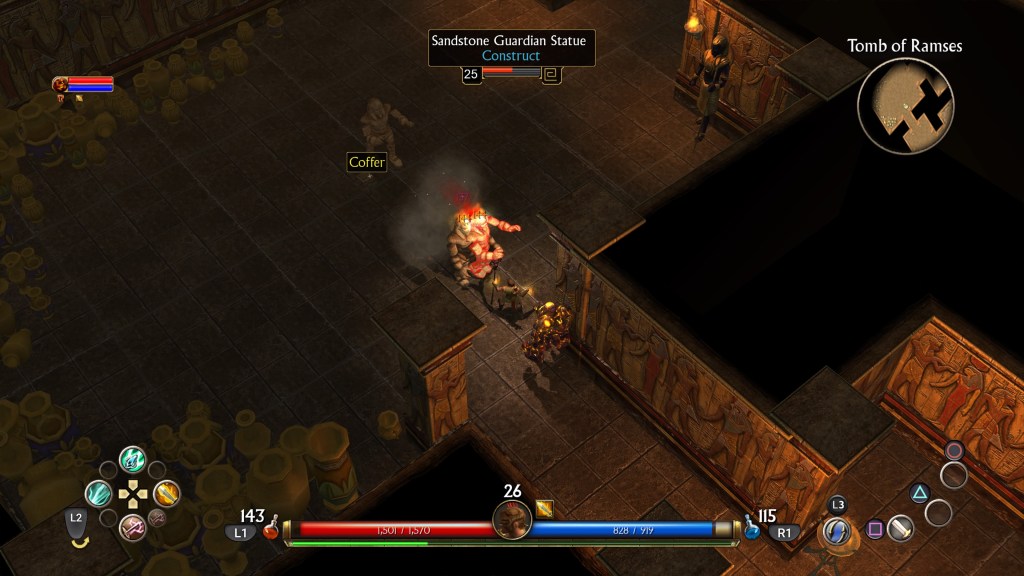
Zeus has spoken. His face appeared in a lightning-lashed cloud, eyes flashing with bolts of blue as the sky crackled and hissed. “IT IS TIME,” he bellowed, “TIME FOR JAYEMG TO EMBRACE ARPG’S!” How could I argue with he who wields the terrible thunderbolt? I nodded in compliance and then downloaded Titan Quest, a mythological adventure originally developed by Iron Lore Entertainment in 2006 and ported over to consoles in 2018.
My avoidance of arpg’s like Diablo has been due in large part to never owning a PC, the platform for which these games are truly made. Also, while I am more than willing to give any genre a chance, I do prefer consistent, skill-based gameplay to keep me engaged rather than a meandering experience driven mostly by the acquisition and compilation of so many numerical stats it’ll eventually make your head spin. I enjoy tracking character progression, provided that leveling is implemented alongside a satisfying gameplay loop easily appreciated on its own. In Dark Souls and Bloodborne, it’s just as important to strategically spend skill points and take advantage of enemy weaknesses as it is to get a firm grip on the high-stakes combat. Of course, FromSoftware leaves plenty of room for players to chase meta builds, resulting in the immediate decimation of most bosses, but deciding to attempt a blood level 4 run in Bloodborne (aka the exact opposite of a meta build) resulted in one of the most rewarding experiences I’ve had with a game, even if I am admittedly still stuck on Gherman (I promise I’ll beat him soon). I’ve never been the type to obsess over grinding and calculating, especially if the ultimate build is so particular that I’d never be able to decipher its equation without the help of a guide. Therefore, even though a decent amount of arpg’s have reached consoles, they still hadn’t reached me. Until now.
Well, kind of. The closest I’ve gotten to an isometric dungeon crawler packed with loot and hordes of enemies is when I got hooked on Marvel: Ultimate Alliance as a kid, ironically released the same year as Titan Quest. Taking control of not only one superstar like Spider-Man in his own game, but of almost every major Marvel character I cared to see was mind-blowing. Complete with a campy, chaotic story not dissimilar to something I’d come up with while playing with my action figures, a ton of unlockable costumes and even optional dialogue depending on which heroes you brought along to take on the next boss, all anchored by an addictive, button-mashing combat system bolstered by sets of unique and powerful skills for each character, the game took a Hulk-like hold of me (I realize Hulk wasn’t in the game, just accept the pun). However, maybe because the Marvel brand was such a big contributor of the game’s draw, or because the beat ‘em up style of the game stood out from the titles that inspired it so much that I didn’t register the inspiration, I never tested the waters when it came to other arpg’s. Until now. Okay. . . I think that transition will work this time.
My first one to two hours with Titan Quest were rough. The console port comes with a noticeable dose of jank, which is a shame considering how long it’s been since the initial release. The screen periodically stuttered as I traipsed along beautiful Grecian landscapes, the auto-targeting screwed me over and my character was seemingly averse to cutting angles, content to instead move like a tiny tank. Tempted to write the game off as a botched port upon my first impression, I attempted to salvage what I could. After a 31-hour playthrough, I’m happy to have pushed past my dilemma, yet not all is forgiven.
Prepared to smash some skulls in Sparta and Athens, I named my character Kratos and began snooping around for something that resembled the Chaos Blades right out of the gate. However, when I realized how touchy the targeting was, I concluded that a melee focus was not the way to go, unless I wanted to be frustratingly backstabbed or bombarded at range the entire time. See, as you walk around encountering enemies, those closest to you will be highlighted. To attack them, hold square. Simple, right? Well, if you hold square and tilt the left analog stick in any direction, then a cone of vision will appear, compelling your character to charge ahead at the nearest enemy within that cone. There is a clear delay, so expect your character to take a few steps in the direction of the enemy automatically highlighted (possibly aggroing them) before obeying the cone. You don’t have to use the cone, as you can swap between targets with R2, but there is somehow no way to smoothly scroll between the enemies in a way that feels natural. Without the cone, you’ll be frantically tapping R2 to cycle between a crowd of attackers that could kill you before you ever land on the target you’re trying to prioritize, especially if when you do finally succeed, you accidentally hit R2 again in the heat of the moment and are forced to restart the entire process. Later, it becomes borderline impossible to cherry-pick and eliminate the most dangerous enemies given how quickly they can dispatch a bullheaded fighter. There’s got to be a better way.
Unfortunately, because the port drops the ball on such a basic, core component of the game itself, I knew that for the sake of my own patience, I had to give up on my dreams of reviving the brutal, blood-soaked Kratos that Santa Monica Studios officially retired with God of War: Ragnarök in favor of becoming a cowardly conjurer. Betrayal of my avatar’s namesake aside, focusing on magic did the trick. I found it much easier to use both the cone and R2 cycling system when engaged in ranged combat rather than melee. From a distance, I was allotted a bit more time to wrangle with the touchy controls and choose between enemies in a somewhat strategic manner, even if many fights did devolve into blindly shooting fireballs at whoever the game decided I was looking at. Surprisingly, it turned out that travelling through ancient Greece, Egypt and Asia, looking everywhere for loot and mini-bosses (or as I like to call them, XP balloons), driven by lowkey combat that I thought would instantly bore me, was quite captivating in a relaxing way. It helped that masteries were introduced, which function as skill trees. There are eleven masteries to choose from, and each character can learn a total of two. It was a bummer to learn that these masteries are not interchangeable after initially selecting them, an absence I could understand in 2006 a lot better than in 2018. As a result, I was stuck with an Earth and Spirit build, turning Kratos into a life-leeching pyromancer. I made it work, but I wanted to replace Spirit with Storm shortly after choosing the former and was let down when I learned that I’d have to create a brand-new character for the opportunity to experiment. My favorite skills to use were a tri-shot projectile attack that burned up numerous enemies at once, as well as a wispy HP-stealer that increased my glass cannon’s survivability. I often waited for a big group of enemies to surround me before activating the tri-shot. From such close range, each ball of flame was guaranteed to hit its mark, and it was a blast to watch multiple gorgons flail in defeat as I punished them for invading my personal bubble.
Gorgons, yetis, cyclopes, arachnoids, tiger men (wait, what?) and a whole lot more mythological creatures will appear across the wide range of environments within the game. As somebody who geeks out over Greek mythology, I really enjoyed seeing which strange beasts would be suddenly introduced. Though there isn’t too much to discuss when it comes to the variety of enemy behavior, discovering and destroying so many different kinds went a long way in freshening things up, as some of the wide plains you’re tasked with traversing can be a bore (Egypt, I’m looking at you). The bosses are fine, for the most part, though my favorite boss encounter, the Gorgon Queens, came early in the game. Evading Medusa’s petrification attempts and divvying up the damage I was dealing became a fun game of cat and mouse.
Again, combat isn’t the selling point (at least not for the port). It’s more about creating a synergistic character with high-level gear, even if finding that gear involves wading through endless piles of junk, like when I found armor with a 9% chance of blocking 52 damage after just getting hit for 260 damage . . . thanks, Zeus. While a slow-paced grind could be dealbreaker for someone like me, Titan Quest’s mellow, aesthetically pleasing romp through ancient areas rife with wild monsters and demons did enough to earn my time. Though the game is intended for repeat playthroughs, as evidenced by unlockable difficulties and of course the myriad mastery combinations available to new characters, I consider Titan Quest an introduction of sorts to more arpg’s of the same style, but with potentially better controls and smoother gameplay. I’ll hold off on jumping into the epic difficulty while I explore other titles. Also, Titan Quest 2 has recently been announced, and no, I didn’t purposely seek out the first game as a result. It’s a happy coincidence that’s got me excited to check out the sequel when it releases.
Now, if I had to arbitrarily list the order of just how pleasant these surprises were from most pleasant to least, it’d look like this:
- Rollerdrome
- Sifu
- Quake 2
- Onimusha: Warlords
- Titan Quest
 GotMeThinkingGames
Leave a comment