Old school survival horror. The kind of games that make you wonder where the hell you are, why one little key takes up an entire block of precious inventory and whether you should donate bullets toward the destruction of monster brains or clumsily slip past the abominations clogging up the narrow halls. Do they still make those? Well, major studios like Capcom, who basically spawned survival horror itself with one of the longest running and consistently high-quality zombie-splatting franchises ever, kind of do. A slew of Resident Evil remakes has shown us that Capcom’s hearts are in the right places when delivering reimagined renditions of beloved games, but their corporate-trained minds will not allow them to take a financial risk in recreating the archaic style of their past portfolio. I can’t say I blame them. A company with that kind of status is under pressure to keep up with current expectations while still pleasing loyal fans. The remake of Resident Evil 2 painstakingly rebuilt the Raccoon City police station from the ground up, but changed the way we interact with it. Standard third-person movement and over-the-shoulder action results in extra gunfire and less disorientation (for better or worse), while detailed alternative scenarios are shaved down in a way that proves Capcom’s priorities are probably more influenced by attention from a general audience than honoring the classic titles to the absolute best of their ability. Still, is it too much to ask for at least a re-release of the original three games in one package? But I digress. We’re not talking about halfway survival horror today. We’re talking about the real thing, because it just so happens that there are smaller studios keeping the claustrophobic, puzzle-heavy horror genre alive and well. Dual Effect / Abstract Digital Works, the co-developers behind 2021’s Tormented Souls and rose-engine, developer of 2022’s Signalis, each demonstrate an impressively delicate balance of inspiration and original creativity in their games. Since I beat them back-to-back, I thought it’d be fun to discuss the differences and similarities of each nostalgic title before choosing a favorite, though I’ll tell you right now that no matter the result, they’re both undoubtedly worth playing.
Let’s start with Tormented Souls. You take control of Caroline Walker, a young woman who receives a photo of twin sisters at the beginning of the game. There’s a cryptically accusatory note written on the back of it that summons Caroline to Wildberger Hospital, an abandoned mansion of former grandeur converted long ago into a makeshift medical facility, which instantly evokes the ominous Spencer residence (of evil). While roaming the halls (during a cutscene), Caroline is knocked unconscious. She awakens within a bathtub, nude, a tube shoved down her throat that she must yank out herself. Oh, and she only has one eyeball. The other was removed during a surely unsanitary procedure while Caroline was taking an administered nap. This scene serves as an effective tone-setter for the rest of the game that didn’t need to be set up. The short introductory segment explaining Caroline’s compulsive curiosity regarding the photograph slightly reduces the shock of the bathtub reveal by already diluting the mystery of it. If the reasons why Caroline wakes up to a nightmare were laid out later, as she foggily recollects herself, then Dual Effect / Abstract Digital Works’ initial bold stroke of eyebrow-raising horror would have had more time to simmer. Nevertheless, the dank, dark interior of Wildberger Hospital does enough to elicit morbid inquisitiveness on its own.
The graphical presentation of Tormented Souls is very reminiscent of Resident Evil’s 2002 GameCube remake and Resident Evil 0. The familiar idea of exquisite architectural craftsmanship tainted by grime and neglect is on display, though when it comes to the artistic design, Tormented Souls stands on its own. There is an aura of dinginess exuding from the old hospital paraphernalia crammed into many of the mansion’s rooms. Enemies are not traditional zombies, but rather radiation-afflicted patients of the past, attached to various medical apparatuses and seemingly merged with the rusted metals stretching out of their skin. The first you’ll encounter is a wheelchair-bound, blade-handed creature that hauntingly scrapes the floor as it approaches. To kill them, you’ll equip a pneumatic nail gun, a shotgun made from thin steel pipes and “modified items” or an electric prod. This homemade arsenal looks dangerous to use and far less effective than the kind of weaponry available to S.T.A.R.S members. Caroline is cobbling together whatever she can to make her way through the dirty and dismal Wildberger Hospital, even if it means accidentally blasting her own fingers off in the process or taking a stray nail to her remaining eye. Such tight thematic cohesion is what boosts Tormented Souls from coming across as a bland rip-off to a new and intriguing survival horror experience.
While there are plenty of monsters that need flatlining, combat takes a backseat to exploration and puzzle solving. Most of my time was spent contemplating the solution to another conundrum only to become hopelessly confused, waste another fifteen minutes searching for that one enlightening item or file that sadly doesn’t exist and finally returning to the same problem, none the wiser, that I’d solve through sheer willpower, a sudden revelation, a lucky discovery or all three. Interactivity with the environment and items in your inventory is a much more common requirement than it ever was in Resident Evil. A scrolling magnifying glass will appear whenever Caroline is examining a locked door, a terminal, a key, etc. It’s easy to underestimate just how thoroughly you should be poring over whatever you can. Sometimes, the answer seems so clear that you’ll wonder why you’re still stuck, until you realize you can indeed interact with that tiny feature on the bottom of the floppy disc, making you feel insanely smart and stupid at the exact same time. Also, some solutions depend on common knowledge as opposed to in-game hints, or are at least more easily deduced using common knowledge, like when an enigmatic textual anecdote was meant to aid me in properly lining up images that incorporated covering the eyes, the ears and the mouth. After reading the story over and over, I finally decided to base my guess on the appropriate proverb, “see no evil, hear no evil, speak no evil” and was relieved when it worked. Looking up the meaning of the text afterwards caused me to kick myself a little, but there was a disconnect between the visuals and descriptions that I couldn’t pin down.
Other roadblocks were overly complicated and unable to convince me of their logic even after I learned the intended method of circumventing them. There is a key introduced a couple of hours into the game with three rotating dials on it. Carved into each dial are the same six shapes. To gain access to four important rooms, all three dials must be set to the shape that corresponds with the hints plastered on the door. The simplest instance of figuring out this process was when the equation “|= 1” was written on the reference note, urging me to count the sides of each shape and apply it to the solution. Easy. However, I ran into an awkward dilemma when I was tasked with finding the connection between the provided shapes and images of a pharaoh, an alien and a bee. The fact that humans come from earth was the only advice the game offered, which is strange because the earth is so broad that it also applies to pharaohs and bees. After deciding that the provided example couldn’t also be used as an answer, I linked pharaohs with triangles (because pyramids are triangular) but had a lot of trouble with the alien and bee. Apparently, two of the other shapes are also supposed to resemble respective habitations, but it’s a bit of a stretch. I’m only human (from earth), so yes, I did eventually cave and Google the explanation, but once I understood the loose rules of the puzzle itself, I didn’t feel too guilty about it. Tormented Souls mostly constructs difficult yet fair brain teasers that are fun to ponder, despite a few that fall flat in the gratification department.
As you retread your steps through the ruined mansion looking for clues and rusted nails, chilling yet oddly comforting tracks by NyxTheShield and Begoña A. Carrasco set the malevolent mood from room to room. Strings and somber piano notes combine to create what almost sound like remixes of the best Resident Evil music. The pleasantly unsettling collection of ambient and memorably melodic themes fits like a jigsaw piece into the amber-lit desolation of Wildberger Hospital. “The Reception Hall” and the choral “Holy Sanctuary” are my favorites. My first impression of the reception hall itself, with its giant staircase, glossy floors and marble statues (all shown off as the standout track triggered in my headphones) was what solidified my excitement for continuing through the rest of the game. Unfortunately, the final act does suffer from replacing its dense and immersive setting with underground areas where all the stone floors and walls look the same, making it feel more tedious to navigate these dark areas than genuinely interesting and unnerving. The sense of slowly settling into an enigmatic house of horrors is replaced with an urgent need to escape as the story escalates. Also, the color-coded map that seems to mimic Resident Evil’s rule of red signifying discoverable items and green/blue representing empty rooms, is falsely advertised. The colors never seem to change, rendering the map a pointless tease rather than a tool used to tie up any loose ends that may be hindering progress. As a result, I mostly relied on my own sense of direction, no matter how many times it failed me.
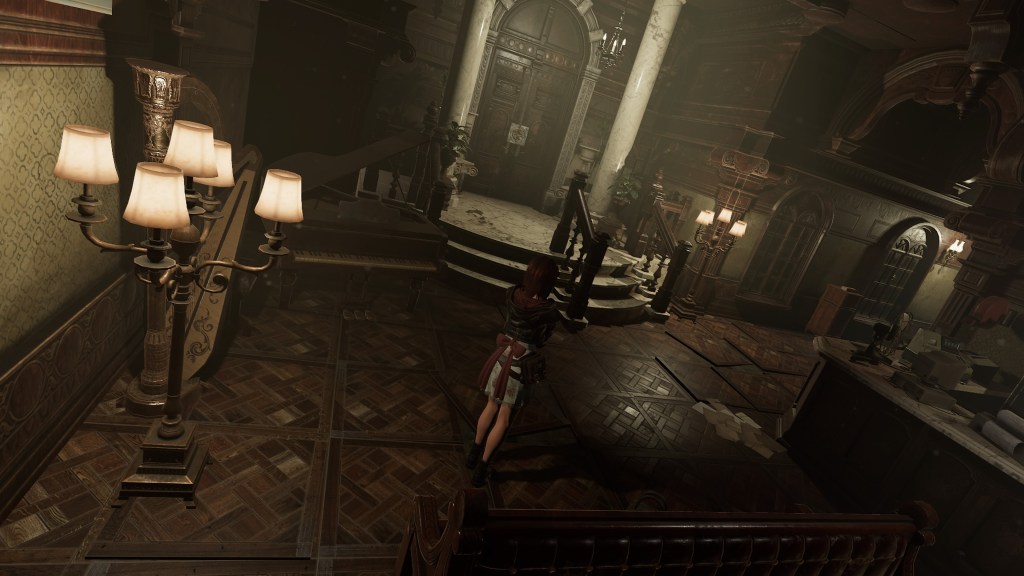
I got lost (literally and figuratively) in the Wildberger Hospital. Familiarizing myself with its layout, finding shortcuts, enjoying the simple combat that’s more about resource management than intense action, listening to spooky compositions and being treated to well-thought-out camera angles that capture the surrounding decay (like when the camera slowly spins as it follows Caroline down a particular hallway until she reaches a grisly crucified corpse at the end), felt like a classic horror experience that I haven’t been treated to in a very long time.
So, how does Signalis stack up?
Remember when almost every main menu in a Resident Evil game was one big, ugly eyeball staring back at you? Signalis spices this up by filling the screen with one big, android eyeball staring back at you, a red glimmer in its pupil. It slides from side to side as you scroll between the adjacent menu prompts, an animation I wasn’t anticipating. What I didn’t know then is that this sentient stare perfectly captures the entrancing inscrutability of the game to follow.
A cursor blinks a few times against a black screen before the words “wake up.” are written in white. A moment later our main character emerges from a pod, presumably aboard a spacecraft, and then it’s already up to the player to begin unraveling the obscure situation at hand. This quick and quiet introduction (including the menu) provided just enough intriguing detail to lure me in. I appreciated Signalis’ barebones, dialogue-free beginning rather than Tormented Souls’ hasty expository montage prior to the bathtub scene. In Signalis, you’ll learn a lot of relevant information right off the bat by reading files scattered around the small ship and paying attention to your surroundings. You’re controlling Elster, a female Replika unit named after her model number (LSTR-512), assigned to accompany a Gestalt pilot on the Penrose-512, an exploratory vessel used by the Eusan Navy “in the search for planets and moons fit for habitation or rich in natural resources to support the continuous growth of our great nation.” Traveling to the cockpit of the ship and looking through the windshield reveals you’ve crash-landed on an icy planet that may or may not contain life of its own. Once you make your way out of the ship via the airlock, the likeliness of native life increases as large, angled stones are seen poking out of the snow symmetrically, as if outlining a path. A path to what? A black door frame standing in the middle of the frozen wasteland. During one of few first-person segments of the game, you walk through the door frame to find a staircase curving down into a large well. At the bottom is a narrow tunnel. Naturally, you must climb through it. On the other end is a book and a radio. Pick up the book and the radio sputters. “Achtung. Achtung,” says a female voice over the crackle of static. The voice proceeds to unwaveringly announce a series of numbers without context. Chopin piano notes play beneath a series of spliced images depicting a strange island, an unknown woman and the deterioration of the skin on Elster’s face until there’s nothing left but a sick, skeletal smile. Finally, the title card appears and Elster awakens once again, this time in a new location with a mission to seek out the missing Penrose-512 Gestalt officer. The game has begun again.
The enigmatic conveyance of Signalis’ narrative doesn’t just work because it’s weird. It’s bolstered by a retro sci-fi setting where society is not unrecognizable due to its advancements. Bulky computer monitors and tangible keycards are still common as opposed to high-tech touchscreens and scanners. The repeated required use of a frequency radio suggests that there may be no cell phones or anything comparable. Presenting the future in this manner makes it seem as if civilization has not yet reached a new plane of perfection where everything is safe and sterile, running automatically on infallible motherboards, but is rather perpetually stuck in the imperfect past where disaster is still very possible. Whether I’m alone in that (admittedly far-reaching) sentiment or not, the 70’s/80’s idea of what the future will look like suits and enhances Signalis’ horror, especially since it’s all appropriately rendered in thematically matching pixel art. The mixture of muted world-building, visual riddles and inspired artistry is what propels Signalis’ narrative past Tormented Souls’ in terms of how captivating it can be. I didn’t spend much time discussing the latter’s plot because it never felt very intriguing. Most of Tormented Souls’ twists and turns were either predictable or underwhelming, and while an adequate backstory is delivered via diary entries scattered around Wildberger Hospital, dialogue exchanges between Caroline and a foggy-headed priest are amateurishly acted and blatantly written, undercutting the foreboding tone so expertly set by the game’s surroundings. In Signalis, dialogue is silently contained in textboxes, thus avoiding the risk of stunted voice acting detracting from the tension.
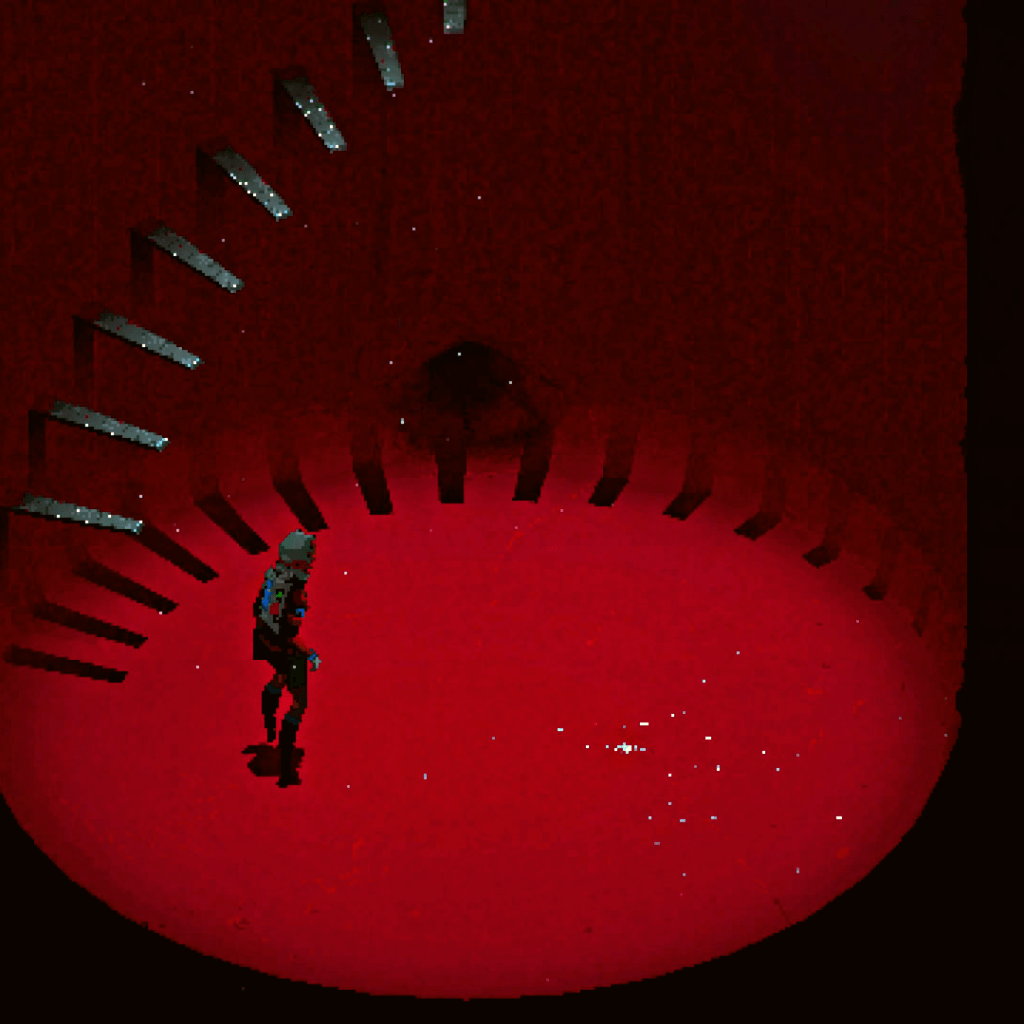
Signalis is a top-down experience where the same perspective is maintained throughout. Don’t expect any experimental camera angles or directorial tricks while playing. The navigation is straightforward thanks to a utilitarian map that’s extremely easy to access and follow. Tasked with jogging back and forth between various locked and blocked paths, avoiding or eliminating enemies and gathering health, ammunition and whatever key items are needed along the way, you’ll be regularly consulting your map to take note of any updates and quickly regain your bearings if need be. Points of interest are automatically marked, as well as the names of each room and if they contain an important interactable device. If you find a sealed safe inside of a room, then it’ll remain on your map while you wander in search of the code. You’ll be on your own when gathering supplies like repair patches/spray to replenish health, as the map doesn’t change colors based on whether you’ve found all the consumables in a certain room, but I never had much of an issue with overlooking items. Besides, when you approach something that can be investigated and possibly taken, it’ll become squarely outlined, further drawing your attention toward it while also implying the idea that Elster’s internal systems are registering relevant items for her as she moves along.
Another reason I felt things were moving more briskly in Signalis than in Tormented Souls (despite my playtime only being about an hour and a half longer in Tormented Souls) is the puzzle design. I was rarely ever stumped in Signalis. If I was, I could always see the light at the end of the tunnel. The solution must be right under my nose, I’d think to myself. Sure enough, I’d figure it out soon after. Signalis isn’t about enduring crimes against your cranium. It’s much more of an exploration/collection game that demands the player become acquainted with the layout of each area they’re introduced to while properly prioritizing where to go and when to go there if they want to stay stocked with as much health and ammo as possible. Most of the keys and puzzle items themselves have self-explanatory applications, like the butterfly key coinciding with the butterfly box. There is one puzzle involving the equal distribution of water within three different columns that I thought would be amount to a fun minigame of balancing volumes, until I found a paper on a nearby desk that literally provides the exact step-by-step solution. I couldn’t help but feel a bit cheated as I read the hand-holding instructions that were impossible to ignore. After all, why place an excerpt from a wiki-walkthrough directly beside one of your puzzles? I again felt disappointed by the lack of a challenge when I first laid eyes on survival horror’s most glorious weapon: the shotgun. I entered an undiscovered lobby and there it was, lying on a desk behind a sturdy pane of glass. I was convinced that I’d be forced to conquer some kind of trial to get my hands on the power of pump-action, but all I had to do was walk into the next room and pick it up. I found it odd that the shotgun was cleverly teased only to become so readily available seconds later.
To make up for a lack of intellectual quandary, Signalis places extra emphasis on its enemy encounters. Corrupted Replika models curated for various roles in Eusan roam the halls and populate many of the rooms Elster explores. Basic knife-wielding enemies that can be outrun or even walked past undetected (yes, Signalis does incorporate a dash of stealth) are introduced first. As Elster gets closer to the answers she seeks, myriad enemies begin to appear in larger crowds and tighter places. There are shielded enemies that serve as protectors to bands of weaker Replikas, mutated brutes that stab at you with their grotesquely sharpened and elongated faces, gremlins that crawl out from under the floorboards to ambush you, and more. Once things heat up, you can expect to face off against several different kinds of enemies at once. Luckily, you’re given a varied arsenal that includes a revolver, flare gun, grenade launcher and an emergency stun baton. Combat is simple but not as point-and-click as in Tormented Souls. Given the speed and abundance of enemies, you’ll need to move around and strategically aim your shots. Pressing L2 will put Elster in a firing stance. Her guns are equipped with a laser sight that can be rotated using the right analog stick. When the laser contacts an enemy, a red box will appear around them, guaranteeing the impact of Elster’s bullets. This serves as a sort of bridge between auto and manual aiming which puts more responsibility in the player’s hands regarding the smart expenditure of ammunition, but the contemplations don’t end there. Dispatched rogue Replikas will resurrect randomly unless they are burned up with thermite or killed with the flare gun (kind of like Resident Evil’s Crimson Heads, but without an added burst of undead speed and damage). Of course, this means that thermite and flares are both very scarce, so you’ll have to choose wisely before igniting a corpse. In each area there are central avenues that end up serving as the most frequently trodden path between locations, but hoarding your gear until you realize which paths you’ll be primarily using to get from A to B and back to A is another risk worth evaluating. Given the simpler puzzle designed that’s supplemented by more enemy interactions, whether that means killing as many as you can or constantly fleeing, Signalis feels like a game tailored for speedrunning. While survival horror generally lends itself to faster repeat playthroughs, Signalis thrives when you’re coasting from room to room, barely escaping aggressive Replikas and taking advantage of merciful shortcuts. The final area, Rotfront, shows off the highest potential of rose-engine’s formula as you discover several alternate routes that become sealed with progression (forcing improvisation) as well as crowds of psycho androids that can either be escaped or warded off with the higher amount of heavy ammunition lying around, if you can find it. As opposed to Tormented Souls, Signalis saves the best for last.
The time has come for me to pick the winner of the recent survival horror resurgence! While I adored Wildberger Hospital for its tenebrous elegance that resembled my favorite Resident Evil game, as well as the intricate and inventive puzzles it housed, I was left dissatisfied with the ending segments of Tormented Souls and could never become fully invested in the tale it told. As the game went on, something seemed to be missing, and I’m not referring to the blob-like creature that gets introduced later and randomly spawns in different rooms, following Caroline like Nemesis or Mr. X if they were both easily stunned and not very persistent. In Signalis, I wasn’t quite as captivated by the retro sci-fi setting as I was by a creepy mansion (I have a soft spot for creepy mansions) but did experience plenty of surprise and wonder as a strange, nightmarish disaster unfolded before me. Also, I enjoyed repeatedly formulating new strategies to save my skin and a little time by keeping the map handy and adjusting to the conditions of my surroundings. Overall, I’d give the edge to Signalis, but don’t let that detract from the fact that both games are fantastic examples of how a mummified subgenre about surviving certain death can come back to life with the right amount of homage, artistry and bold creativity. With the announcement of Tormented Souls 2, I can only hope to see a Signalis sequel soon so I can gladly do this all over again.
 GotMeThinkingGames
Leave a comment