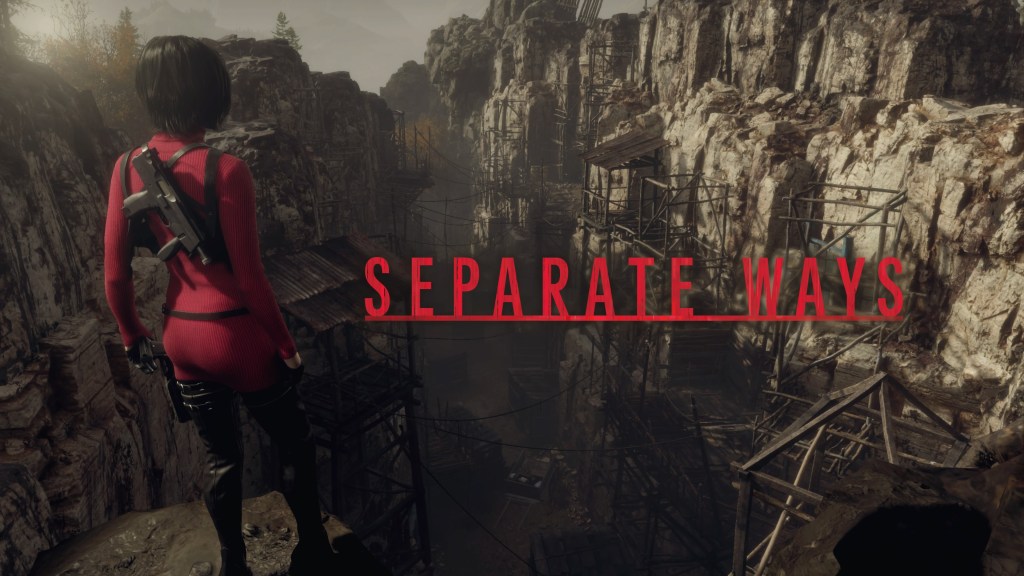
Well. . . if it isn’t the *redacted due to censoring demands* in the red dress. That’s right, Resident Evil 4’s “Separate Ways” campaign dropped today (or technically yesterday by the time I post this), and I just spent five straight hours playing through it! While it’s still as fresh as can be in my brain, let’s talk about why this iteration of Ada’s covert adventure is not only superior to the original, but also adds a considerable amount of value to Capcom’s latest remake.
In preparation for “Separate Ways,” I went back and played the 2005 version. It’s an addition I’ve never revisited on its own, because whenever I’m in the mood to kick some Ganados in the face, I choose to take control of Leon S. Kennedy and strap in for the entire story instead of a remixed, behind-the-scenes take on it. Therefore, I had only completed “Separate Ways” once. Returning to it for the sake of vitally important videogame research did scratch the itch I’ve been having to play Resident Evil 4 for my *number redacted due to misguided boasting* time since blogging about the remake and ultimately deciding that it didn’t quite dethrone the king. As a result, I appreciated following Albert Wesker’s orders more than I anticipated. The original “Separate Ways” is a condensed retelling of the main campaign from Ada’s perspective, answering questions I didn’t really have like, who rang that church bell? and offering a few unique twists and turns, including a brand-new boss fight against Lord Saddler. It’s kind of like an ode to the A and B scenarios of old. Plenty of recycled sections are tweaked to make them more action-packed, but the few stand-out moments come when Ada’s path deviates most from Leon’s, like during a segment spent running along battleships while dodging turret-fire and then blowing those turrets apart with your own. Otherwise, the best parts of “Separate Ways” are the little details it adds for the sake of continuity and plain fun. Ada refusing to take the shotgun in the village that was such a relief to see when playing as Leon is a nice touch. Also, after killing the Ganado who stole Leon’s jacket, examining the body will prompt Ada to wonder, why’s he wearing it? Uh, I don’t know, Ada, how about because it’s awesome?! I also liked how Ada gets abducted and awakens on a stone altar just in time to prevent her own sacrifice. It’s an example of connecting the dots that didn’t need to be connected but are fun to consider during the next playthrough as Leon.
So, does today’s “Separate Ways” also retread a lot of the same territory from the base game? Sure does. But do enough additions to the gameplay and story make it worthwhile? Absolutely. Instead of beginning in the village, we see Ada rescue Luis from a cell in the castle and are very quickly treated to a boss encounter with “The Black Robe.” It’s really U3, the scorpion-looking monstrosity that stalked Leon through a maze of shipping crates in the original game but was seemingly cut from the remake. However, he’s not yet transformed into an enormous beast, so this initial clash consists of The Black Robe whipping tentacles toward Ada from beneath a baggy cloak and then duplicating himself all over the room like Mergo from Bloodborne. I found it interesting that Ada is already equipped with the tools to help distinguish The Black Robe from his clones (a flash and hand grenade), showing how much more prepared she is for her mission than Leon while also throwing a little combat puzzle at the player. This introduction is great for the way it differentiates itself from 2005’s extra content and shuffles the expected order of locations.
It doesn’t take long at all for the new and improved grappling gun to get shown off. It’s the star of the show. Grapple prompts in close proximity will be automatically targeted, showing how far you are from being able to activate them. It’s incredibly responsive and fun to use. You’ll be swinging around and enjoying Ada’s smooth, Spider-Man-esque animations very often, setting her apart from the functionality of Ashley’s bodyguard. It’s not only required to traverse the environment and progress the story, but also to get a leg up on enemies during combat. What could have felt like a tedious copy-paste El Gigante fight ends up earning it’s place by allowing Ada to zip between several surrounding rooftops and shoot the ugly giant’s exposed parasite from above.
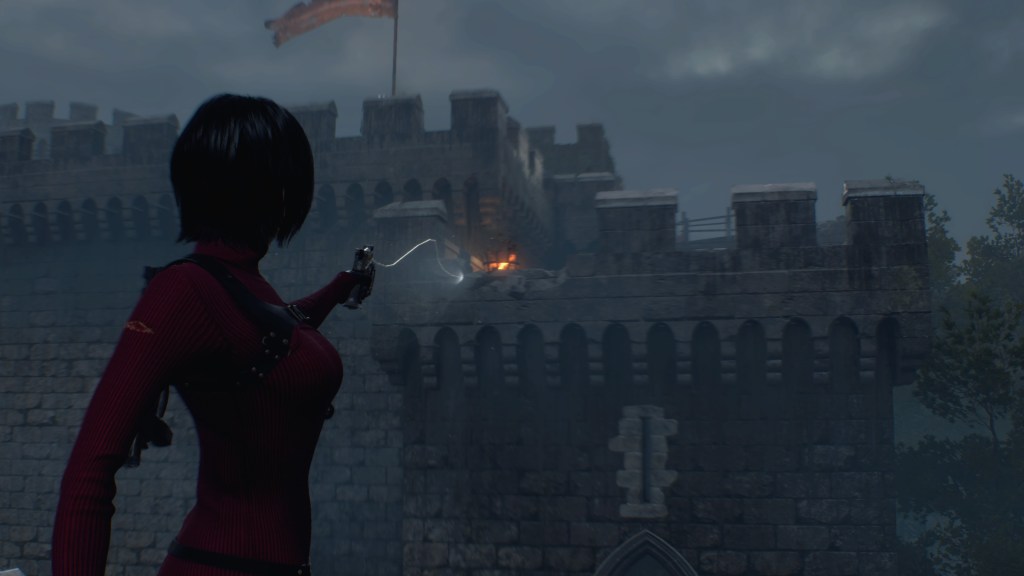
Ada is also far more dangerous at a distance for her ability to close the gap in a flash by, you guessed it, grappling onto stunned Ganados. If in range, Ada will launch forward (i-frames included) and execute a powerful kick on an whichever enemy is currently reeling from their gunshot wounds. After a couple of hours into my playthrough, the ever-cheery merchant started selling a charm for my attaché case that allowed me to also hook onto shields and yank them from the Ganados’ grubby little hands, exposing enemies that could have otherwise forced me to waste several shotgun shells on a wooden board. I’m glad I bought the charm when I did, as it gave Ada yet another exclusive skill to flaunt.
I knew it was coming, but the boss fight against an unleashed U3 was a gripping challenge that greatly increased the threat level of Salazar’s left-hand man. The tense, two-phase battle really gave me a run for my money, but a small part of me couldn’t help but miss the creatively tense shipping crate sequence from the original. Although it’s a bit gimmicky and loses luster on repeat playthroughs, a vast variety of unpredictable ideas is what makes Resident Evil 4 so brilliant. Still, I don’t have any real complaints about the remake’s take on U3 and I’m thrilled they didn’t give him the axe. The same goes for this edition of the climactic Saddler confrontation. It’s a harder, more intricate showdown that demands players make use of parrying, crouching, grappling and of course running around in a panic when your health is low. I wasn’t amazed, nor was I bored.
In between the enhanced and compelling gameplay, a few key cutscenes are repeated to seamlessly tie Ada and Leon’s missions together like in the original, as well as a lot more scenes that were created just for “Separate Ways.” Some feature impressive choreography that reminds us of how badass Ada really is, even (or especially) in heels. Others elaborate on the connection between Ada, Wesker and Luis. I enjoyed Ada’s snarky sense of humor and indifference to impending doom. She feels closer to the Ada I know and love than she did in the base game, where something felt off about the way her lines were performed or mixed. Wesker, on the other hand, is portrayed as a gruff bad guy without any truly memorable moments except for when he says, “complete local saturation,” which made me laugh out loud and remember how funny it was to watch him catch rockets in mid-air during the finale of Resident Evil 5. You know what’s missing? The nasally voice. Wesker needs to be nasally, and I don’t care how shallow of a critique that is! Luis gets plenty more screentime, but he’s still less suave and mysterious than he used to be, so I wasn’t too excited to see more of this do-gooder rendition. Overall, I appreciated the added effort to separate (no pun intended) Ada’s story from Leon’s, making this feel more like a standalone experience than a clingy afterthought, even if I still prefer the original game’s character writing.
After five hours looking for The Amber, I can confidently say that Ada Wong is a fantastic fit for Resident Evil 4 remake’s reworked gameplay, and I wish I could play as her through the base campaign. I can see myself returning to the easily digestible “Separate Ways” sooner than later, as it’s a great way to enjoy the technical improvements of the remake over the original without feeling like sacred ground is being somewhat unnecessarily retread.
 GotMeThinkingGames
Leave a comment