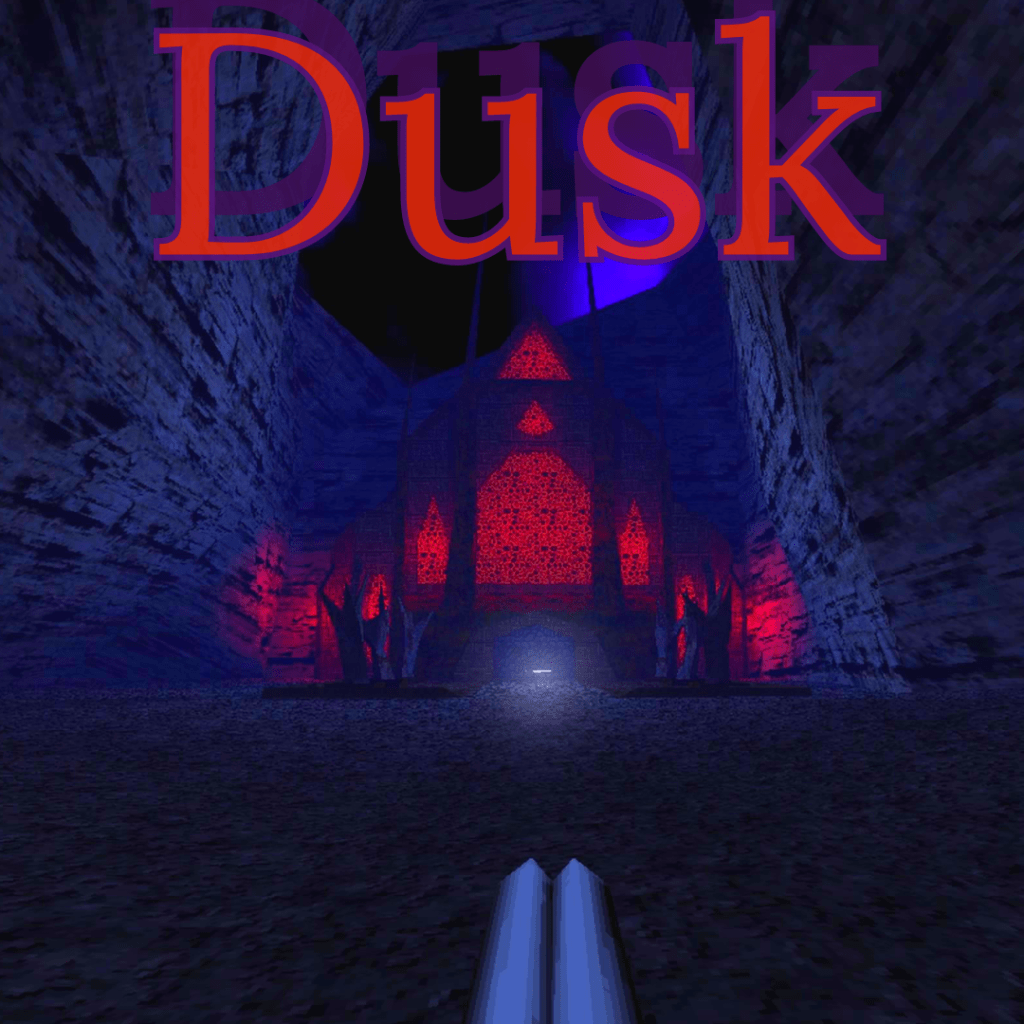
Last month, I found myself craving another boomer shooter/Doom clone/retro FPS, so I sat back in my creaky gaming chair and googled “Best throwback shooters on console,” expecting different results than the last time I had searched for the exact same information during a lack of fresh ports. If you think such a shallow and desperate technique of finding another game to play damages my reputation as a legitimate gaming critic, then I admittedly don’t have much to say in my own defense, because not always doing the legwork to gamble on hidden gems without any outside influence steering me in one direction or the other does make me feel a little guilty (also, my only credential is being some dude who really likes videogames, so you may be onto something). For whatever reason, I find poring over lists and waiting for a title I’ve never heard of to pop up and intrigue the hell out of me to be quite satisfying. The problem is, I usually have heard of and probably played the games on most lists I search for by the time I’ve read through one. Therefore, I’m often left in the same place I started once I’ve finished scrolling. But on one of the first days in November, I clicked on an article by Shane Schmid of thegamer.com that had been published on October 20th. It featured eight retro-FPS titles including Project Warlock, Ion Fury, Forgive Me Father and Warhammer 40,000: Boltgun, listed here in order from my favorite to least favorite, as I had already beaten each of them. The remaining titles (aka the ones I don’t have access to) were Ultrakill, Cultic, Hedon Bloodrite and Dusk. I quickly realized that this wasn’t a list tailored for console players. I had mistakenly clicked on an overview of boomer shooters for all platforms. Even so, I booted up the PlayStation app and took a couple of longshots. Maybe something had slipped through the cracks. Was it possible that either Ultrakill or Dusk, two games I’ve been badly wanting to get my hands on, had made their way to my console of choice? Ultrakill? “No results.” Dusk? “Dusk.” There it was. Not only a result but a very accurate result indeed. I thought it must’ve have been some sort of mistake, but when I saw that the release date was Halloween 2023, the perfect release date for a game featuring corn mazes and chainsaw-wielding enemies with red flannel shirts and sacks over their heads, I snapped out of my disbelief and made the purchase. I originally became hyped for Dusk when I watched the first installment of Civvie-11’s YouTube series called, “Beneath Dusk.” I refrained from watching subsequent episodes with the hopes of being able to someday experience David Szymanski’s solo project firsthand. Now that I’ve had that opportunity, I’m here to share how I think Dusk successfully separates itself from other 90’s revival shooters that, on the surface, attempt to accomplish the same goals. I’ll include comparisons with other similar titles I’ve played recently, including Warhammer 40,000: Boltgun (which I’ll call Boltgun from here on out) and Forgive Me Father.
Dusk commences in a claustrophobic chamber where three sack-head hillbillies immediately race toward the protagonist, chainsaws rumbling. It’s easy enough to hack them up with the dual-wielded sickles that are equipped by default. Once they’ve been disposed of, you’ll make your way through the dank, dark dungeon and eventually outside, getting a feel for the game’s controls and design tendencies along the way. There’s a handgun hidden in a small alcove in the cavern wall, prompting the player to crouch and retrieve it. If you crouch while moving, you’ll slide across the ground. A vent at the bottom edge of a stone wall can be shot open to crawl through the shaft and retrieve a diamond (collecting treasure contributes to Dusk Dude’s “morale,” which makes sense since he is a treasure hunter whose sole purpose for visiting the town of Dusk was to plunder its guarded riches. What doesn’t make logical sense is that morale functions as armor, suggesting that the happier Dusk Dude is at gaining wealth, the more fireballs he can take to the face. . . but whatever, I like it). There will be plenty of more breakable vents as the game progresses, in addition to switches that open doors, misaligned wall textures blocking secret rooms and cracks in the walls or floor that can be blown apart using environmental tools like gas cans. The opening of Dusk masterfully introduces the game’s fundamental features and rhythm. I knew from the very beginning that I would enjoy the rest of my time with this game; the type of first impression that’s hard to come by. After finishing Dusk, I reflected on why I would have been content to play well beyond its three available episodes. I determined that the atmosphere, player control and unique personality of the game were the three main contributors to my positive perception. These are such simple concepts that rely heavily on style and execution for a game to stand apart from the rest. Fortunately, Dusk has plenty of both.
Let’s discuss the atmosphere and level design, which align perfectly with the title of the game. The first episode includes plenty of tight interiors that are spaced out by expanses of brown, sodden ground beneath forebodingly grey and red skyboxes. Szymanski was able to do a lot with a little, as the graphics are polygonal without much room for very intricate detail. The composition of each level is what complements the barebones approach to these environments. Many of the levels’ borders are defined by rows of dead trees that can also be seen in the far, foggy distance. Large, dilapidated farmhouses and barns conceal evil enemies lying in wait. A corn maze splits the rain-soaked second level in half. It’s quick and easy to get through, yet additions like this go a long way in delivering an immersive first impression. As the levels progress, there are more and more memorable moments that build on Dusk’s feelings of isolation, horror and suspense.
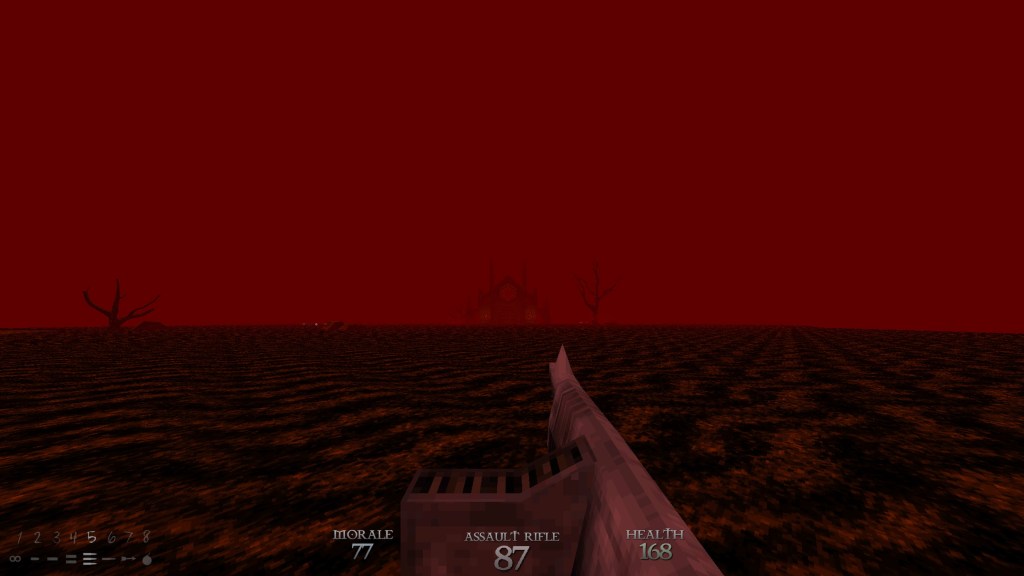
This isn’t an all-out gorefest like Boltgun, where hordes of enemies continually spawn only to be mowed down in speedy succession. Szymanski is not afraid to slow things down for the sake of slow-burning impact. When I was forced down into a cramped basement to retrieve a key, I knew something dangerous was awaiting me. I could never have guessed I’d be invisibly ambushed by humanoid Wendigos, creepy creatures who charge forth and only reveal themselves once they are shot. The following two thoughts came to mind during that sequence: 1) WTF?! And 2) That was awesome. In Boltgun, for a contrasting example, new enemies just kind of show up without any buildup or big reveals, which matches the fast pace of that game but doesn’t allow the player to be surprised or thrown off in a way that feels meticulously planned by the developer. I often smiled at unexpected events occurring around me in Dusk, like when I crash-landed into a cave to end one level and begin the next. THE FALL BROKE YOUR FLASHLIGHT popped up on the screen in red text when I tried pressing circle to light my way. I was at once drawn out of boomer shooter territory and into a survival horror game where I felt extremely vulnerable. The lack of predictability in Dusk makes it feel more special than a straightforward shooter.
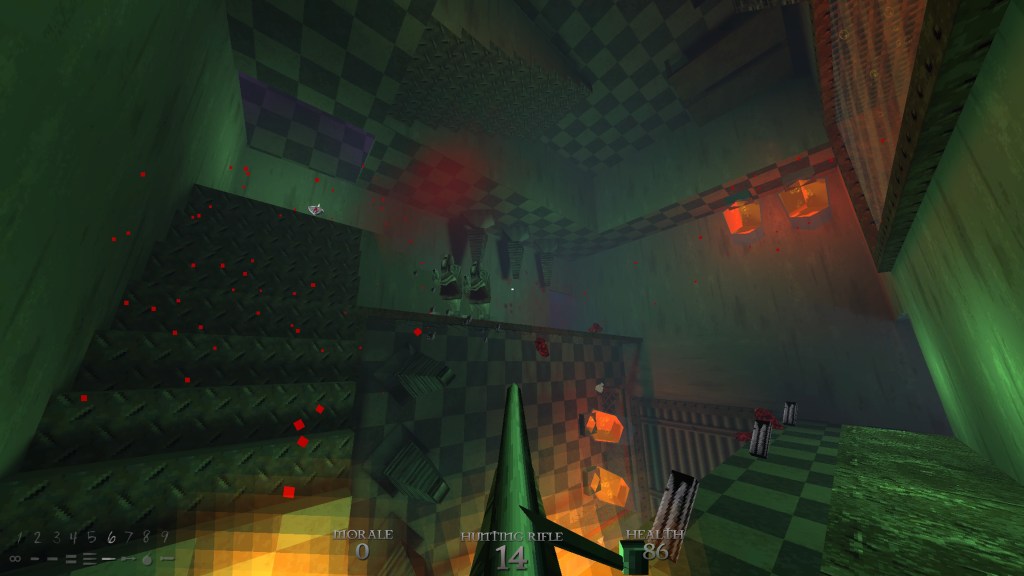
Heading into the Escher Labs in Episode Two feels familiar enough. Maniacal doctors roam around a hospital full of otherworldly experiments as you pass through rooms full of beakers and other scientific paraphernalia. However, the turning point of the level acts a literal turning point, since the whole lab suddenly folds in on itself and becomes a fragmented house of horrors with stairs on the ceiling. SOMETHING ISN’T RIGHT, according to the red text on the screen, to which you’ll respond, “No shit.” It’s another example of Dusk making a statement in its own language. The game feels like an amusement park instead of one wild ride. One moment you’re on a steep rollercoaster, blasting Mages to bits with the Super Shotgun, and the next you’re tiptoeing through a haunted house, still blasting Mages to bits with the Super Shotgun albeit more methodically.
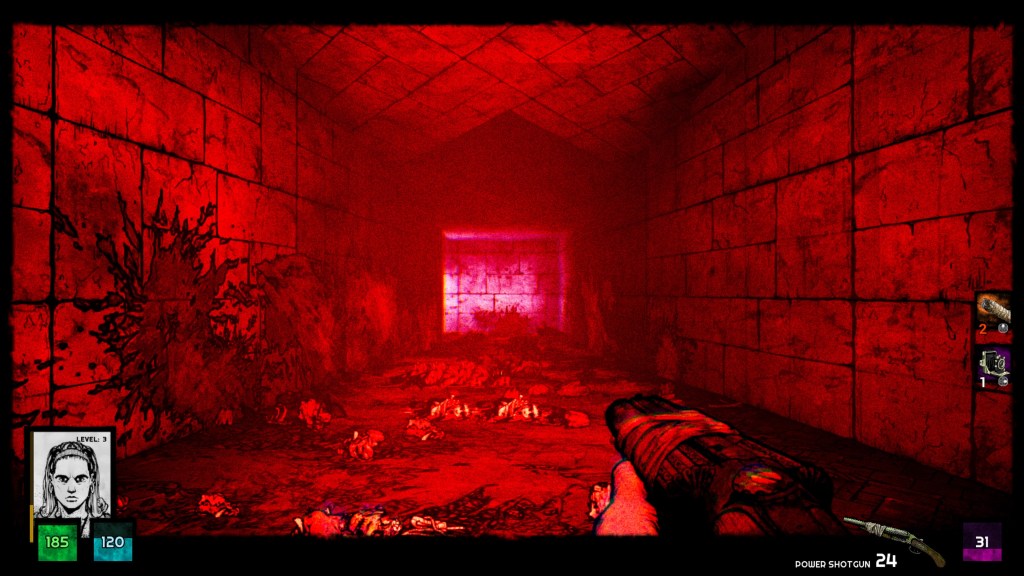
I was somewhat surprised at how absorbed I was in this somber world, given the blurry textures and blocky objects/character models. That’s not because I require high-fidelity graphics to be captivated by a game. I truly believe graphics are extremely overrated, but with so many retro-inspired titles coming out over the years (seeking to appeal to gamers who have gotten tired of fancy, cinematic showcases that show nothing but shiny skin and particle effects), it can be tempting to simply accept the aesthetic promise of a return to pure fun. Boltgun is one such retro-inspired title that prides itself on beautiful pixel art and nonstop battle. While I was initially excited about my first foray into the world of Warhammer 40,000, it eventually feels like something is missing, as each episode follows the exact same formula. The player is constantly thrust into a huge level with repeated assets and a misleading layout that’ll require lots of boring backtracking to nail down. When it does try something new, like including a portal puzzle, the game grinds to a halt, confusing the player with a cheap gimmick rather than enticing them with an enjoyable mechanic or intricate sequence. My time with Boltgun served to remind me that while a callback to the simpler days of gaming can be refreshing at first, there needs to be some kind of X factor involved that proves old gameplay blueprints and classic graphics can merge with new philosophies to create something that pleases fans of both retro and modern titles. Dusk accomplishes such a synthesis, showing how spicing up classic frameworks with anachronistic ideas ultimately enhances the boomer shooter genre.
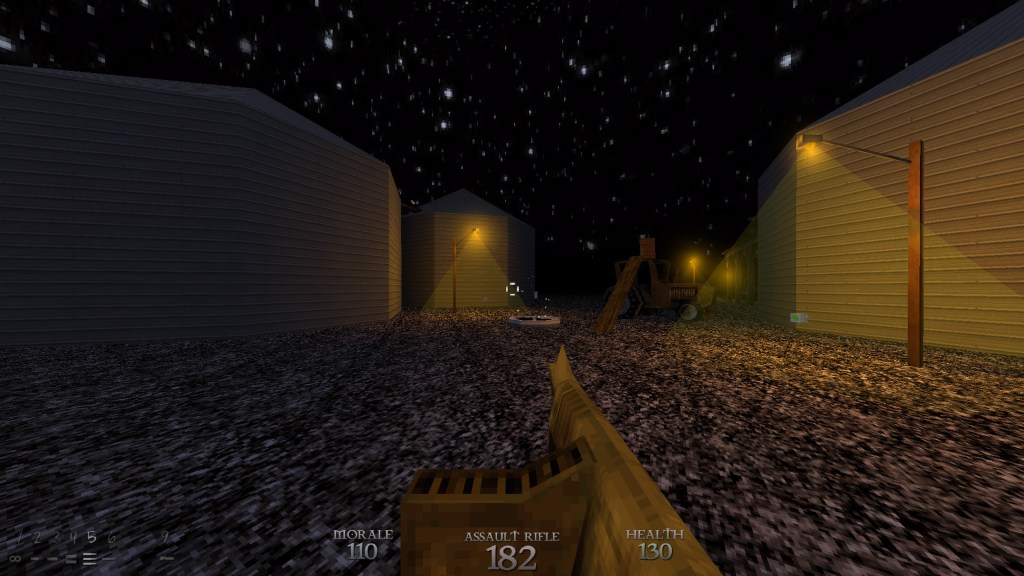
I’ve only touched on the combat of Dusk, but rest assured, it’s fantastic. The available arsenal includes everything you’d hope for. Gun models are chunky but charming. The Riveter, Dusk’s rocket launcher, is a big brown hunk of metal that can destroy several enemies at once, turning them into globs of flesh and red mist. Lever-action shotguns can be dual wielded, causing Dusk Dude to shoot and reload them like the T-800 in Terminator 2: Judgement Day (potentially the greatest sequel of all time?), or you can switch to the Super Shotgun to fire high-powered slugs into the animalistic skull of a Wendigo. A single shot hunting rifle provides lots of damage at a slow rate which, paired with the zoom function available to all weapons, can efficiently eliminate rooftop Mages from a great distance. The most creative weapon on display is the crossbow for its magical ability to shoot green glowing arrows through walls. The punchy sound of an arrow being embedded into the flesh of foes is a satisfying signal that confirms a kill or successful shot.
While the guns deliver the right kind of kick, combat is mostly enhanced by Dusk Dude’s smooth movement. You’ll be gliding gracefully through each area as you strafe and release countless rounds into hooded cultists. The same can be said for plenty of other boomer shooters, but Dusk’s jumping mechanic gives it the edge over contemporaries. Jumping diagonally will grant Dusk Dude a burst of speed after a short delay. So, after a few jumps in one direction, the speed boost will activate and then allow you to continue jumping at that same advanced speed in any direction you please, all while keeping the kill count going, of course. This complements the wide-open spaces that appear in many of Dusk’s levels, as it makes traveling from one side of a large map to the other a fast and fun process. I also found myself more encouraged to hunt for secrets in Dusk versus Forgive Me Father (another title that gradually increases the scope of its levels) because backtracking never felt like a chore. Forgive Me Father is a solid experience that I can gladly recommend, though developer Byte Barrel’s strongest ideas come in the first and second episodes where mazelike levels consisting of tight corridors are soaked in dazzlingly disorienting color and thick film grain, giving the surroundings a dark and ethereal edge that closely coincides with the unsettling nature of the Lovecraftian lore on which the game is based. The simple gameplay seems designed for a more subdued boomer shooter experience that focuses on paranoia and mystery. Enemies hide around corners and flank you from behind in shortcut-laden levels like Streets from Episode One, forcing the player to be ready for anything to emerge from the shadows. The issue is that when the game begins to add more flat battlefields covered in bloated enemy counts, there is nothing like Dusk’s jumping mechanic to reduce the monotony of slowly jogging through these expansive areas, nor is there the option to zoom in on enemies from a distance. Forgive Me Father loses its personality toward the final third of its runtime, opting for what are supposed to be more exhilaratingly overcrowded encounters that become quickly tedious due to the somewhat stiff and slow controls that wouldn’t have otherwise been an issue, thanks to the apt design of earlier stages.
If we’re talking about personality, then allow me to praise the extra details sprinkled into Dusk that I can’t forget. Some of these connect to the gameplay, like the way enemies are blown back forcefully by a centered shot from the hunting rifle before combusting into clouds of blood, and some are there to elevate the B-movie mood of the entire adventure, like the haunting voice of the demonic antagonist saying, “Go on, take it. Taste the power” right before you pick up a time-slowing powerup for the first time in Escher Labs. Then there are comedic boss encounters like the Intoxigator and Big John. There is a trophy that can be attained by killing the Intoxigator while intoxicated off the beer bottles scattered around the arena, and Big John is a parody of Arnold Schwarzenegger whose 80’s and 90’s movies I incidentally love (is Terminator 2: Judgement Day the greatest sequel of all time?) Bars of soap can be found once per level and thrown at any dirty cultist you choose, resulting in an instant kill. There are also inconsequential abilities thrown in like rapidly spinning your weapons around, which can actually kill enemies if you’re close enough, as well as deflecting projectiles back at enemies with the sickles, something I didn’t know was a possibility until I ran out of ammunition during my second playthrough. You won’t use these discreet features a lot, but the fact that Szymanski took the time to develop them adds to the lasting impact of Dusk as a game with its own voice. There are so many small aspects of the game that ironically stand out upon reflection. I can see myself in the future, saying, “Remember Dusk, that game where soap makes people explode?”
Dusk met my expectations that were admittedly quite high after seeing the game get its well-deserved praise over the years since it released in 2018. Of the retro-FPS games I’ve played on PlayStation, Dusk has left a strong impression comparable to other favorites of mine like Ion Fury, Prodeus, Project Warlock and Nightmare Reaper for its integration of fresh ideas within the refreshingly simple confines of an old school shooter. The alluringly melancholic atmosphere, free-flowing control, sophisticated level design and entertainingly unpredictable personality of Dusk make it a must-play for fans of shooters old and new.
 GotMeThinkingGames
Leave a comment