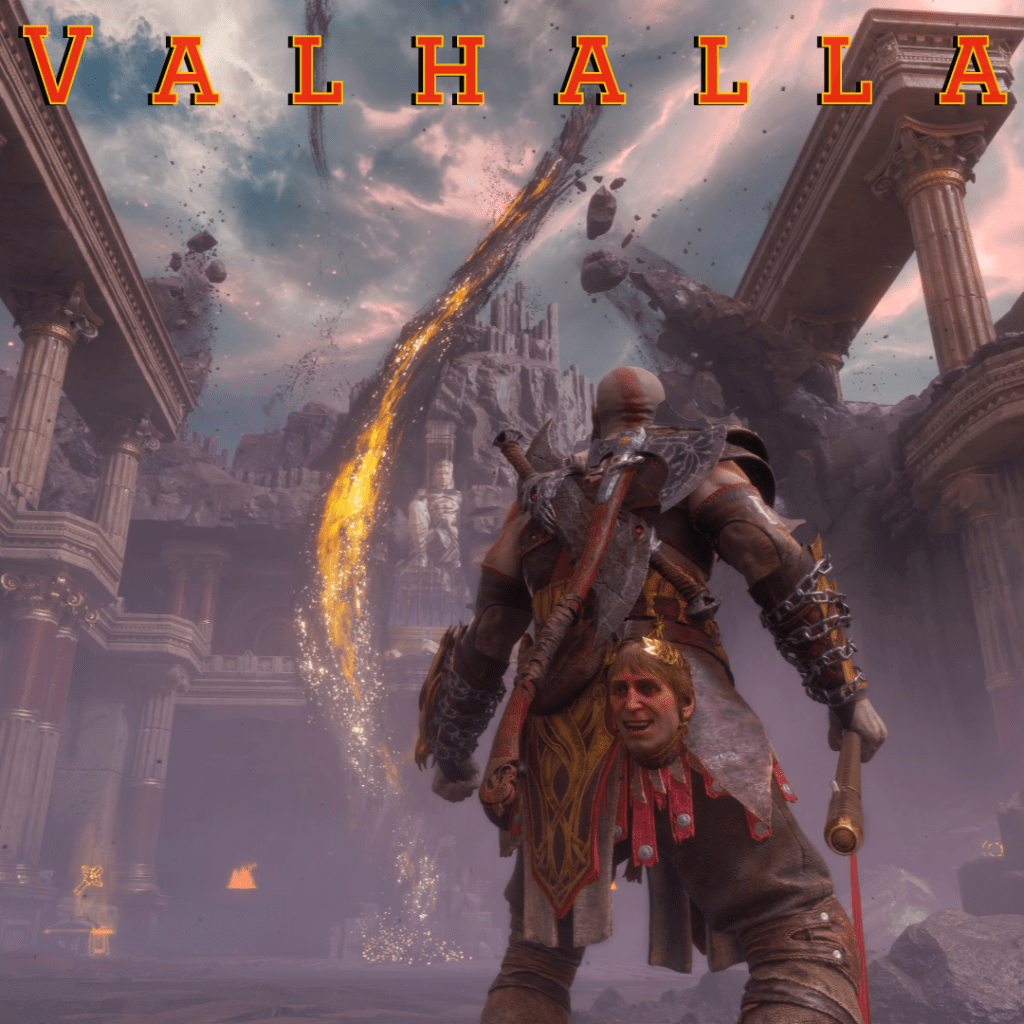
If you’re familiar with this blog which, judging by the current statistics, you’re probably not, then you’d know I have already reviewed God of War: Ragnarök. Newsflash to the abundant uninitiated: I didn’t like it. If you want to know my in-depth thoughts, then you should totally go check out my corresponding Got Me Thinking post. To briefly summarize for our purposes here, I thought the redemptive character arc for Kratos had grown stale and wishy-washy, major story beats like the discovery of Asgard lacked the proper excitement and payoff to keep me curious for what was to come and every section where Atreus was forced upon me as a playable protagonist dragged on so agonizingly slowly that I felt trapped in Fimbulwinter with nothing but a tinfoil scarf. The silver lining was the combat, which maintained the same grit, weight and strategic approach (while controlling Kratos at least) that made it so immersive in 2018. Unfortunately, participating in the fun, axe-throwing part of the game became a reward for enduring the boring, so-sentimental-it’s-hard-to-take-seriously parts of the game, as the heavy-handed story was constantly cutting the action short. That brings me to Valhalla, a free roguelike expansion that Santa Monica Studios dropped on December 12th. I hadn’t heard anything about the expansion until its release date was fast approaching. When I realized it would include roguelike elements, I assumed that meant players like me who were hungry for more gameplay and less melodramatics would be treated to a satisfying loop of brutal kills, stacked upgrades and a few surprises along the way. My assumptions were almost spot-on. **Warning** spoilers for Valhalla will appear.
After an unknown beckoner invites Kratos and his trusty severed head, Mimir, to Valhalla, the Greek God of War rows himself onto the shores of a nondescript beach that acts as yet another realistic interpretation of a mystical Nordic realm that I find immediately underwhelming. The trend continues as Kratos enters one combat arena after another, which are all aesthetic remixes of the realms he already traveled through during the base game. Again, underwhelming. The grounded take on Kratos’ surroundings worked a lot better when Midgard took center stage in 2018, because Midgard isn’t expected to be all that fascinating, yet enigmatic realms like Asgard and Valhalla should have been a lot more imaginatively designed, in my opinion. Anyway, Freya and the other Valkyries show up sooner rather than later to explain that Valhalla is its own entity, capable of changing at will and challenging individuals in unique ways. It will reward you for changing your tactics, they say. This all roughly translates to; Valhalla is magical and functions in this roguelike way for magical reasons because of magic. I’m fine with the in-universe explanations for the DLC, but still found them ironically amusing. What I also found ironically amusing is how quickly Mimir and Kratos begin going back and forth about Kratos’ reluctance to accept Freya’s offer to become the new Norse God of War.
The conversation quickly devolves into an elongated therapy session, broken up by the player’s choice to enter a new arena and disregard the next line of sappy dialogue, which will resume once they’ve reentered a hub area. I made my own fun by bluntly interrupting Mimir mid-sentence. Kratos would yell something like, “NO TIME FOR WORDS” while Mimir attempted to whine about his ex-lover, Sigrun. Unfortunately, I couldn’t hide from on-the-nose dialogue forever. Kratos’s main conflict is overcoming the paralytic fear that he will become what he once was, or that by adopting another version of his former mantle, he will essentially be honoring his younger, rage-fueled self. Listening to Kratos be so overly cautious about the implications of his consent to support the nine realms feels very out of character for a man who once snapped the neck of a drunk and helpless Hera. During that confrontation in God of War 3, Hera tells Kratos, “You destroy all you touch.” As a player, it was ironically motivating to hear such a complaint from one of the most spoiled and pompous Greek Gods, because destroying all he touches used to be Kratos’ ace in the hole. The power trip offered up in that first trilogy, where morality and patience were completely disregarded in favor of the selfish lust for violent and savage revenge, was a cathartic option that many other games were reluctant to dish out. In Valhalla, Kratos’ past is conveniently reconfigured so that it can be redeemed. Mimir and later Tyr (the one behind the invitation, who acts as a repeated boss fight at the end of each run) try convincing Kratos that he always had good within him, an apparent fact shown off by such acts as replenishing the sun after decapitating Hermes. However, this feels more like the writers’ way of permanently altering the fabric of Kratos’ DNA for the sake of thematic preferences rather than a legitimate argument that anyone who played the original trilogy can appreciate. Sure, Kratos replenished the sun (after causing its disappearance) and was at one point a man full of love for his wife and child who were ruthlessly torn away from him. But he also never hesitated to kill several innocents who threatened to delay his achievement of absolute vengeance by even one second. The Kratos who began as a husband and father is a Kratos who we the players have never had control over. We never asked for control over that Kratos, because that Kratos doesn’t deliver the same chaotic bite that has long been a series staple. Kratos is irredeemable. There is nothing about Kratos that suggests he is akin to a protagonist like Link, a noble and ambitious fighter with an obligation to save lives and bring peace to his kingdom. No. Kratos is mean.
Angry.
Brutal.
Dark.
Merciless.
And that’s okay! He doesn’t need to be the happy-go-lucky guy that Valhalla wants to shape him as. Kratos will never wave to his neighbors while checking the mail. He’ll never stop to help a stranger swap their flat tire with a spare on the side of the road. If Kratos got a flat tire, he’d launch his Chaos Blades through somebody’s windshield and yank the driver out onto the asphalt, then steal their vehicle with the hopes of making it on time for his one o’clock murder appointment. With all that being said, I was gladly open to the character’s evolution in 2018, when the exact ways in which he was attempting to evolve weren’t repeatedly spelled out so plainly for the player at every turn. I never felt like the writers were trying to sell me on the purification of Kratos’ soul, but rather the ability of Kratos to recognize the harm he’d be doing by teaching his young son the same toxic methods of dealing with traumatic agony. I didn’t consider Kratos as I know him to be lost forever simply because he was attempting to become a good father. The old demons that had haunted him for so long were still there, only they were no longer flying around freely in his head like Harpies. Kratos had willingly chained them up in his own mind as a means to prevent them from reaching his son’s. Don’t mistake this for a noble action. It’s Kratos’ duty as a father. His past remained unjustified by the end of God of War because of course it did. He is damned from every angle, but that’s why we love him. Controlling Kratos is an outlet for the rage and indignation that threatens to consume us all at some point or another throughout life. I mean come on, we’ve all fantasized about walking into a former boss’s office and yelling, “ZEUS!!!!!! Your [assistant] has returned. I bring the destruction of [this business]!” Right? Or is that just me?
The absence of Atreus becomes an issue for the story that Valhalla is trying to tell, because now Kratos’ number one motivation to change (and the only one that makes any sense when considering the history of the God of War franchise) is removed from the equation. Don’t get me wrong, I didn’t miss Atreus at all from a gameplay standpoint, but this new and emotionally improved Kratos feels so much more like a cardboard cutout with no son to guide and/or learn from. The bond Kratos has with Mimir feels shallow in comparison and I was never invested in Kratos’ final choice. Who cares if he becomes the Norse God of War? Personally, if I was worried about the protection of my realm, then I wouldn’t vote for a guy who’s become so anti-war that he was looking for a way out of what was supposed to be an awesome showdown against Thor in Ragnarök, which, as a result, devolved into a sad clash complete with a sob-story about Thor’s alcoholism. Of course, Tyr would remind me that there is a difference between war and mindless war; that selfishness should never invade the decisions of a rational and capable general. By instilling a selfless Kratos with the confidence to resume his role as a leader, the nine realms can become more unified than ever before. But all I can think is Blah, blah, blah, I want to rip somebody’s arms off already!
Okay, I’ve spent enough time picking on Kratos for trying to be a good guy. Now I’d like to discuss my journey through Valhalla and why I feel an expanded version of this game mode could have been a suitable replacement for the entirety of Ragnarök. It all comes down to the one big bad word in gaming: BOREDOM. After cruelly punishing us with a lackluster story that suffered greatly from the absence of Cory Barlog’s personal influence, torturous Atreus segments and tediously slow backtracking and traversal, Santa Monica Studios has finally shown mercy with their allowance of fun. If you’ve also lost interest in the wimpy, whiny Kratos who second guesses every throw of his axe, then you’ll remain slightly peeved by the story beats in Valhalla. However, it is at least far easier to ignore those beats while you roleplay regular destruction, quickly going from one run to the next, resetting each time you either die or defeat the final boss. The final boss battle is really a sparring match against Tyr, who cycles between different historical weaponry as he tests Kratos’ will to reflect, accept and change (cue the eye roll).
Every run begins back on the beach. Over time, you’ll earn currency to spend on various permanent upgrades including basic stats, which have not been carried over from the base game, though you will have immediate access to all three weapons and their unlocked skill trees. Runic attacks, relics, amulet enchantments and stat/weapon/perk glyphs that offer such benefits like 30% more ranged damage are found over the course of a run, locked within chests that can be opened only after every enemy within an area has been killed. Each time a chest is opened, another choice must be made, as two to three options are always available to select from. Thus, the standard roguelike formula is followed quite closely, as players must create their own builds with whatever they can glue together on the fly. Once you become familiarized with the pool of randomized rewards, as well as upcoming boss encounters and likely enemy configurations within a particular area, seeking out an ideal build becomes much easier. I ended up using the Draupnir Spear far more frequently than I bothered using it in Ragnarök. Because the spear came somewhat late in the base game, I inadvertently overlooked it due to my established comfort with the Leviathan Axe and the Chaos Blades. I’m happy I gave it a chance in Valhalla, because now I can safely say that I like it better than the current iteration of the Chaos Blades and, in some cases (depending on who or what I was fighting), better than the Leviathan Axe as well. If I was able to gather and enhance two runic attacks like Mountain Splitter and Vindsvalr’s Windstorm before entering the final arena for a one-on-one versus Tyr, then I always felt far more confident than if I had chosen to focus on the other weapons. The ability to throw and detonate multiple spears at once can be almost unfair for the enemies at times, especially if I find the proper glyphs that increase ranged damage and all abilities mapped to the triangle button (an odd breakage of the fourth wall).
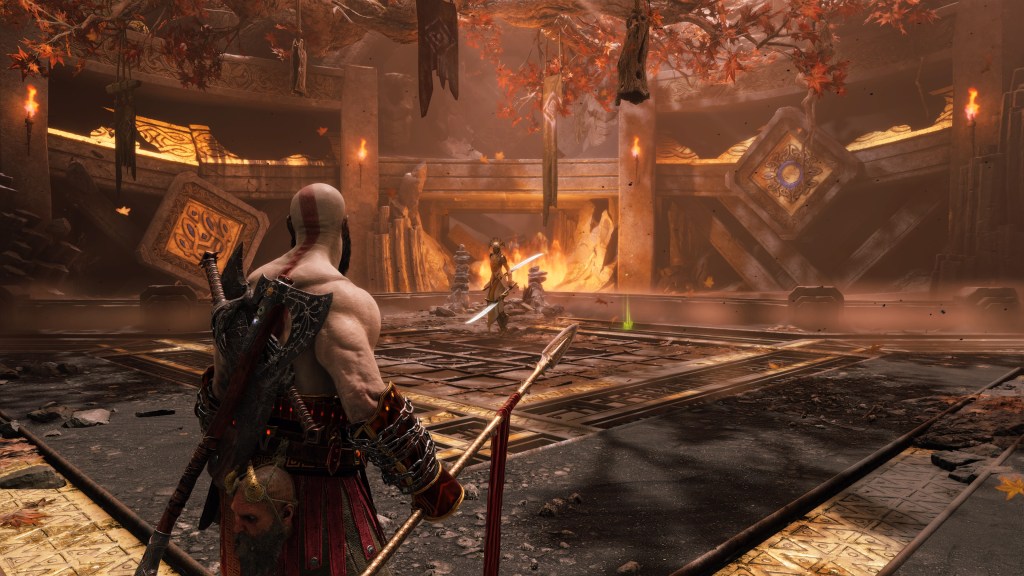
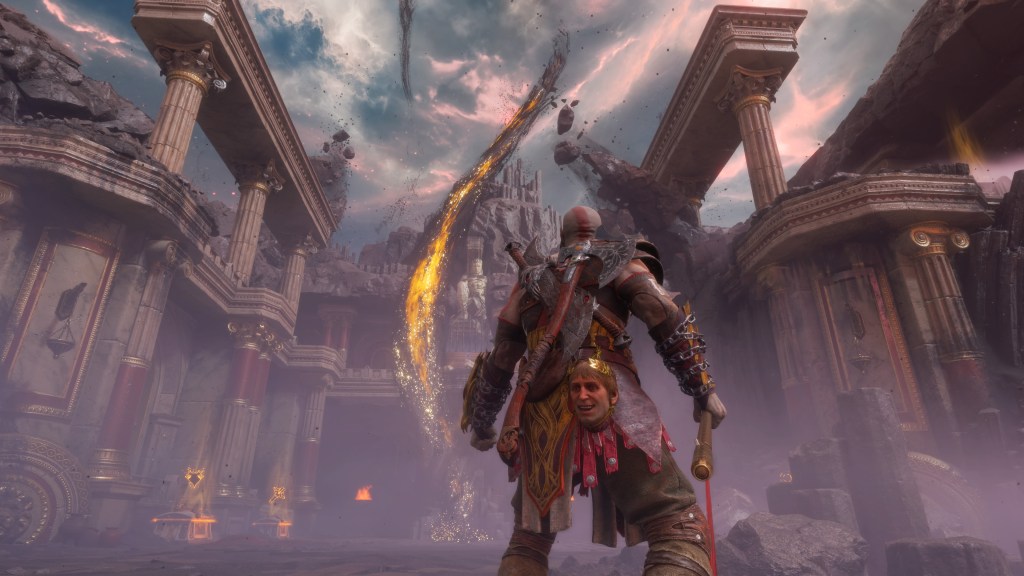
So, what’s the catch? Are we just running around in pared versions of the realms we’ve already conquered, fighting waves of enemies, gathering upgrades, finally battling Tyr for the most precious rewards and then repeating the same process until we’ve had enough? Yeah, basically. But there was also a big surprise in store that I didn’t see coming. In retrospect, I probably should have, yet I can appreciate my own cluelessness for the joy it brought me. Once you make it to a certain point of progression, Kratos is thrust back onto the peaks of Mount Olympus, where he must literally and figuratively confront demons of old. From then on, Olympus will act as the final crucible before reaching Tyr. The best parts of this last stage are the special guest appearances. Legionnaires, Cyclops, Harpies, Sirens, Minotaurs and Centaurs all come together to crash Kratos’ Nordic party with sets of classic attack patterns remixed to fit the established combat system. I was almost expecting the camera to zoom out and mimic the original series’ style of fighting, but I suppose it was more interesting to see these character models up close and personal as Kratos used his foreign arsenal to tear them apart once more.

Also returning is Hermes. Well, not all of him. Just the head. After speeding down a zipline to reach the hub area of Olympus, I noticed that Mimir looked a bit different. . . Then he began speaking sardonically, mocking Kratos for how soft he’s become and for his foolish endeavor to evolve from the monster he has always been. Hermes’ heckling brought a huge smile to my face, as he began voicing exactly what I had been thinking during my Ragnarök playthrough! The return to Greece was the curveball that Valhalla needed to keep me interested, even if the purpose was not to celebrate the younger Kratos but instead lay him to rest. Now is a good time to tell you that young Kratos does also make an appearance at the end, albeit a wordless one while current Kratos delivers a cringe-inducing monologue of raw emotion that young Kratos won’t deign to answer (at least that’s my canonical reason for his cold silence). I snickered a little at the juxtaposition between the Shakespearian Kratos getting choked up by his own speech and the throne-occupying Kratos who looks ready to smash his face in at any moment.
Earlier, I said that Valhalla could have replaced Ragnarök altogether and I will stand by that statement. If they had done more with Valhalla by adding even more Greek and Nordic areas, reimagined boss fights like the one against Hercules that gets referenced by Kratos (what a tease), the ability to play as young Kratos against Norse enemies, a new playable character whose name is NOT Atreus and/or a variety of other zany ideas, then this mode could have been its own standalone title capable of capitalizing off of God of War’s 2018 success while not alienating fans of the reboot by dumping what felt like a rushed full-length sequel onto their laps. Valhalla could have bridged the gap between 2018 and Ragnarök while highlighting the addictive combat rather than a stuck-in-the-mud storyline that picked up much too soon after the last adventure. That probably sounds ridiculous to anyone who thoroughly enjoyed Ragnarök, but throwing out weird ideas that might not make any sense is one of my strong suits, so don’t hate. For anyone wanting to reengage with modern God of War melee without being hampered down by so much bloat, Valhalla is well worth the download. Did I mention it’s free? Kudos to Santa Monica Studios for that one, and I hope I can better connect with the next tale they tell.
 GotMeThinkingGames
Leave a comment