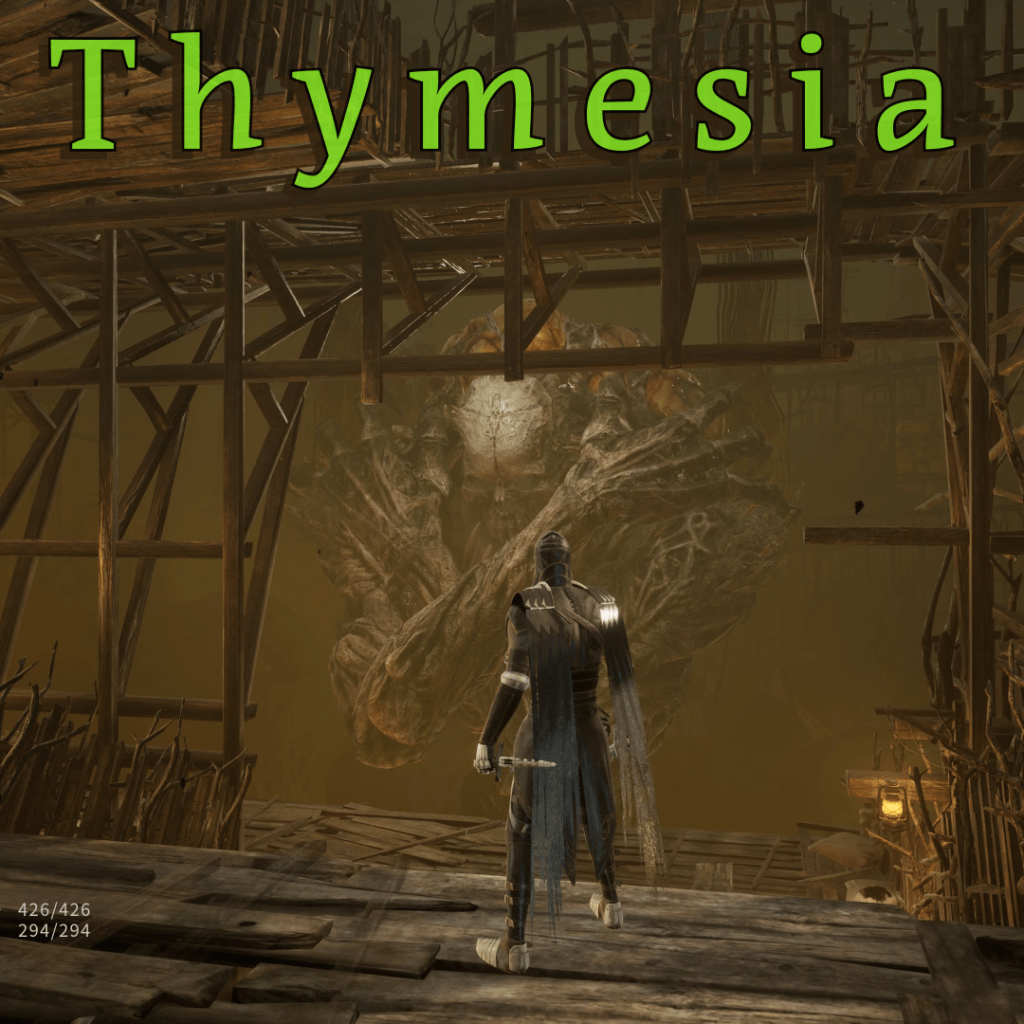
Bloodborne will never die. Even in the wake of Elden Ring, I still consider Bloodborne to be FromSoftware’s current magnum opus (bigger isn’t always better). Whenever I reflect on some of the most memorable gaming experiences I’ve ever had, I always see the gothic spires of Cathedral Ward, pointing with melancholic menace at the vermilion moon above Yharnam. While I realize that titles like Bloodborne are extremely rare, I’m still hopelessly desperate to replicate the profound impressions left on me by the hunter’s nightmare. That’s why Thymesia stood out to me. The first sentence of the game’s description appealed to my dark tastes. It reads: “The once thriving Kingdom of Hermes has fallen to an age of calamity.” Pair that with the cover art of a creepy-looking plague doctor protagonist and I was ready to buy in. But did Thymesia deliver the grim and grotesque goods? Well. . .
Developed by OverBorder Studio and released in 2022, Thymesia puts players in the silver shoes of Corvus, an agent of Hermes imbued with strange powers derived presumably from the very alchemistic experimentations that have upended the entire kingdom. Corvus is tasked with exploring various sections of Hermes for memories, which he can then absorb to uncover the truth of the disaster. Only after the truth behind the manmade plague is exposed can the ongoing horror be reversed. Fellow Bloodborne fans may already notice some parallels. A lone fighter is thrust into the decayed splendor of a disease-ravaged territory full of ailing mutants because of man’s undying greed and reckless curiosity in pushing the limits of something they don’t fully understand (alchemy and the old blood). Of course, many stories presented in all forms of entertainment contain some overlap in terms of structure and theme, so execution becomes incredibly important for one similarly framed narrative to separate itself from another. Thymesia’s execution unfortunately leaves a lot to be desired, especially because it invokes the aura of a more skillfully presented story like Bloodborne’s, where complexly nuanced lore adds so much to the allure and replay value of that game. However, I’m not here to directly compare a $30 indie release (that I snagged for $18) to a FromSoftware title. If we remove Bloodborne from the equation, then the barebones approach taken by Thymesia, including non-spoken dialogue, a lack of notable NPC’s, notes that offer plenty of not-so-compelling information as the primary resources available for players wondering what the hell is truly going on as well as environments with some interesting visuals sprinkled in alongside empty and recycled spaces does ultimately underwhelm. At the same time, I wasn’t totally put off by Thymesia’s somewhat insipid presentation or world-building. It felt oddly relaxing to coast through a quiet and more linear soulslike than I’m used to. Plus, I would come to find out that OverBorder Studio chose to make certain visual and immersive sacrifices in favor of prioritizing the most critical element of any game: the gameplay.
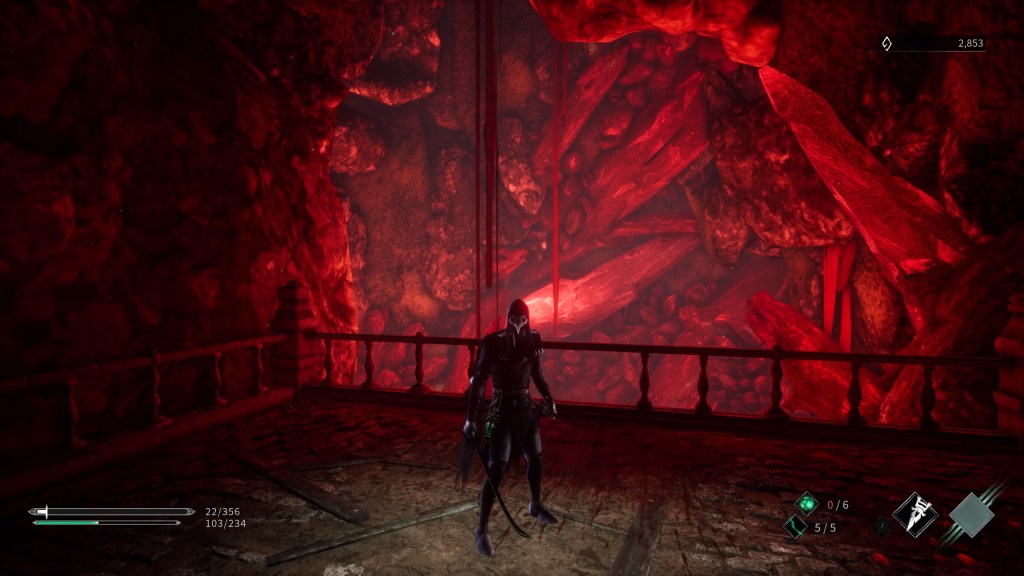
Thymesia follows the Demon’s Souls formula of entering disconnected levels via a central hub rather than traveling to and fro on foot. There are only three areas to explore, each with their own assigned boss that prevents progression onto the next area until they are defeated. Players in a rush can theoretically blast through the game’s main missions in a few hours, but for those of us who like to stop and smell the roses (or simply have a crippling completionist mentality), there are also side missions that become available within recently conquered areas. These side missions often involve retreading the same ground, just from a different starting point, culminating in a fight against a particularly spongey and damaging foe (including the occasional bonus boss fight). Sometimes, side missions lead to Corvus unlocking a brand-new section of the level, which would be more exciting if there were any notable secrets to search for. Given the fact that Corvus went to the Sekiro: Shadows Die Twice school of equipping one sword and outfit for the entire game by default (more on that soon), exploration falls flat by not rewarding any new weaponry or armor. Instead, currency for levelling and ingredients for healing potion enhancements is all you’ll find off the beaten path. Oh, and notes. Lots of notes.
I don’t get the sense that OverBorder Studio took lazy shortcuts by stretching three relatively small areas across the duration of the game. The effort to spread what resources they had at their disposal in a creative manner is clearly seen in the ways they remix enemy encounters during side missions and also offer optional showdowns with bosses like God of Fools, a toxic behemoth that acts as an obstacle the player must avoid until they finally climb enough scaffolding to plunge their sabre into the beasts bulbous, bubbling core. At the end of the day, this is a small yet heartfelt project that really shines when it comes to control. Combat in Thymesia is exactly the kind of thing I was looking for when I played Lies of P, another indie soulslike, albeit with a bigger budget and much more detail on display. Both titles have what the other one doesn’t. Thymesia lacks the depth, beauty and intricacy of Lies of P’s universe, while Lies of P fails to distance itself from the dated concepts of soulslike gameplay, opting instead for features that failed to impress me with their rigidity and middling level of precision. In other words, I thought that for all the personality Lies of P brought to the table, it still couldn’t shake the looming shadow of FromSoftware. While Thymesia may not be the belle of the ball, it accomplishes a unique approach to combat that synthesizes mechanics from other popular titles without regurgitating them in a less intuitive manner. As someone who puts gameplay on a pedestal above all else, Thymesia is one of the better indie souslikes I’ve encountered. Allow me to break it down.
A sabre and a pair of magical claws. Those are the starting and ending weapons for Corvus (I keep wanting to type Corvo, by the way. Shoutout to Dishonored). The functionality of each weapon on their own is basic, but there are upgrades to be purchased such as extended sabre combos and slower or faster claw slashes. This isn’t a one or the other situation though. The sabre and claws must be used in tandem to defeat your opponents, because each enemy is given two health bars. One is white, one is green. The sabre is capable of chipping away at the white bar, which will then reveal the green beneath; a job for the claws to take care of. The sabre can technically drain the green bar as well, but it does so with a fraction of the claw’s effectiveness. I was worried that this mechanic would become tedious, but as the game went on, I grew to appreciate the strategy it could involve. See, the sabre and claws operate at different speeds and with different ranges. Sabre strikes are for close quarters. They offer quicker, longer combos that are more easily cancellable, while the claws allow Corvus to close in on enemies from a distance but have a slower wind-up and attack animation (at least when using the higher damaging two-slash variation of them, which I opted for after growing tired of the weaker, more rapid alternative). Once enemy patterns become implanted in your memory, it gets easier to figure out an optimal balance between sabre and claw, given the openings that are presented. Added tension comes with the fact that if green health bars are left unattended for too long, then the white bar will regenerate back over them, threatening to reverse your progress. The tougher the enemy, the less green health is revealed with each hit from the sabre, the faster white health bars return and the harder it typically is to gauge safe hits.
So far, it probably doesn’t seem like Thymesia’s combat is all that unique or engaging. Sure, double health bars are an interesting idea, but the combat isn’t much more than the same old dodge and hit that we’re used to, right? Wrong. Have you ever heard of a feather powerful enough to repel the blitz of a crazed knight wielding an enormous sword? Well, now you have. Replacing the hunter’s pistol from Bloodborne, Corvus’s delicate little feather can be thrown at an enemy just before they have the chance to land a flashing heavy attack, knocking them off balance and opening them up to a few free hits. The obvious difference between the way the feather and firearm parry work in Thymesia and Bloodborne, respectively, is that the former doesn’t bring the enemy to their knees for a visceral attack but briefly staggers them instead. This maintains the precedent of a higher tempo that Thymesia sets almost immediately, so I believe it works to the game’s advantage. Feathers can also be thrown haphazardly to interrupt an enemy’s health regeneration, which comes in especially handy when trying to learn a boss who is exceedingly dangerous the closer you are.
But wait, there’s more! Thymesia also includes a deflect system like the one seen in Sekiro. With a short dagger hidden up his sleeve, Corvus can thwart whole chains of attack. The timing required to earn a successful deflect feels slightly more generous than Sekiro, yet still requires the player to pay attention and refrain from spamming. If you aren’t attempting to enter five different inputs at once, the transitions from attacking, deflecting attacks and throwing a feather are satisfyingly smooth. While the game is for the most part fast and free flowing, some degree of patience when allowing animations to play out is necessary for making the most out of a combat system loaded with different options.
Speaking of options, Corvus’s talent tree can be reset at any time, giving the player several new avenues to pursue by unlocking upgrades that alter the nature of each available tool. For instance, Corvus can learn the dodge and stab sabre technique (great for closing the gap) or a dodge and slash, which has less range but seamlessly transitions into the third strike of his 5-hit combo, thus eliminating any delay in the pursuit of dealing more damage. The timing window of deflections can be increased, or players can do away with deflections entirely in favor of a “Defence Mode” which causes Corvus to shell up and absorb 75% less damage. I found it much more fulfilling to master deflections, but someone else may prefer the simpler approach. A similar replacement is available for the feather, as Corvus can ditch the defensive projectile for an “Intercept Wing” that requires the enemy attacks to reach him before being parried, causing fights to become up close and personal every time.
Although the talent tree is fun to experiment with, the best mix-ups come in the form of Plague Weapons. These 21 summonable ghostlike versions of enemy axes, knives, bows, or, when things get more interesting, mutated tentacles, are accessed by obtaining the corresponding crystal shards that drop from defeated foes using the real deal. They can be mapped to either square or triangle for a one-time use before requiring a recharge, with the potential to turn the tide of any battle. As I progressed through the game, gradually discovering more dangerous foes with advanced weaponry, I began realizing the perks of using something like the Greatsword, a hefty blade that knocks most enemies off balance for a brief interval like the feather, allowing Corvus to either retreat or stack damage in the meantime, or the sneaky Katar, which grants Corvus the acrobatic ability needed for a forward leaping attack and immediate backward leaping retreat. To upgrade the effectiveness of Plague Weapons, more crystals are required, meaning players are incentivized to reload certain boss fights and repeatedly hunt down the appropriate enemy type if they want to max out their favorite choices. This helped to mitigate the void left by never finding any regular weapons to replace the sabre or claws, giving me more of a reason to continue engaging with the impressively ambitious combat system in the process. Throughout my playthrough, I repeatedly felt the urge to try out new tactics against certain bosses and elite enemies, including changes to my talent tree and preferred Plague Weapons.
While Thymesia could have benefitted from more elaborate levels harboring desirable loot in line with deeper RPG experiences, as well as a longer list of enemies and bosses, the game delivers what it needed to. The action is solid and rewarding, the atmosphere is passably foreboding and none of the boss encounters felt cheaply designed. The final boss was the perfect fit for the game’s finale, and by the time I put the controller down, I was already brainstorming about what I wanted to see in a sequel. Thymesia is a modest soulslike that succeeded in capturing my attention for the eight or so hours it lasted, and I’ll be keeping an eye out for another installment.
 GotMeThinkingGames
Leave a comment