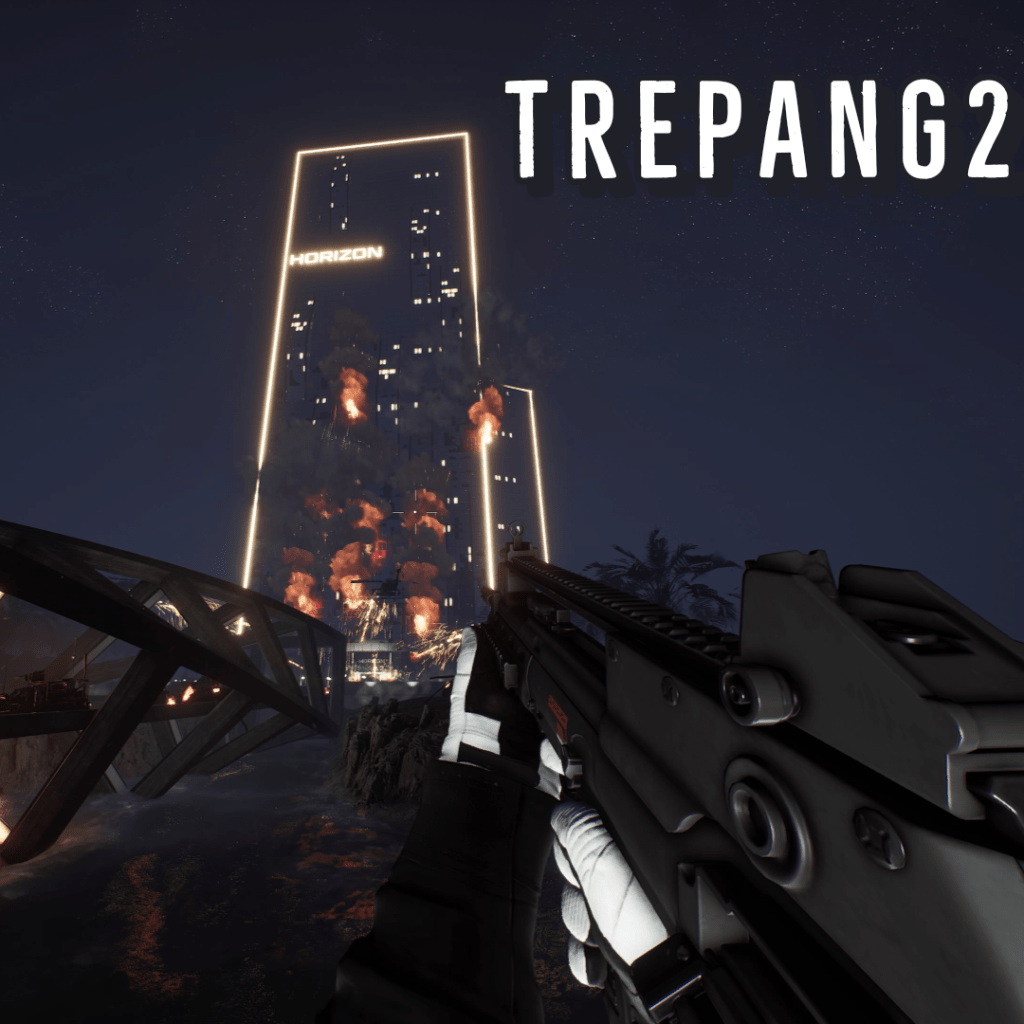
Remember when a new Call of Duty release was regarded with even a slight fraction of excitement from people who enjoy single-player experiences designed to impress and entertain for the duration of a proper campaign? Barely? Yeah, me too. But the remnant of those memories still lurks deep in the recesses of my brain’s nostalgic folds, and what I can recall most clearly are the sights and sounds. The rustle of swaying tactical gear and the pounding of combat boots as I approached the next near-death set piece in Call of Duty 4: Modern Warfare. Grenades going off all around as gunfire hailed from the windows of a skyscraper. Rain falling onto the deck of a freighter as my team of SEALs snuck between stacks of wet cargo, relying on me to potshot guards with a silenced pistol. There was something novel about the way that series thrust players into virtual war, a war so full of consistently chaotic catastrophes that the likelihood of any playable protagonist surviving in a real-life recreation of the events unfolding would be lower than the bar that Call of Duty has currently set for the military shooter subgenre. Of course, Call of Duty’s nearly on-rails segments were a big reason for the series’ success. Those who can put themselves back into whatever shoes they owned in 2007 (for me it was a pair of bulky and way too colorful Osiris sneakers) might remember appreciating the ways in which a laser-focused Infinity Ward took advantage of relatively new technological capabilities, much like Naughty Dog did with the Uncharted series. Since then, the mysticism of how closely games can resemble films has gradually dissipated, as it’s been more and more difficult to blow minds with the graphical and cinematic quality of a game over the last three console generations. While the corporately configured Game Awards still shine the spotlight on developers who seem to reject the idea of creating compelling gameplay in favor of delivering overwrought narratives crammed with too many cutscenes to count, and/or bafflingly monetized single-player content infused into the blueprints of the game from the ground up, I have faith in the fans to appreciate titles that haven’t forgotten about the controller in our hands. In other words, the industry is long overdue to come full circle with a return to engaging gameplay as a top priority.
Such a philosophy is what has allowed Doom to remain so accessibly engrossing for over 30 years, yet many AAA developers (and publishers) continue to resist. That’s why the indie scene is so important to me. Without smaller teams of passionate creators putting in the hard work to turn gamers into endorphin junkies, I would have never discovered Trepang2, a 2023 ode to the F.E.A.R. franchise, developed by Trepang Studios. You may be asking yourself, if this game borrows heavily from F.E.A.R., then why talk so much about Call of Duty at the start? That’s a perfectly valid question to ask, and the answer is that I’ve shamefully never played F.E.A.R. I’m only aware of its influence on Trepang2 from the brief pre-purchase research I conducted. Therefore, I come to you with a different perspective on Trepang2 than F.E.A.R. enthusiasts. For me, Trepang2 evoked those old, worn memories of playing Infinity Ward’s tactical military shooters. It felt like Call of Duty starring Arnold Schwarzenegger. The immersive elements were all there. The susurration of ammo pouches with every step, a reconnaissance team chattering over the radio, helicopters soaring overheard before dropping off repelling enemy units. Yet instead of relegating simplistic gameplay to the background of a high-octane, interactable movie, Trepang Studios decided to develop an addictively empowering, challenging and rewarding combat loop. It’s Call of Duty unfiltered, and with no pretense of realism. Before the long story, here’s the short one: Trepang2 is a ridiculously intense imagining of tactical warfare featuring an unstoppable super soldier who can light people on fire with a shotgun. Interested? You should be.
Trepang2 opens with our protagonist, known only as Subject 106, handcuffed in the basement of an unknown facility. It’s easy to piece together that some sort of outbreak has occurred, as chaos can be heard over the radio comms that Subject 106 is inexplicably tuned into. As you sneak your way past groups of enemy soldiers, they exchange stifled worry with one another over the inability to locate and recapture their prisoner. . . experiment. . . weapon? It’s not quite clear. Soon, you find the key to free yourself, along with a pistol. Contact is made with Task Force 27, an ostensibly benevolent squadron headed by an unseen, no-nonsense Director who wants your cooperation. It’s a tension-building beginning to what will soon become a ferocious rotation of flailing, burning and obliterated bodies. Once you reach main floors full of white desks and computer monitors, all with the same Horizon Corporation screensavers, you’ll start to infer more about the plot and learn more about the controls. It doesn’t take very long at all for Trepang Studios to reveal the game’s core structure.
Like Doom Eternal, Trepang2 leads the player through action-packed levels that typically culminate in arena battles featuring increasingly difficult waves of adversaries. You’ll encounter one such fight at the end of the first mission, where resources aplenty are scattered nearby several sets of elevator doors, which begin opening two at a time to deliver more resistance against Subject 106’s escape. This was the moment I knew I’d enjoy the rest of Trepang2, as it not only took the training wheels off the game’s sleek and showy gunplay, but also shared a bit of its occasionally silly personality, an unexpected but welcome addition to an initially sterile and somewhat generic presentation. As each batch of hapless Horizon goons were unloaded and summarily squeezed dry of their souls, another report was radioed to their leader, each update containing more and more apprehension, until finally the leader was forced to yell threatening profanities at his (justifiably) cowardly men in an angry plea to motivate them. It plays out as a humorous moment that also promises players the chance to feel like an empowered force to be reckoned with . . . if they play their cards right
But what kind of deck are we using? The premiere skill in Subject 106’s repertoire (and probably the main reason for the F.E.A.R. comparisons) is the temporary activation of slow-motion. By tapping L1, the player will enter the same mode Spider-Man did when Green Goblin was throwing those razor pumpkin bombs at him inside of a burning building (team Tobey forever!). The meter is modest, so attempting to abuse slo-mo by diving headfirst into a half-dozen trigger-happy troops, ploddingly spraying and praying, isn’t very prudent, as you might get brought back to speed at the most inopportune of moments (at least on hard difficulty and higher, where your mistakes are very quickly capitalized on by sharpshooting shotgunners). I found the most advantageous and entertaining way to integrate slo-mo into a blizzard of ballistics was to pop it just before and after landing another lethal shot. This technique also introduced me to a brand-new dopamine cocktail I didn’t know I needed, made with one-part incendiary shotgun fire, one part kill-confirming hit-marker, two parts slow-motion and garnished with a shriek of agony from the guy whose corpse was sent flying across the room. I call it the Trepang Bang.
If L1 is the friend who says, “you got this” before you’re about to do something that you definitely might not have, R1 is the friend who will pick you up from the bar at 2 a.m., because that’s the button mapped to Subject 106’s cloaking device, aka his get-out-jail-free card when things get a little too messy. While the slo-mo meter fills up gradually with every kill, the cloaking bar will replenish on its own. Therefore, I inevitably found myself in many situations where I had (evidently inefficiently) used all my slo-mo during a particularly harsh combat sequence and was forced to hide, surrounded by intelligently flanking ai. That’s when I’d go invisible, sprint to safety and let Horizon’s bullet budget be wasted on the now empty spot I had just occupied. During these reprieves, I could formulate the ways in which I may clear the area. On higher difficulties, these choices are being made in the blink of an eye, so while it may seem conceptually simple to always get yourself out of dodge and come back swinging, your survival greatly depends on the precise deftness of your every move, as miscalculations come with fatal consequences.
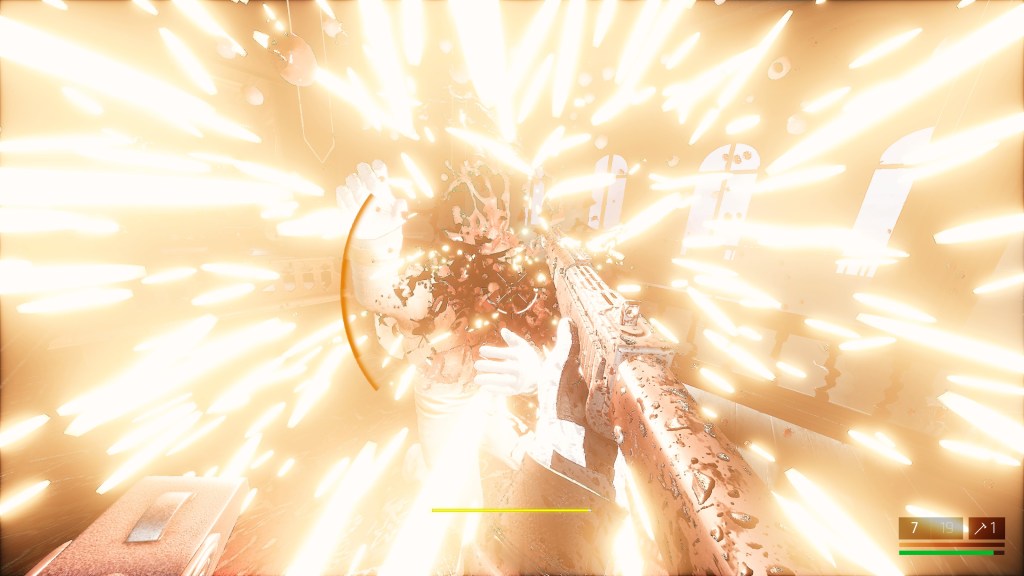
Subject 106 can also slide across the floor if the crouch button is held down, sending enemies airborne by whipping their legs out from under them. Pair this technique with slo-mo and you’ll give yourself a generous chance to either spin back around and shoot them like fish in a barrel or grab their airborne bodies to use as bullet-sponges, before casually snapping their necks or face-punching them into the depths of Hell. You can also throw them back at their buddies with a grenade stuck to their gear, causing a conveniently distracting and damaging explosion. With each of Trepang2’s mechanics laid out before you, the potential combinations between them feel endless, considering the constantly shifting context of each combat scenario, where the ideal expenditure of Subject 106’s meters will depend on what exactly is happening from one second to the next, regarding your location, enemy locations, enemy types, ammunition capacity and the level layouts.
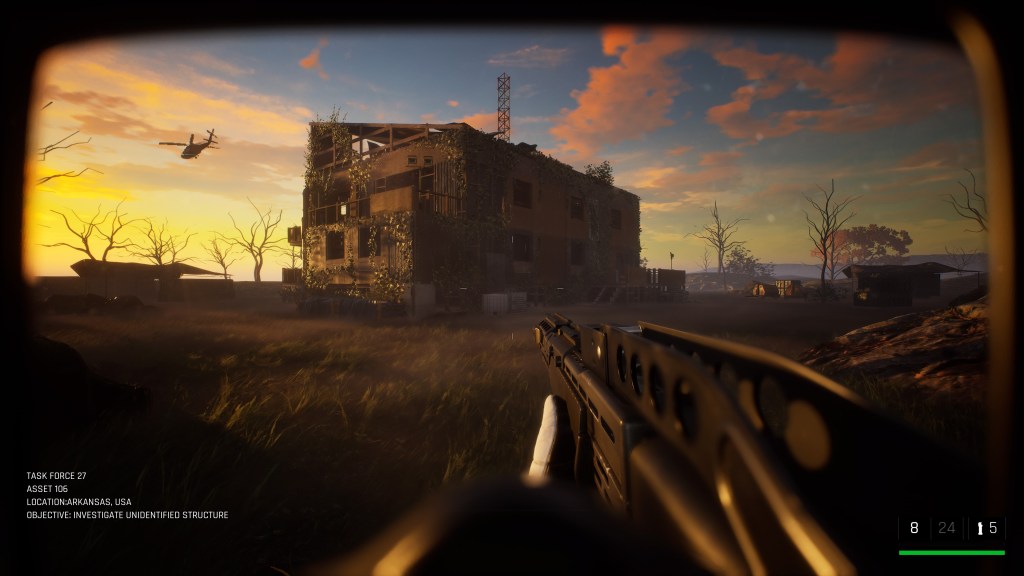
I can’t find anything worth complaining about when it comes to Trepang2’s combat design, but how is the game designed around it? Well, after each mission, Subject 106 is delivered back to The Safehouse via helicopter, where players can equip their favorite loadouts before jumping into the next hectic chapter. The available arsenal doesn’t feature any wacky options like the BFG, despite there being room for one in this sci-fi universe. Still, each gun (pistol, SMG, rifle, shotgun, sniper, minigun) is perfectly viable when laying waste. Weapon parts with often predictable pros and cons are found hidden throughout missions, like providing extra recoil but faster reloads. However, once I had unlocked the incendiary modification for the shotgun, I was jubilantly barbequing bad guys until the end of the game. When you’re done choosing the gear you’ll bring into the next mission, it’s time to enter a control room with an interactive world map, where the game’s missions are plotted in different geographical zones. The best side missions are frantic hacking events that require the player to withstand heavy opposition in the form of intensifying waves, which include specialists who can nullify and reverse your hacking progress, if they’re in range of the server. This results in running around like a madman as you hunt down spawning specialists and avoid being killed by the other, tougher Horizon agents sent to protect them. I enjoyed braving the inevitable descent into absolute anarchy as I rushed to circumvent the increasingly numerous blockades of armored brutes in order to kill a couple of pesky specialists before they restored the servers. A few other side missions followed a more linear progression, bringing me to some unique locations that captured a sense of simplistic artistry, like an abandoned house on an Arkansas plain that must be investigated and then defended during a sunset, or a crash site that reminded me of Modern Warfare 2’s Scrapyard map, with wide-open skies that can be watched for a rotation of enemy choppers. These added to the perceivable scope of a relatively short experience (about 7-8 hours overall).
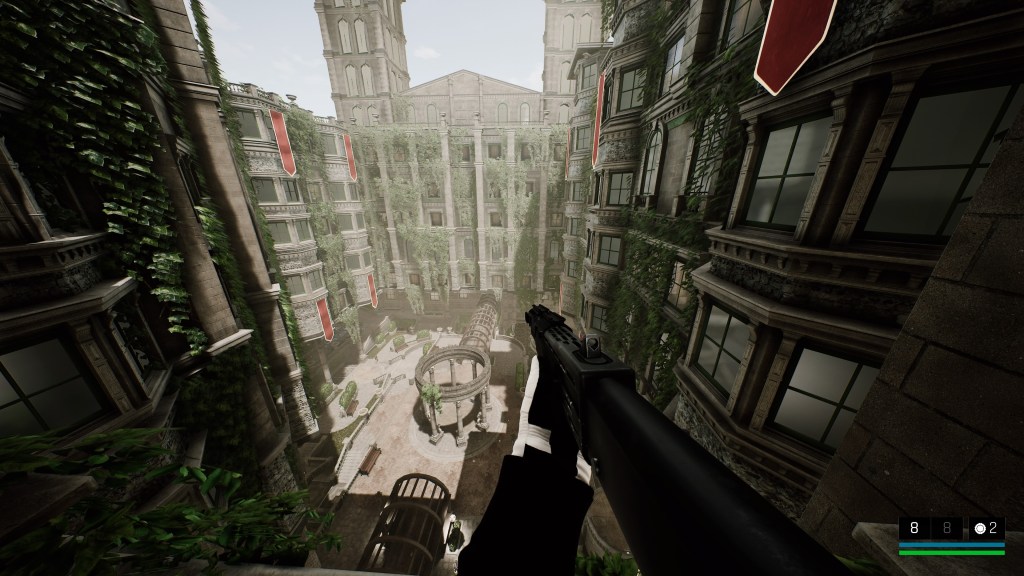
As far as the campaign missions go, I was pleased to see a serviceable amount of variety in settings, including a sandstone castle that immediately made me think I was playing Wolfenstein (a real shame what happened to that series after The Old Blood, ain’t it?). Radio chatter between Horizon members and Task Force 27 add a lot to the story’s immersion, as these communications range from procedural sitreps to panicked arguments. Credit is due to the voicework for its authenticity. I always felt like I was listening to a real group of soldiers try their best to stay focused and issue commands while a maniacal Steve Rodgers runs rampant through piles of their comrade’s corpses. The objective of each mission is always essentially the same thing: kill everything you see and reach the evac point. That’s great, but I unfortunately have a bone to pick with the bosses that are sometimes waiting at the end. Trepang2’s boss fights feel lackluster, so much so that I wish these encounters were relegated to their own plot on the world map as opposed to serving as the supposed climax to an hour-long level. When replaying certain missions, I cringe at having to make it through what feel like tedious grinds when I would much rather skip over to the next traditional combat encounter. Subject 106’s mobility and skillset struggle to shine during one-on-one battles that last too long, due to bullet-sponge health bars and annoyingly periodical openings for burying a couple of rounds in the right places. Most of the bosses are also somewhat lazily and/or generically designed (visually and mechanically speaking), causing them to feel like a tacked-on part of the experience rather than an integral and memorable one.
After about 12 hours spent completing each of Trepang2’s missions and then going through half of them on a higher difficulty, I’d describe it as a hybrid of sorts between Doom Eternal, Wolfestein, Call of Duty (the good ones) and, on extreme difficulty, where dying and respawning at generous autosaves occur outrageously frequently and rapidly, Ghostrunner. If you do decide to check it out, expect to be on board for a short but sweet storyline starring a silent, badass killing machine who loves a good game of hide and seek. I’ll be trying to get through the rest of extreme difficulty with a controller. . . there’s no hope for me.
 GotMeThinkingGames
Leave a comment