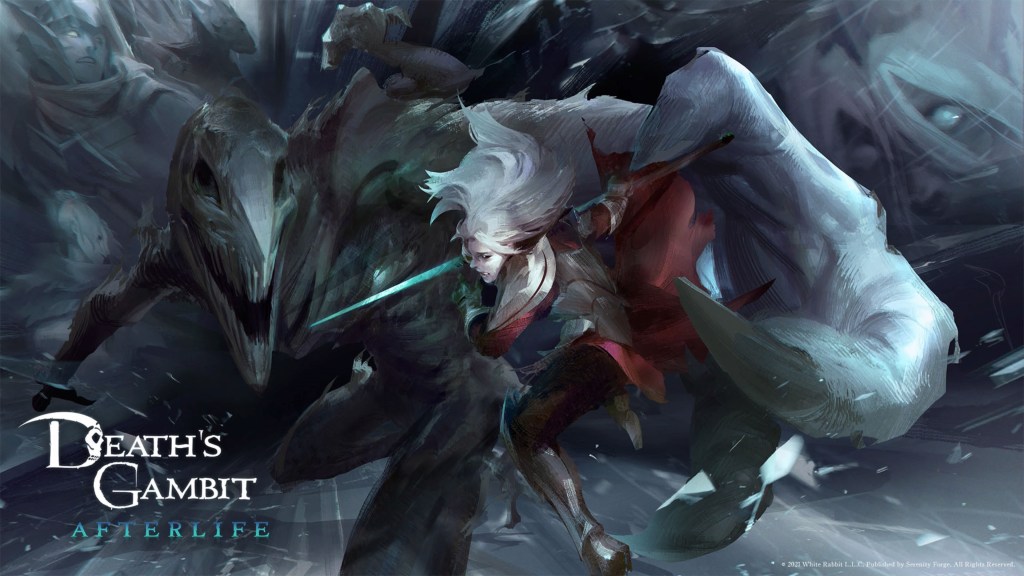
Death’s Gambit Afterlife Got Me Thinking about the unlikely benefits of streamlined genre conventions.
Remember when Vas hit us with the ol’ proverbial definition of insanity in Far Cry 3? He eloquently claimed, “insanity is doing the same f#!$ing thing over and over again, and expecting sh** to change. That is crazy,” which reminds me of my time playing metroidvanias, as I eventually run into a roadblock that compels me to repeatedly return to the same areas I initially accessed hours ago, desperately jumping around a suspicious section of the map, hitting/shooting the walls and expecting a secret panel to suddenly slide aside and allow entry into that hidden alcove where the next major upgrade has been hiding. When no such panel will budge, I may leave to assault some more nondescript walls on the other side of the map, but I’ll be back again, hoping the solution could ever be so barbarically simple. The risk of insanity is also present in the Dark Souls series. Who tried killing Yhorm the Giant like any other boss in Dark Souls 3 before ever considering reading the Storm Caller’s description, only to inflict chip damage on his toes? I sure did. But drawing out a Dark Soul’s player’s senseless tenacity isn’t only exemplified during such gimmicky encounters. Several bosses relentlessly bash us back to the bonfire over and over in the exact same fashion before we think to change our strategies or loadouts, convinced by nothing tangible that our provenly non-optimal build will randomly suffice on the next run or the subsequent twelve runs after that. Now, if we accept that Vas’s definition of insanity is a likely side-effect of both metroidvanias and Dark Souls, then what happened when I played a metroidvania soulslike called Death’s Gambit Afterlife? Did I go doubly insane in my frequent searches for cryptic puzzle solutions and recurring defeats against overwhelmingly difficult bosses, reduced to a drooling husk of a clueless, headstrong gamer? Well, despite getting stuck in the occasional loop of trial and error, I was fortunately able to retain a sound mind during my playthrough of Death’s Gambit Afterlife. That’s because of the balance between genres that developer White Rabbit deftly establishes throughout, preventing the game from becoming a “hardcore” example of either genre, which results in a refreshingly consistent pace of enjoyable gameplay and exploration that never feels disappointingly “watered-down” or half-committed.
Before I go on, it’s important to note that while Death’s Gambit originally released in 2018, the Afterlife expansion was permanently attached to the game in 2021 to create a revamped version of the experience including new bosses, locations, weapons and more. Because I don’t have any first-hand knowledge of what Death’s Gambit was like without the expansion, I’ve chosen not to get caught up in describing the differences between the game’s debut and its upgraded counterpart, opting instead to give my thoughts on the only version I am able to play.
Death’s Gambit Afterlife tells the tale of a defeated militant leader named Sorun, who must make a deal with Death on his quest to recover his lost mother from the unknown consequences of a failed expedition dedicated to destroying the source of immortality hidden away in an ancient kingdom known as Caer Siorai. Apparently, Death doesn’t have the decency to restore the deceased Sorun’s mortal appearance, so he battles through hostile armies with cold blue skin, as if permanently hollowed like any number of clumsy, non-resourceful Ashen Ones. Sorun does indeed feel clumsy at the beginning of the game. After being immediately prompted to select one of seven classes based on weaponry and playstyle at the outset of their postmortem adventure, players will realize that blocking and dodge-rolling are their primary defensive tools while simple, somewhat sluggish combos mapped to only one button are the extent of their offensive capabilities. This perception could in part be credited to the Noble starting class that I selected, which equips Sorun with a halberd and is described as suitable for those who prefer “slower and strategic gameplay,” but even so, Sorun generally controls in a way that resembles the patient Penitent One from Blasphemous more closely than the zippy, head-hopping Hollow Knight, at least at the start.
Consequently, the game’s first few boss battles follow the same structure as early boss battles in soulslikes:
Dodge.
Strike.
Wait for stamina to recharge.
Repeat.
Ione, a high-pressure spearwoman halting Sorun’s progress near the outset of the game, sent me back to the grave in a matter of seconds. However, as the game goes on, more abilities and techniques are unveiled, giving Sorun less excuses for defeat at the hands of his opponents. For instance, there is a perfect block and a parry, meaning there are essentially two parries. The perfect block is activated by throwing up Sorun’s shield just before an attack lands. Upon success, the enemy will become briefly stunned, giving Sorun the chance to land two slashes for free damage. The official parry is more deliberately performed by first blocking, then pressing the action button as an attack lands. Sorun swipes his shield from side to side, rebuffing an incoming weapon with enough force to daze the wielder and subject them to a powerful counterattack that can substantially heal Sorun, while also eliminating a more significant chunk of HP from the enemy than is granted by the follow-up to a successful perfect block. Each method has its advantages and disadvantages based primarily on speed and power, but when used together, many of the bosses’ movesets become hopelessly porous. Faster attacks are handedly deflected by perfect blocks while premeditated aggression falls victim to the parry (with enough practice, of course). Many boss encounters are initially challenging, but I never felt forlornly dominated or dejected upon death, as I had so many tactics at my disposal with which to turn the tables, unlike my first ten or fifteen attempts against, say, Nameless King in Dark Souls 3, where I kept getting body-slammed by a dragon I couldn’t see, and/or impaled by a ridiculously delayed attack that I could never hope to parry and could barely manage to roll away from (still a great fight, just frustrating and demanding).
In addition to Sorun’s defensive maneuvers, special offensive abilities also foster the flow of battle. On his journey, Sorun can find, earn and purchase different abilities that are typically tied to a specific weapon type, like chucking a hatchet through the air that spins in place for a few seconds, grinding health off whoever or whatever is caught in its radius. These abilities cost soul energy, which is generated by inflicting damage onto enemies. The numerical value of soul energy and the numerical cost of each equipped ability (players can choose three at a time, and later four if they dish out the required skill points to unlock an extra slot) are always shown, but once soul energy is gained, it immediately starts ticking back down to zero. I always appreciate game design that promotes action over stagnation, and that’s exactly what soul energy does here, as players are pressured to continue engaging with each boss for a chance to chain together more harmful blows, resulting in an overall faster pace than I anticipated based on the game’s description.
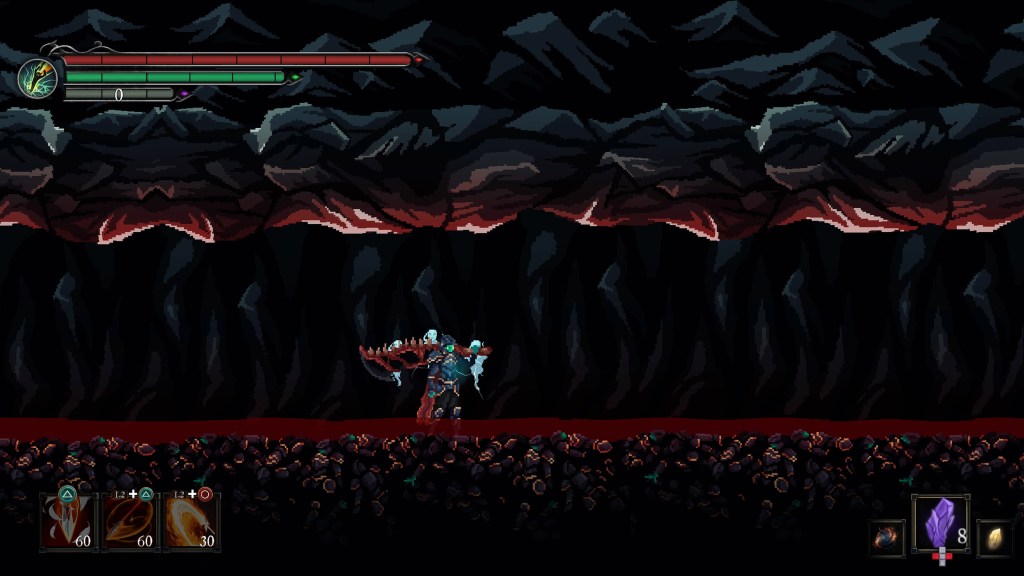
Death’s Gambit Afterlife also incorporates a staple in any RPG: creating a unique build by favoring different statistics. White Rabbit decided not to be so strict or stingy over how scaling and leveling works. Each weapon I used throughout the duration of the game scaled with only one stat, so I continued to inflate that stat (Strength) with the leveling currency (shards) that I had accumulated. Because I wanted to get the most damage out of my weaponry that I could, I ignored the spell-enhancing Intellect and dexterous, dagger-friendly Finesse, reducing an already small list of six stats to just four practical options, including Vitality and Endurance. Haste seemed useful for its cooldown reductions on both abilities and stamina, but I probably could have gotten away with ignoring that too, in retrospect. When it came time to allocate shards, I was never at a loss. The right choice was always a simple one, which may disappoint RPG enthusiasts who prefer to carry out complex calculations when determining just how effective a certain piece of gear will become alongside x value of x stat, but I quite enjoyed not being held up by lengthy deliberations every time I had taken enough lives to make mine easier.
Gone too is the soulslike stress of losing an abundance of currency after stumbling into an inevitably deadly situation that should have been saved for later. Shards absorbed from enemy corpses are not lost upon the player’s death. Instead, Sorun will drop a plume (this game’s magical healing item) in the exact spot he expired. It’s then up to the player to return to that spot and reclaim the lost plume. Otherwise, shards can be spent at any shrine to reclaim plumes. Conceptually, this is a neat idea that could theoretically see players dig themselves a hole that only success in combat can pull them out of, but in practice it’s all too easy to rush back to the spot you died and quickly snag the floating feather before being thrust into any immediate danger. Therefore, the plume-dropping mechanic becomes just another reason why Death’s Gambit Afterlife isn’t nearly as unforgiving as what gamers may come to expect from a soulslike title. In my eyes, creating a more capable protagonist and trimming the leveling system was a smart way for White Rabbit to avoiding plainly copying other genre entries while encouraging players to keep pushing past the snags in their progress with the promise of rewarding results. Maybe I’ve simply played too many soulslikes so similar in nature that I’ve lost some patience for the genre, but feeling confident in my odds against most bosses (even after a few deaths) was quite refreshing.
Hold on there, masochists. Don’t go anywhere just yet. While skilled players going straight through the story probably won’t be getting dropped like a bag of bricks on a loop by each big bad, Heroic Rematches become available upon Sorun’s initial victories. These rematches can be activated at any time, though level recommendations are included as fair warnings. The heroic iteration of each boss is significantly more powerful, including a few tricks up their sleeves. Soul of the Phoenix, a ferocious, fiery entity that twirls weapons akin to Kratos’s Chaos Blades over her head that can be difficult to parry, jumps directly into what had once been her second-phase form, complete with the capability of inflicting a nasty status ailment that greatly reduces Sorun’s healing effectiveness for a few seconds. To make things more hectic, Soul of the Phoenix splits into two Souls of the Phoenix during the last leg of the battle, which made my eyes get wide and my health bar get narrow. Completing Heroic Rematches will reward players with unique items/weapons, as well as a big chunk of shards to spend at a shrine or shop. Its’s a great way to provide more daring players with a non-mandatory test of skill and patience that will result in their mastery of the combat as well as a bigger, better arsenal.
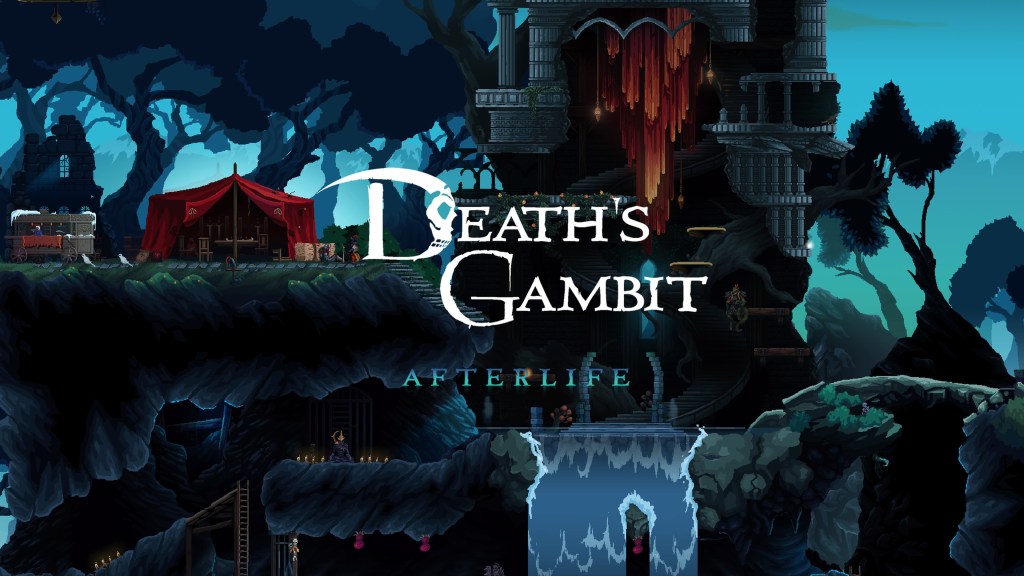
As for the metroidvania aspects of the game, Deaths’s Gambit Afterlife provides a substantial amount of satisfying exploration that never comes to a screeching halt, as alternate paths and not-so-secret solutions to potential dead-ends keep things moving. Muted blues, greens and oranges bring the beautiful pixel art to life like a surrealist painting, and soothing tunes straight out of a Legend of Zelda title charmed me from the beginning. I’ve always believed that the right atmosphere can make any kind of game worth playing, and that sentiment is especially true for metroidvanias, where backtracking through the same places is such a core part of the experience that those frequently revisited areas must be built on absorbing artistic direction. The outdoor segments of Death’s Gambit Afterlife shine brightest, as snowy mountain ranges provide the backdrop to mystical, melancholic forest paths.
While the map is sizeable, it’s not gigantic. I finished the game after 15 hours, half the time it took me to complete Hollow Knight. Had fast travel between shrines been an option earlier in the game (the mechanic is unlocked only a few hours before the end, or maybe a bit sooner depending on the order of objectives you complete), then a couple of hours could have been shaved off my final time. I’m not complaining. It’s a popular opinion to criticize games based on how many hours they provide during their base campaigns, but I’ll always prioritize consistent enjoyment over drawn-out dawdling. Therefore, the number of hours a game lasts isn’t indicative of its value, as developers like Ubisoft have proven by giving us the same recycled gameplay over the course of 100 hours to justify a price tag. So, while Hollow Knight’s 30 hours (more like 120 since I beat that game several times) never had a dull moment, Death’s Gambit Afterlife doesn’t deserve a penalty for its shorter runtime. If the game had gone on for double the length but with half the quality, I’d have walked away from the experience with the resolve to never go back. Luckily, that’s not the case, and I look forward to entering a cycle or two of new game plus in the future.
Death’s Gambit Afterlife isn’t necessarily a sprawling epic. Progression isn’t gated by wildly abstruse puzzles, so Sorun’s quest develops at a relatively brisk pace. Bosses are difficult yet fair, and with the tools at his disposal, including a perfect block, parry, dodge-roll and air-dash, Sorun is a match for any antagonist, big or small. I experienced many of the metroidvania and soulslike tenets without drowning in them. Although my sleeves were rolled up for a more hardcore side-scrolling RPG, I ended up being grateful for several subtle formula changes which streamlined the game just enough to preserve momentum, making for a graceful journey that I’ll certainly return to.
 GotMeThinkingGames
Leave a comment