When Rise of the Ronin was announced, I knew I’d be picking it up at full price, as I’ve been an avid Team Ninja fan ever since my first foray into Nioh (I missed the boat on Ninja Gaiden, but I might pick up the collection someday). However, the core design feature that most notably sets this game apart from its siblings is its open-world status, which differs greatly from the one-by-one level system in Team Ninja’s other recent titles. Over the years, I’ve begun to scoff at open-world games for their presumptuous nature. I’ve grown tired of developers expecting me to settle for tedious, recycled activities to prevent boredom as I venture through a limitless world with beautiful scenery and not much else, where compelling gameplay goes to die (even though it’s apparently more immersive and “realistic” to run around aimlessly for hours on end). With that being said, I’m not one to outright refuse playing a game from a genre I don’t typically gravitate towards, I simply need more of an X-factor to pull me in; a genuinely interesting reason to defy my better judgement and give it a try. The X-factor in this situation is Team Ninja and their combat design. After enjoying several consistently entertaining and enthralling experiences, including the masterful Nioh 2, I’ve grown to trust the developer, though their latest release has been built around dated concepts regularly seen in mainstream releases like Assassin’s Creed, making for a bigger, not always better, blend of loot-grinding, exploration, parrying, stance-switching, and dialogue trees. Does Rise of the Ronin sink beneath the weight of so much fluff, or does it ultimately take Team Ninja to new heights? I’m here to discuss.
Life got in the way of this one. I intended to release this review closer to the game’s debut, but to fully grasp the intentions of Team Ninja in terms of world-building and combat, I ended up needing an entire 62-hour playthrough, including the acquisition of my 37th platinum trophy (which I proclaim with some sort of deformed pride). Properly interacting with each mechanic in Rise of the Ronin felt like looking for seashells on an infinite shore; finding all sorts of shiny vessels with eye-catching patterns and occasionally stepping on a sharp shard of crustacean carapace that caused me to profanely yell in pain. In other words, there are a lot of ideas beneath the surface that would be impossible to engage with had I rushed through the story, yet not all these ideas result in favorable reception. We’ll start with the element of the game I was most skeptical of: the open world.
Before playing Nioh for my first time, I was under the impression that it was intended as a Dark Souls clone with faster gameplay, but after interacting with FromSoftware’s skillfully interconnected level design, I was mildly disappointed to learn that Team Ninja didn’t follow the same script, choosing instead to provide linear, small-scale stages that could be selected from a hub rather than organically traveled to. As I played, I ironically began to realize just how important of a change this really was for Team Ninja to stand out, as it streamlined the action and looting in a way that added an addictive, arcade-style edge to the game. Now, we have neither clever interconnectivity nor high-octane pacing. Instead, Rise of the Ronin recreates late nineteenth century Japan for players to wander within, accepting missions that are usually carried out in places you may have already tread before finding the matching quest, complete with warnings to return to the mission area if undisclosed boundaries are exceeded. While I can admire glimpses of Mount Fiji in the distance at dawn, there is no denying that realism and Team Ninja aren’t the greatest pairing. Lots of downtime will be spent on a horse, traveling 600 meters through lush landscapes toward the next objective, stopping a handful of times along the way to open a treasure chest, kill a couple of samurai rejects who put up little resistance, pet a cat, take a photo, or pray at a shrine. I’ve done these activities before, or at least slightly different versions of them. Many years ago. It got old then. It gets old now. It’s not long before I rub my eyes and wonder where the time has gone. But I’m not thinking, wow, this game is really pulling me in. More like, where did the last three hours go?
Even though Rise of the Ronin’s filler activities are optional, they are still filler. Where 2023’s Wo Long: Fallen Dynasty was able to beneficially complicate level design by adding more verticality and hidden battle flags to find and capture, Rise of the Ronin chooses to place shrines (that award skill points upon discovery) and treasure at random and easily accessible spots on a giant map, allowing players to earn bonuses without having to work for them, which makes it feel like padding, not priority gameplay. Another typical defect of the open-world formula pops up in the form of side-objectives called public orders. Some areas will contain an enemy presence that must be eradicated to restore harmony for the surrounding civilians. These tasks function the same as clearing bandit camps in the Far Cry series. The problem is, public orders are hands-down the most entertaining optional activity in the game, just like clearing bandit camps were in Far Cry, as they force the player to engage with another slightly remixed version of Team Ninja’s trademark combat (more on that soon). “But Jayemg,” you may be asking, “how does that make it a problem?” I’ll tell you, grasshoppers. The juxtaposition of public orders and, say, taking photographs of famous landmarks for XP, highlights the faults with Rise of the Ronin’s exploratory gameplay. It’s simply a palette cleanser that very rarely felt preferrable to fighting enemies. This means there is a huge imbalance in the value of all available pursuits, and I often found myself eagerly sprinting toward the next public order, as all I really wanted to do was “play the game.” Of course, having earned the platinum trophy means I achieved 100% completion in the side content, so it isn’t torturous, rather repetitive and stale, just like it would have been in 2014. The game needed more distinctive implementations of these cloned tasks to keep them fresh. One of the best ideas Team Ninja could come up with, for example, is adding calico cats to cat-collecting. There is a character in the game who takes great pride in her feline friends, and tasks the protagonist with finding every stray cat in Japan. Calicos are the only breed that will sense the player approaching, to then get spooked and run off before you can pick it up and give it pets. But this isn’t exciting or challenging. It feels quite pointless, especially since players can simply run 50 meters away and wait for the cat to quickly respawn for another try. What if some of the cats were to randomly spawn into an enormous demon that pursued the player across the map until it was defeated? Unfortunately, the mythical ingredients from Nioh and Wo Long have almost entirely disappeared in favor of a more grounded historical experience, so that’s not an option.
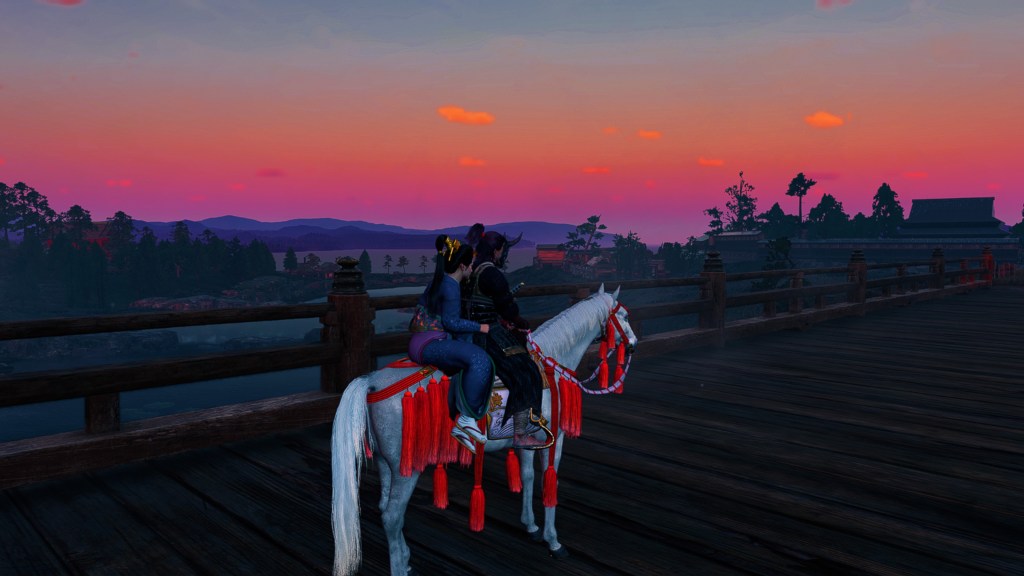
To give credit where it’s due, Team Ninja did add a few welcome features that prevent the open world from feeling like way more of a slog. First, there is a hang glider obtained relatively early into the game which greatly influences the ease of traversal, as well as a convenient grappling hook that allows players to quickly access rooftops as they navigate through Yokohama, Edo, and Kyoto. Also, mounting your horse doesn’t cause an annoying delay, as blowing the horse whistle will send your steed steamrolling into the frame, causing the protagonist to swiftly jump into the saddle without losing any momentum. I know we’re only talking about a couple of seconds here, but hey, those seconds add up. I appreciated being able to remain sprinting while I called for my trusty stallion. You can even do so while gliding. As you approach the ground, the horse will appear, and your character will do a mid-air front-flip directly onto its back. Unfortunately, this doesn’t always work quite as intended, since the horse can sometimes glitch, causing it to either not arrive when beckoned, or run wildly back and forth like it just saw a king cobra come slithering toward it. A similarly small but noticeable quality of life enhancement is the fact that while guiding the player toward an objective, NPC’s will sprint ahead whenever the player does, always maintaining a slight lead. This prevents such time-consuming loops of running in circles, desperately waiting for characters to hurry the hell up during escort sequences, as is so common in something like Assassin’s Creed. Overall, there is a subtly welcome flow to Rise of the Ronin’s traversal that eliminates a notable degree of potential tedium.
While I remain unconvinced that open-world games provide superior moment-to-moment gameplay than captivatingly condensed adventures, Rise of the Ronin began to reveal its best aspects once the combat and story heated up. The prologue of the game introduces us to two Blade Twins. Both characters are customizable, but only one of your choosing will be playable, while the other acts as an antagonist for the duration of the game. The Blade Twins are shadow-lurking trainees of the Veiled Edge, a group of violent rebels opposing the current shogunate’s willingness to potentially trade and cooperate with the west. As American steamships begin swirling around the Japanese coast, seeking an alliance with the samurai, the Veiled Edge and other rebellious forces gather to prevent the shogunate from accepting foreign terms and potentially sacrificing the cultural identity of their nation. There is also a British presence on the island country, large enough to result in the construction of embassy buildings. Whichever Blade Twin is chosen by the player will become a ronin on their own independent quest to decide whether the pro or anti-shogunate forces deserve support.
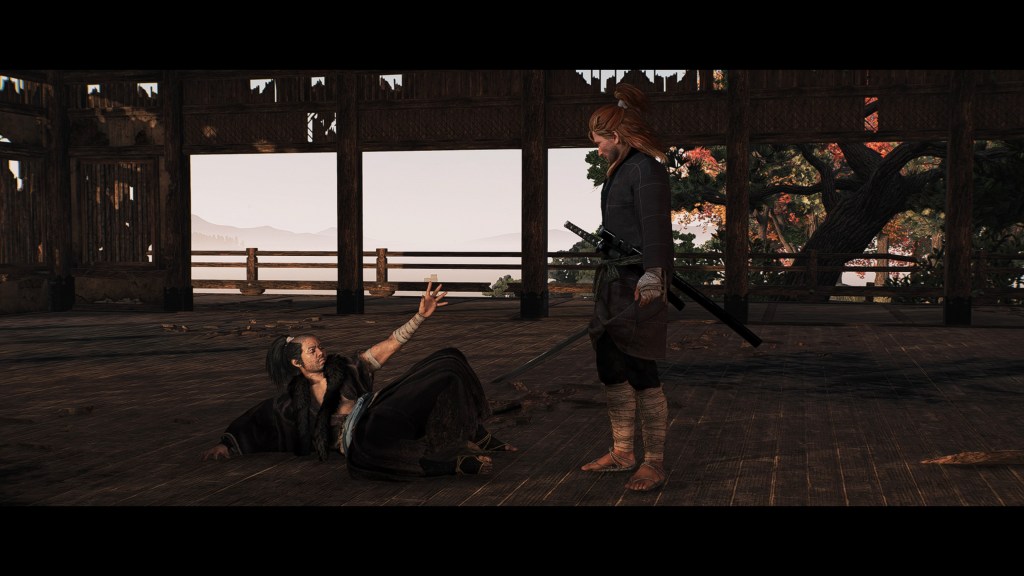
The scene is set for a classic tale of rebels versus overlords, as seen in Star Wars and countless other stories, yet here the lines are blurred as to which side will truly preserve peace in Japan. The shogun himself isn’t vilely corrupt like Palpatine, nor do the rebels always exhibit the mercy you might expect from freedom fighters. Player agency and allegiance is portrayed through Rise of the Ronin’s bond system, which allows the protagonist to build relationships with characters on both sides of the coin. Some of these bonds are contained within brief interactions, while others last throughout the duration of the game, like the relationship established with Ryomo early on, another friendly ronin whose intentions remain pure throughout. Major characters like Ryomo come with their own sets of bond missions, or optional quests that increase the strength of your companionship upon completion. Forming and fostering bonds with certain characters will also provide the player with specific rewards like the special weapons they use and armor they wear. Main missions will allow you to take up to two allies along for the ride, which increases your mutual loyalty to another and leads to similar benefits. To shortcut some of the legwork it’ll take to get on somebody’s good side, players can find and engage in conversation with whoever they have already encountered, choosing to offer gifts as a means of getting closer to the next phase of friendship. The progression goes like this: Acquainted, Friendly, Inseparable, and Fated.
Before I go into how the bond system affects combat, I want to focus on how important it was to my overall investment in Rise of the Ronin’s epic tale of trust, treachery, identity, ambition, and unity. There is a continuous influx of optional connections to be made that offer new perspectives and progression paths. I didn’t expect so many bond-eligible characters to be introduced, but they just kept coming. Admittedly, the fact that rewards are tied to the development of these bonds is what initially convinced me to see some of them through, as I was prepared to surrender to the expected reality of getting somewhat lost in such a sprawling story (like I did during the Nioh games), and therefore didn’t worry too much about understanding every plot point. However, the more figures I met and bond missions I embarked on, the more I found myself consulting the pause menu’s encyclopedia and detailed timeline to better understand the aims of who I was dealing with. I grew to appreciate the ambiguous nature of the game’s central conflict. It was oftentimes difficult to tell who was right and who was wrong as I jumped back and forth, playing both sides, and I had fun picking my favorites to root for. It helps that while the game spans several years, the story is relatively direct. There are no extreme leaps in time or offscreen alterations to the cast. Many minor bonds don’t make much of a difference in the grand scheme, nor do most conversations with optional dialogue, but I appreciated the ways in this mechanic influenced my experience with the story and gameplay.
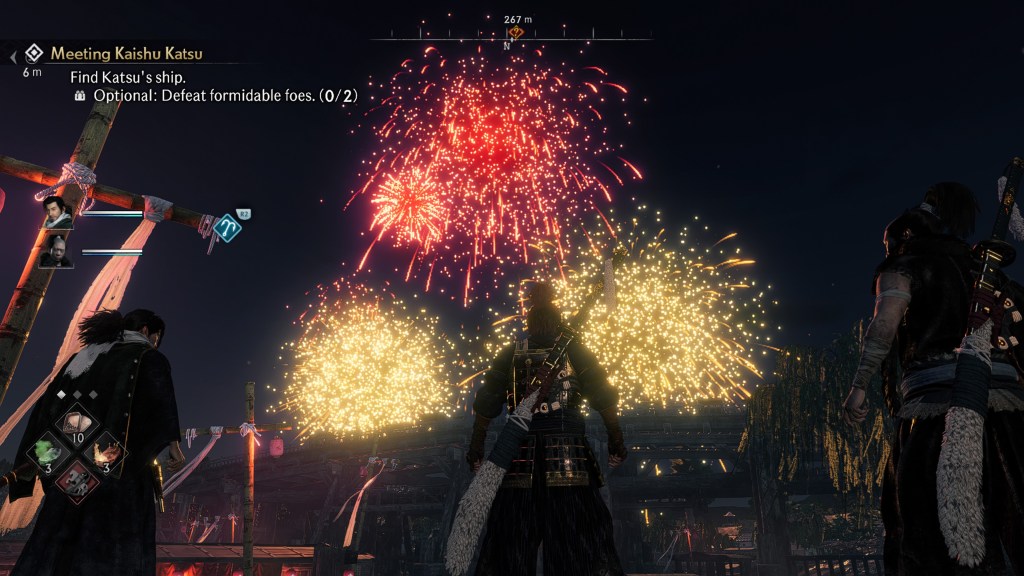
The sacred techniques of the disciplined samurai are what give such warriors a legendary status as adept swordsmen. In Rise of the Ronin, there is plenty of passing down when it comes to such creative and powerful arts. The promise of brand-new attacks, or new functions for attacks available by default or previously unlocked, is the best incentive Team Ninja could have offered to push players toward investing in their relationships with so many characters. Ryomo, the ronin I mentioned earlier, uses a katana as his primary weapon. Therefore, as your friendship blooms, you’ll be able to gain access to some of his nifty tactics with the classic samurai blade. But the well of weaponry goes far deeper. There are also dual blades, oxtail blades, odachis, greatswords, spears, polearms, British bayonets and sabres, as well as good old-fashioned fists. My two favorites turned out to be the katana and odachi. Each weapon can be used with one of four stances: Chi, Jin, Ten, and Shinobi. The effectiveness of these stances will depend on which weapon an enemy is using, so fighting a group of three or four will require the player to switch between their weapons and stances on a moment’s notice if they want to take advantage of optimal damage, a requirement made easy with Violent Gale, a mechanic activated by holding R1 and flicking the right analog stick in the direction of the appropriate stance you want to switch to. This will cause the protagonist to swiftly spin into a new discipline mid-combo, then continue pummeling their next opponent. While stance-switching is taken right from the Nioh games, it has been further developed to promote longer, more ferocious combos. Due to these intricacies, fully mastering even one weapon could occupy players for hours on end, especially because accessing each special ability requires interacting and cooperating with corresponding allies, a time-consuming task that requires carrying out various missions, gift-giving, and doing battle in the dojo. Remembering how each weapon functions between stances will also take a lot of practice, as one weapon can often feel like three or four separate weapons from other RPG’s blended into one.
When I reviewed Wo Long last year, I defined it as a marriage of Nioh and Sekiro: Shadows Die Twice. Rise of the Ronin feels even more deserving of this designation. Mastering deflections will be vital to your enjoyment of the combat. I selected Twilight difficulty for my entire playthrough, the most challenging option before beating the game and unlocking Midnight, so the following judgements may not be as relevant on lower settings, but there came a point in the game where I realized how disappointingly rare it was to remain entrenched in a flow state. While I conceptually like the fact that Team Ninja sets high standards for deflections, as mistiming one will cause a delay in player mobility, during which the opponent can potentially trap you in a deadly sequence, the long recovery window can feel like an unnecessary blow to a battle’s momentum. I’ve seen some complaints in the past regarding Sekiro’s allowance of deflection-spam, but I do think that game offered players a better chance to stay in the fight while they learned how to attain a more rewarding rhythm, even if it was some sort of psychological trick. Let’s be honest, no one is beating Isshin (or any other boss for that matter) by haphazardly mashing L1. That’s clearly not the way FromSoftware intended the game to be played, which is reflected in the potential growth of player skill as the game goes on. It’s also worth noting that Sekiro did away with a stamina bar, something I think Rise of the Ronin could have benefitted from.
Many bosses will use cheap tactics to gain the upper hand, like delaying the final move in an otherwise rhythmic combo, or powering through your attacks without losing any poise at all. Failing at deflections during an opponent’s onslaught will certainly see you take chunks of damage that requires a reset to rectify, and trying to dodge them all will most likely leave your character gasping for air, ready for death. Even if you properly deflect a dangerous strike, enemy stun periods are so brief that by the time you’ve input a chain of counterattacks, it’s too late to bounce back and defend yourself from a super-armored foe’s swift retaliation. Make no mistake, every boss has super-armor. This doesn’t mean the game is unfair or too hard. In fact, I died far less than I remember perishing in Sekiro, Nioh, or Wo Long, especially thanks to help from allies and numerous wide-open areas that provide space for a temporary escape and health replenishment, but the sense of perceived confidence coming from an occasional accidental deflection is considerably lower, and some of the fun goes missing whenever you’ve been tricked into a fast-paced skirmish that turns out to be filled with unnatural delays. The way I ended up adapting to the demands of the combat was to avoid deflecting every attack, as tempting as it may be, and saving it mostly for block-breaking red attacks that are more aggressively rebuffed. That way, the number of attacks that I absolutely had to learn became greatly reduced, and I could focus mostly on punishing my enemies. But because the game is already less difficult by design than its peers, doubling down on something more akin to a traditional hack ‘n slash may have been the better route for Team Ninja to take.
I commend Rise of the Ronin’s deep combat system, and I did have lots of fun adjusting to the functionality of various weapons and stances. However, the system put in place is so deep, and many of the bosses so full of unpredictable attacks, that even a totally thorough playthrough didn’t feel like enough to achieve the same kind of fun I was having in other similar titles at an earlier point in their relative runtime. I’m willing to bet that the ceiling for Rise of the Ronin’s combat is potentially the highest Team Ninja has ever provided, but the surrounding experience doesn’t motivate me enough to linger around for another fifty hours to find out. Because of an open world without many bold creative choices, somewhat homogenous boss design, and a reduction in the colorful, crazy flavor brought to mythology-based games like Nioh and Wo Long, this may be my least favorite Team Ninja title so far. Still, I enjoyed Rise of the Ronin and can recommend it to those who enjoy challenging RPG’s that take place in an expansive world. There are multiple difficulties to try and tons of progression to pursue. I’m left pleasantly surprised with how interesting the story turned out to be and how invested I became in the growth of character bonds. There just isn’t much here that Team Ninja hasn’t already proven they can do.
 GotMeThinkingGames
Leave a comment