
Intro: The Beat Goes On
I sit down at my desk to write my latest review, a hot cup of chai tea beside my laptop. As I consider how to begin, I watch the cursor blink. . . blink, blink, blink, blink. Impatiently hoping to stir up some content, I tap my foot a bit faster than the cursor, filling in the empty beat between each blink. Tap, tap, tap, tap, tap, tap, tap, tap. Outside, a delivery truck that overshot its intended address starts backing up. Beep (tap, tap, tap) beep (tap, tap, tap) beep (tap, tap, tap) beep. Distracted and in need of more artificial brain juice, I take a tentative slurp of steaming tea. Beep (sluuuuurp) (tap, tap, tap). I contemplate whether I should I just come back later and try again. After all, it’s a beautiful day. The sun is shining, birds are chirping. . . chirpchirpchirpchirpchirpchirpchirpchirp beep (sluuuuuurp) (tap, tap, tap). Wait a second. . . is it possible that this cacophony of random sounds could be so accidentally rhythmic, or is that perception simply a side-effect of my time spent playing Hi-Fi Rush, a stylish hack n’ slash developed by Tango Gameworks, filled to the brim with crunchy riffs, exploding robots, vivid animation, and crowd-pleasing humor, published by none other than Bethesda Softworks? Yeah, it’s probably a side-effect, which is a bit inconvenient when it comes to typing each word to the beat. Oh, man, this is going to take forever.
Verse 1: The Set-Up
A groovy prologue introduces players to Chai, a young wanna-be rockstar who has decided that a little artificial assistance is exactly what he needs to achieve his dreams of being on the big stage. Therefore, he visits Vandelay Technologies’ state-of-the-art facilities to become the latest recipient of a robotic arm capable of shredding face-melting solos under Vandelay’s advanced prosthetic limb-giving initiative dubbed Project Armstrong. “Lonely Boy” by The Black Keys kicks off a montage of Chai being transported around the factory like a leaf in a monsoon, at the mercy of myriad machines. But something goes wrong. Chai indeed receives the arm he came for, but soon finds that the music player he brought along has somehow become lodged within his chest like Tony Stark’s arc reactor, thus imbuing Chai with the power of the beat. Unfortunately for Chai, this also causes him to be labeled a defect that must be destroyed. It’s clear that the real Vandelay Technologies is not the humanitarian company that has been marketed to the public, but something far more sinister. As he attempts to escape from the enormous facility, Chai discovers that his new arm is far more powerful than flesh and bone, with the capability of sprouting a magnetized rod that attracts gears and bits of metal from his industrial surroundings, forming a swingable weapon in the shape of, you guessed it, a rad electric guitar. Once Chai is confronted with Vandelay robots who show no signs of relenting to a hideous defect, he’s got no choice but to do what he does (or thinks he does) best: rock n’ roll. . . n’ smash. . . n’ not die.
He’s not alone. Chai will meet allies along the way, including Peppermint, a mysterious and sarcastic insider hiding out in the factory. She’s determined to uncover Vandelay’s sinister secrets, even if it means she must enlist a clumsy dreamer like Chai to help her out. Her initial purpose is to guide Chai through the massive premises, using a floating, robotic cat called 808 as her eyes and ears. The unlikely pair bicker back and forth as Chai is tasked with completing lengthy platforming segments, broken up by several fenced-in battles at pre-ordained intervals. Following this linear formula, Hi-Fi Rush gradually develops its gameplay and plot in a way that refreshingly reminded me of classic PS2 era games like Sly Cooper and Ratchet and Clank. It’s direct and done well.
Verse 2: The Music
I probably don’t talk about videogame soundtracks as much as I should, because a great list of memorable melodies carefully calibrated to convey a specific self-contained mood can easily elevate an experience from “just okay” to “will replay.” But the value of gaming music doesn’t have to be limited to its role in the game itself. I can’t even count how many times I’ve fallen asleep to the soothing yet somewhat unsettling Save Room Theme from Resident Evil, which perfectly translates the weariness of stranded S.T.A.R.S. members taking a breather in the Spencer Mansion, or the number of jogs that have been fueled by the Cartridge 1987 remix of Echo Basin from Rollerdrome. If I want to sit around in the darkness and reflect on the meaning of the universe (perfectly normal), I won’t hesitate to allow Hyper Light Drifter’s haunting Disasterpeace composition to hypnotize me with all its saturated spikes of synth rising up above creepy percussion and ambient piano accompaniments. But there’s never been a more appropriate time in my last year as an independent gaming burnout. . . I mean blogger. . . to speak on music than right now. After all, Hi-Fi Rush is the first bona-fide rhythm game I’ve chosen to review.
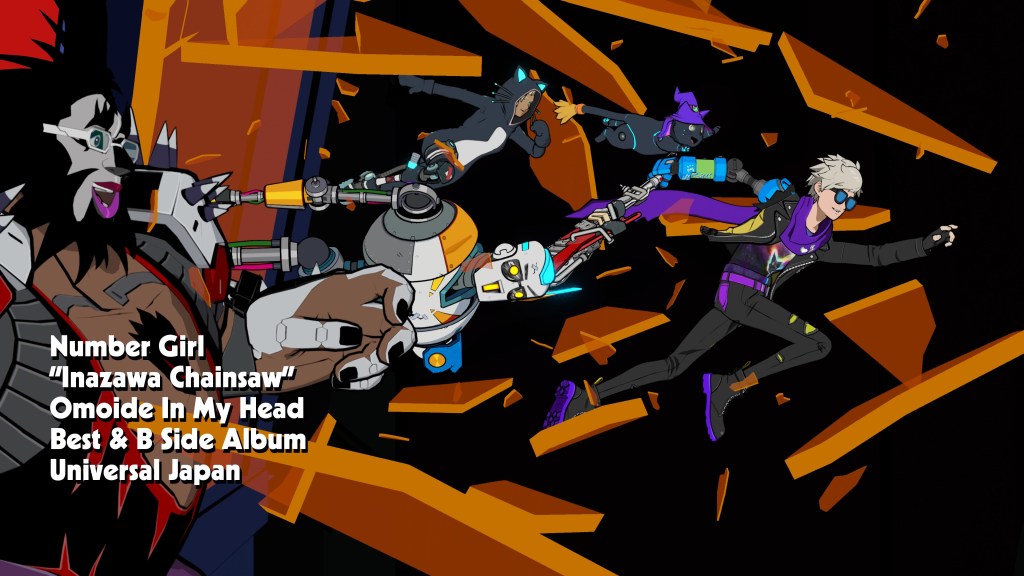
I was pleased to find out that most of the OST is composed of Hi-Fi Rush originals. “Lonely Boy” serves as a great start to Chai’s adventure. Getting players on board with a familiar bop was a good move by Tango Gameworks, but I feared there may be too many licensed radio hits from then on, turning the game into an EA sports main menu. However, the top-notch work done by Shuichi Kobori, Masatoshi Yanagi, REO, and The Glass Pyramids, featuring John Johanas and Kayla Brown, underpins the gameplay for most of its runtime. This makes sense, as the collection of consistently steady tracks seem deliberately designed to synchronize with Chai’s actions. Therefore, the refrains are satisfyingly simplistic rather than distractingly complex. Take “Heatwave” by Shuichi Kobori for example, which opens with catchy electric guitar chords straight out of an early KISS record. Consequentially, some of the rock tracks can begin to blend from level to level, though they always perform their primary function, which is to preserve momentum and never annoy. Then there are palette cleansers, such as “Through the Halls of History,” a jazzy, upbeat tune featuring trumpets and bongo staccatos. There are of course other tracks tied to specific set-pieces, especially boss battles. Without giving away too much, a certain symphonic remix served as the main reason why one of the boss fights almost immediately clinched its spot as my favorite.
Enhancing the immersion were numerous environmental responses to the perpetual beat. Steam pipes bulged in time to the bass, steam vents spit up cymbals of smoke. During an underground level including volcanos, volcanic rock erupted to create muffled percussions. Whenever Chai dashes forward, a hi-hat sounds, allowing players to contribute to the active track by dashing in different sequences up to three times in a row. This became so addicting that I almost exclusively dashed through stages instead of ever bothering to quietly jog. On that same note, Chai’s jump and double jump cause an electric guitar to be strummed once or twice. Combine dashes and jumps and Chai becomes his own one-man band! Overall, Hi-Fi Rush is built on a solid OST that Tango Gameworks skillfully incorporates into the gameplay at every moment.
Chorus: The Combat
During combat, players are incentivized to scrap robots as efficiently and creatively as possible by receiving letter rankings ranging from the coveted ‘S’ to the dreaded ‘D’ (which factor into rewards earned), as seen in numerous other hack n’ slash action games. There are three categories that determine the grades at the end of each battle, which are later averaged at the end of each level to produce one final grade. These categories are “Score,” referring to the number of points gathered by maintaining unbroken combos, “Just Timing,” which measures how well-calibrated players are to whatever song is currently playing, and the self-explanatory “Speed.” At the beginning of the game, I had flashbacks to my math teacher handing back our exams in high school, a big red C circled at the top of my paper full of nonsensical equations and random doodles scrawled in the margins. Then, I would shrug and think, math sucks. But now, as a grown man who takes way too much pride in my ability to dexterously press buttons, I was disgusted by seeing so many C’s. I was. . . C-sick, if you will. As a result, I was forced to remind myself that I wasn’t just playing any old hack n’ slash game, but one that literally marched to the beat of its own drum. I was so used to going on a rampage of combo-mashing in, say, Transformers Devastation (one of my underrated favorites) that I had defaulted to the same ferocious pace in Hi-Fi Rush, only to be penalized for my lack of measured rhythm. Too stubborn to take advantage of the beat-tracker that can be enabled at the bottom of the screen (a nice option nonetheless), I started to let the music lead the way. That’s when the B’s, A’s, and eventually S’s started rolling in.
Chai’s list of combos contains all the standard light/heavy attack mix-ups you’d expect, but there are a few added embellishments that make the game the feel more unique than a Devil May Cry clone with a rhythm gimmick slapped onto it. After every full combo performed, a Beat Hit opportunity will automatically trigger in the form of a hollow green circle appearing on screen, encompassed by a red circle that shrinks once, twice, three times with the beat as players follow the cadence by pressing the attack button. Attacking just as the two circles overlap will result in a successful Beat Hit, dealing more damage alongside a brief visual/auditory spectacle that keeps the music front and center. Because Beat Hits require more time to pull off, players will often have to abandon them for the sake of evading incoming danger. I would have appreciated some way to prompt a post-combo Beat Hit on my own rather than wait for the process to inevitably commence. I say post-combo because there is an unlockable skill that allows Beat Hit activation without having to input any prerequisite attacks at all, but it’s not very practical. There were many times where, halfway through inputting a combo, I could tell I’d have to cancel the subsequent Beat Hit before resuming the fight. This felt like a tease that somewhat interrupted Hi-Fi Rush’s flow, but Beat Hits generally add enough impact and flare to the combat to raise its stock.
Maybe because of the game’s rhythmic demands, its fights tend to feel a bit more controlled than its ludicrous hack n’ slash cousins’. There were times where the gameplay grew close to stale, until a new addition to Chai’s abilities would swoop in at just the right moment and give CPR to my attention span. There’s Chai’s robotic arm’s grappling ability, which not only factors into traversal, but also allows for air-juggling and rapidly closing the distance, making it useful for keeping combos alive when the enemy count becomes sparse late in a fight’s duration. Speaking of air-juggling, enemies will be staggered once a semi-circle stun meter over their heads has been filled, which makes them vulnerable to successive, uninterruptible strikes and being launched toward the ceiling. I had fun prioritizing which enemies to stun first and which to temporarily ignore as I weaved my way between skinny bots with short swords and dodged distracting laser-fire from afar in pursuit of that leaping BA-BOO model I wanted so badly to get rid of.
Also, did you think there would not be a parry? In a 2023 release? Well, if that’s the case, you’d be mistaken, because the pervasive parry indeed strikes again! I’m typically a big fan of the mechanic, even if it’s become almost comically popular in recent years, a revelation that really struck me when Leon S Kennedy gained the supernatural prowess to easily deflect pitchforks with a tactical knife in the Resident Evil 4 remake. But here we have another example of why parries have become the prettiest girl at the developer dance, because Hi-Fi Rush’s is just as responsive and conducive to seamless action as many others. Here, the parry is used against enemies attacking in tune to the music, making it even more fulfilling to not simply suppress potential damage, but to do so while maintaining perfect synchronization with the soundtrack. It’s a two-for-one power-move that ties everything together and provides recourse to overwhelmed players trying desperately to achieve and preserve triple-digit combos.
Move over Ebony and Ivory, because Peppermint just appeared out of nowhere to blast robots with her plasma blasters while Chai keeps smacking the bolts off ‘em! Over the course of the game, Chai will cultivate a team of allies who can teleport in to assist him at any time, each with their own strengths and separate cooldown periods. Peppermint, with her long-range combo-extending blaster shots, was the friend I most frequently called on. There are two other characters who I won’t give away for the sake of keeping this analysis spoiler-free, but one of them can break enemy shields, while the other allows for faster stun accumulation. The latter is especially useful for the more durable artificially intelligent machines that appear in in larger numbers later in the game. Switching between allies on the fly, all while Chai keeps hammering away at the Vandelay contraptions out to kill him, allows for highly entertaining and versatile gameplay scenarios to play out.
So, while it took me a while to find my groove with the combat, I eventually became metronomic in my mass destruction of Vandelay bots. It’s not until late in the game that everything starts firing on all cylinders, as expected, which is why I’ve already completed half of a second playthrough where I haven’t had to wait to lay maximum waste. The hack n’ slash genre seems a very natural candidate for the incorporation of a rhythm element, and I hope to see Hi-Fi Rush inspired titles in the future.
Verse 3: Style and Charm
Hi-Fi Rush’s vibrant, cel-shaded aesthetic is certainly a treat for the eyes. But all the visual stimulation in the world won’t fix a bland personality. It takes smart writing, solid performances, a story to get invested in, and a heap of hand-crafted adornments to ensure the color and flash of a title like this is the initial draw for a layered adventure that sticks with those who experience it, rather than the primary selling point. It was clear from the start that Tango Gameworks didn’t skimp on making a memorably cohesive world.
The character of Chai was instantaneously likable and relatable. He’s a young guy with big ambitions that border on delusional. His constant display of reckless naivety is like watching Nathan Drake go through the events of Uncharted 2 Among Thieves without ever having visited or researched the exotic locations he visits. . . or the basics of rock-climbing. . . or how to fire a gun. . . yet he still survives! This quality gives Chai an edge as a risktaker, something offset by his geeky, awkward, and goofy nature. He’s down to try whatever it takes to escape Vandelay Technologies, and he’s supremely confident that he’ll succeed, despite running into multiple roadblocks and constantly making the wrong decisions. He’s like nerdy Peter Parker in costume as Spider-Man, only Chai’s costume is a hipster outfit complete with cuffed jeans and a scarf. The dialogue between Chai and the more mature Peppermint exhibits the latter’s reluctance to team up in the first place and the former’s reluctance to heed clear warnings and directions, making for a humorous dynamic that made me root for their eventual discovery of common ground. Robbie Daymond and Erica Lindbeck give effortlessly high-quality line delivery.
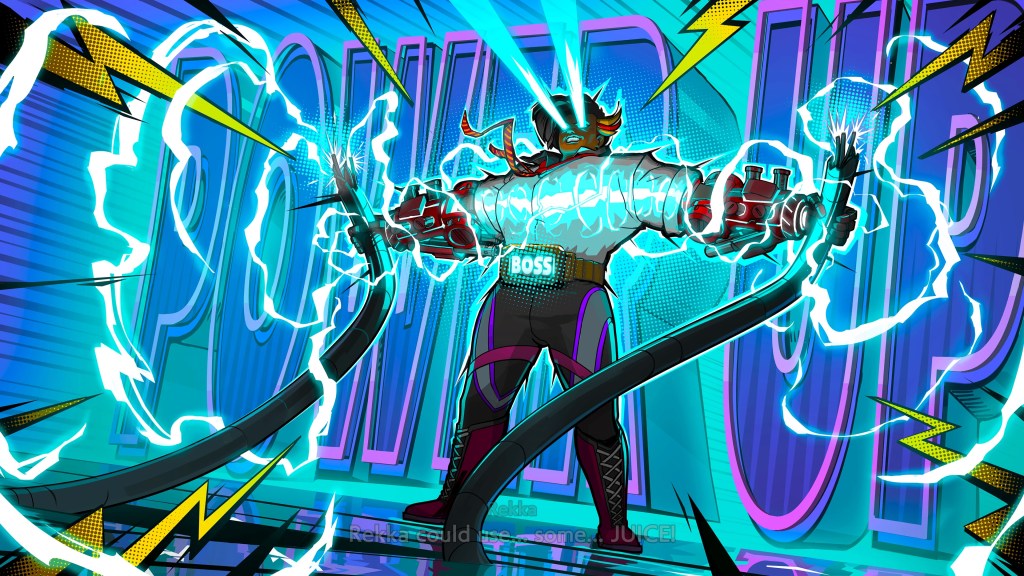
As Chai stumbles his way into a larger conspiracy during his quest for freedom, Vandelay executives catch on to the unlikely progress of their latest defect. These cybernetically-enhanced coworkers serve as the major boss fights throughout the game, which are all quite varied, including a rhythm QTE-style showdown that ditches traditional combo-inputs for a tense and measured duel that I really enjoyed. Each boss controls one sector or department of the factory. Before infiltrating these areas, Chai and his crew consult one another at their hideout (the game’s hub) and whip up a quick and never-guaranteed-to-work plan, complete with briefings that evoke the same voiceover comic book style of the Sly Cooper franchise (two Sly references in one review? Sly not?. . . see what I did there? Wait, does that count as three?). Once all of the platforms have been platformed and the battles battled, levels will culminate in boss fights worthy of a music video. Live-action intros and outros are spliced with incredibly creative and striking still images that make the case for the creation of a Hi-Fi Rush graphic novel, which always got me hyped for the bout to follow and equally hyped for the final blow. Each boss has their own distinct personality, from the abrasively aggressive Rekka to the paranoid, financially irresponsible Zanzo, leading to a lot of curiosity for what kind of wacko was going to show up next, and a lot of satisfaction when these pompous, greedy, and predatory businesspeople took a face full of guitar.
The worker-robots milling around the factory, attempting to fulfill impossible demands, can often be interacted with to throw out funny lines that point out the never-ending, monotonous torpor of corporate society. “Not much but rocks down here, but sometimes you gotta break the tension,” says one robot attempting to go fishing in a pool of hot magma, so broken down by his duties that he’ll settle for any activity that isn’t work. Keep in mind, these are robots designed solely for the tasks they carry out, which have become so mind-numbing as to become circuit-numbing, resulting in self-awareness with shades of the deep depression we’ve probably all felt at one point or another on our way to our jobs, so why not laugh at it? I enjoyed the fact that Tango Gameworks added depth to the world they created by incorporating an underlying theme to collaborate with the central conflict.
Outro:
Hi-Fi Rush is a feast for the eyes and ears. Its slow start promises more to the players who stick with it for the first few hours, like if the acoustic rendition of “You’re Crazy” by Guns n’ Roses suddenly shifted to the amplified, hard-rock original midway through. After an adjustment period and a few upgrades, the game comes together just as its story becomes more intriguing, even if that intrigue is mostly carried by the set-pieces around each corner rather than the writing of the plot itself. Hi-Fi Rush is a game that begs to be played more than once to master its rhythmic combat. Unfortunately, with the news of Tango Gameworks’ closure, this feels more like a eulogy than a celebration, and that’s a shame. I hope the talented people behind Chai’s journey through Vandelay Technologies find other outlets to share their skills in the gaming industry, because we need more games like this and less broken-on-release live-service messes being hurled our way on a monthly basis. Tango Gameworks, you rock!
 GotMeThinkingGames
Leave a comment