
Nostalgia is a beautiful, heart-breaking little phenomenon. That alluring temptation to revisit days long gone, when simple pleasures were the nucleus of our younger lives, before the mundanity of adulthood stomped all over our action figures and cancelled our favorite cartoons. Occasionally, it can be hard to accept that life goes on, leaving once-treasured games, movies, and various innocent activities in the back of our memory banks like knick-knacks in the attic, collecting dust. In these moments of reluctant maturation, it’s only natural to attempt rediscovering what made our former selves so perfectly content, even if doing so might make our melancholic longing become even stronger in the end. Personally, video games often light the nostalgic fuse within my own brain, setting off wistful detonations when I remember first experiencing some of the games that accompanied my childhood and adolescence. I remember rocking back and forth on a weird plastic chair on the floor of my bedroom at the home I grew up in, charging at wizards after school as Spyro the Dragon. Or teaming up with my father in Marvel: Ultimate Alliance for PlayStation 2, goggling at the sheer scale of Galactus. I remember beingbewildered by the level of strategy involved in Socom U.S. Navy Seals as my father commanded a squadron of special forces soldiers during the infiltration of a terrorist’s mansion. Then, years later, we were both bewildered by Naughty Dog’s cinematic achievement from the very first frame of Uncharted 2: Among Thieves. We passed a bag of Rold Gold pretzel rods back and forth until the sun came up, in mutual disbelief that video games had come so far. I could go on and on with more and more titles. Maximo, Resident Evil, Madworld, Ultimate Spider-Man, Infamous, ect. But there’s one franchise that dominated my early gaming years. It was somewhat niche at the time, at least compared to its counterparts, Jak and Daxter and Ratchet and Clank, which all my classmates and neighbors constantly raved about. While I also enjoyed those games, there was just something about Sly Cooper that I cherished so deeply. Maybe credit goes primarily to the eponymous star himself, a suave raccoon with the sneaky skills to back up his cool confidence, presented in humorous contrast with the anxieties of the tech-wiz turtle, Bentley, and the clumsy hippo, Murray, Sly’s two best friends from the orphanage they grew up in together. The three anthropomorphic BFF’s make up a small gang that carries out grand heists within the criminal underworld, narrowly avoiding capture at the hands of Inspector Carmelita Fox along the way, before rumbling in a customized van to their next caper across the country, or even the globe.
Just that set-up alone is enough to emphasize the edge that Sly had over his contemporaries from the start. These games were snazzy, shadow-soaked introductions to stealth gameplay for many young gamers, including me. Up until June 11th of this year, the Sly trilogy was only available on PlayStation Now, but seriously, who pays for that? Anyway, imagine my surprise when I saw Sly Cooper and the Thievius Raccoonus available in the digital store for $9.99. Unfortunately, it wasn’t joined by its sequels in one remastered package (an odd decision considering the success of so many nostalgia-bait collections of other mascot games like Crash Bandicoot). Instead, this is an independent port that’s barely been tampered with, providing an experience very close to PS2 original. While I would have been thrilled to see the release of both sequels as well (yes, both, even though there is a fourth game. I never played Sly Cooper Thieves in Time, as by 2005 I was moving on to more thrilling, “big-boy” titles like Resident Evil 4 and had greatly diminished interest in another chapter developed by Sanzaru Games instead of Sucker Punch Productions), beggars can’t be choosers. I immediately downloaded the game, feeling a twinge of guilt for not simply digging up my PS2 from the basement instead, and got ready to put my nostalgia to the test. Would revisiting Sly’s debut serve up a sentimental, palette-cleansing walk down memory-lane, or fill me with existential dread when I realized the magic had indubitably worn off, never to be reclaimed? I took the risk and, like Sly himself, tiptoed tentatively into a classic from my youth. Here’s my report:
There I was again, watching a cane-wielding raccoon run and jump along the rooftops of Paris, France at 4:20 am as an agile silhouette against the giant moon. He hops on top of the Paris police station’s neon sign, then weightlessly bounces down onto the station’s roof. He takes out his Binocucom to scope out a point of entry and touch base with Bentley back in the van. We see close-ups of Sly and Bentley via the Binocucom video feed as they discuss how to break into police headquarters to steal a file that will shed light on the whereabouts of Sly’s father’s killers, The Fiendish Five. After acquiring the file and narrowly evading the shock-blasts of Inspector Carmelita Fox’s “bazooka” (as Sly refers to the weapon when flippantly informing Carmelita that it brings out her eyes), the extremely captivating introduction comes to an end. Soon, I’m listening to Sly Cooper narrate the death of his father at the hands of the Fiendish Five, a ruthless group of crooks who then tore The Thievius Raccoonus, a legendary tome containing the secret tactics of Sly’s larcenist raccoon ancestors over hundreds of years, into five separate sections that each member kept for themselves. Luckily spared from the same fate as his father, Sly would go on to follow in the silent footsteps of his relatives as a clever thief, but not without assistance from his wheelman, Murray and his nervous yet snarky hacker, Bentley. After proving their competence as a band of bandits, gaining notoriety and the ire of Inspector Carmelita Fox along the way, it’s finally time for the gang to avenge Sly’s father by reassembling The Thievius Raccoonus and putting the Fiendish Five out of commission.
The game is split into five acts. Each act sees another Cooper rival’s criminal operations sabotaged by Sly, which lures them out for a final confrontation that culminates in the recovery of an important chapter of the titular book and a brand-new skill to go with it, like spire-hopping or rail-running. What captured my attention back then and what still charms me now are the intros to each act. Delightfully illustrated and partially animated, these run-downs of the next major villain and the objectives required to take them down became a Sucker Punch trademark, as they’d use a similar approach to convey certain story beats in 2009’s brilliant Infamous. It didn’t make as flashy of an impact as Ratchet and Clank’s cutscenes back in 2002, betraying an obvious budget discrepancy, but I always perceived such limited theatrics as being highly creative and distinct, way before I ever thought about costs and production value. I happen to prefer the blueprint of multiple exciting missions being dished out one at a time in Sly’s games, all with their own (typically alliterative) titles like “Tide of Terror” and “Sunset Snake Eyes,” where each antagonist is given their due, including a brief backstory, an analysis of their former contributions to the Fiendish Five when the group still worked as one, and what kind of racket they’re currently running within a specific territory. Ironically, I mentioned Sly’s presentation in my latest review of Hi-Fi Rush, which framed the beginning of its chapters in a visually comparable way. At that point, I had no clue I’d be playing as Sly Cooper again just days later. It’s almost like it was meant to be. . .
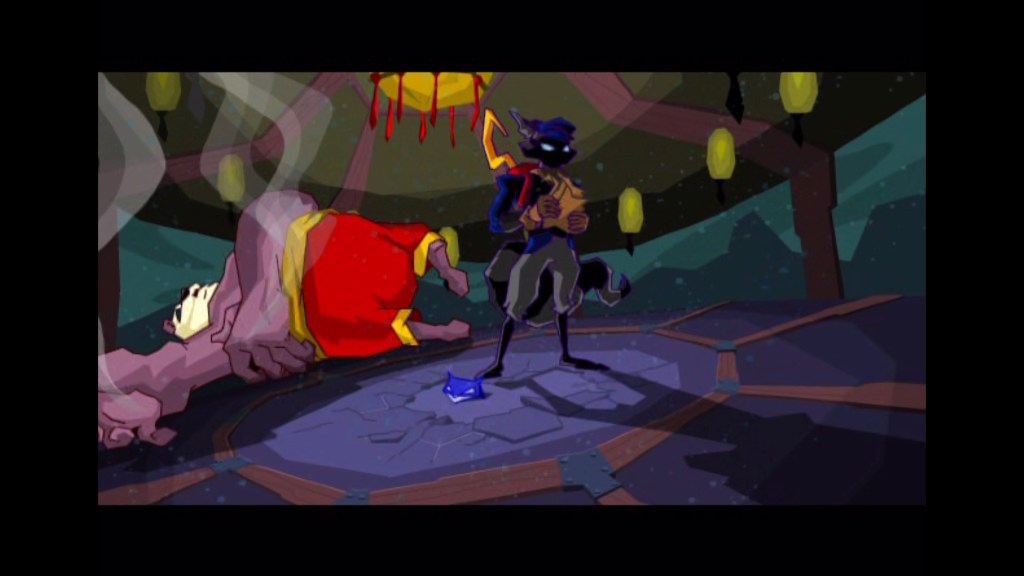
“Rain or shine, I’m going to steal my family’s book back, and if Raleigh gets in my way, it’s on.” This is the kind of nonchalant panache that made Sly seem like such an unprecedented star of a children’s game protagonist. He drops this quote just before the start of Act 1, which sees the gang go after Raleigh the Frog, a top-hat-rocking ribbeter with his very own storm machine on the coast of Wales, which he uses to shipwreck passing vessels rife with plunder. When Sly first leaps out of the van on Raleigh’s rainy turf, the scene is already set for something I never could have expected as a kid so used to saturation and loud sound effects. Today, it’s still pleasantly subtle. An upbeat, bass-heavy percussive track plays beneath falling rain as Sly slinks through a storm-battered island obscured by fog. Sly’s blue outfit stands out against the muted backdrop as he swings himself on hooks and hangs upside down from ropes. Listening to the director’s commentary after completing this level’s time trial (more on those soon), I learned that one of the level designers in charge of lighting put the initial level through 30 different lighting calibrations to ensure that players could still clearly see everything happening within the game’s nighttime setting while keeping the dark ambience intact. The challenge was worthwhile.
Speaking of challenges, I remember the game feeling unforgiving in comparison to its contemporaries when I was a kid. Sly can only take one hit/fall/scorch of flame/accidental cannonball into the water before it’s game over. Hidden in the corners of some levels are glowing horseshoes, which Sly can wear on his back to scrap a single mistake. Horseshoes can also be spawned or upgraded to gold (for another layer of protection) by collecting one hundred coins. My younger self struggled with this design, as I often missed jumps or was gunned down by flashlight guards without a horseshoe to save me or enough coins to find quickly enough, repeatedly sending me back to the beginning of the stage. The sequels would implement a preferable health bar. As an adult, it’s much easier to dodge danger in Sly’s first outing. He doesn’t have an arsenal of weaponry on hand to deal with giant sledge-hammer-wielding weasels and tommy-gun-toting Dobermans in tuxedos. Brute force is never the point. It’s usually in the player’s best interest to avoid enemy encounters as much as possible, only pausing occasionally to smack a vulnerable guard with Sly’s cane if they’re posing an immediate threat. There are also loads of coins to be collected whether by picking them up along a level’s central path or smacking myriad objects with Sly’s cane to produce more. This became a habit of mine, as the sound design of Sly’s swing paired with its destructive impact against rocks and rooftop antennae was too satisfying to pass up. Finally, Sly can learn several skills that minimize the game’s difficulty to microscopic size by finding all the bouncing clue bottles hidden within each level and then using them to crack open a safe that’s usually sitting right near the exit. These include recovering from a fall with no consequence or automatically surviving a splash in the water, making Sly virtually invincible to several hazards. However, there were some annoying moments that weren’t traditionally difficult, but rather oddly designed and seemingly shoehorned in to fill runtime. Driving the van in Murray’s racing missions feels like controlling a toaster on four rolls of masking tape, and a minigame that tasks Sly with whacking 50 panicked chickens within one minute and thirty seconds while explosive-laden roosters chase him around can be quite the hassle. There’s also a conceptually acceptable QTE rhythm-based boss fight that overstays its welcome. It’s clear that Sucker Punch attempted to kill two birds with one stone by adding more variety and filling time slots, but just like turret sections in plenty of early to mid-2000s games like Dead Space, these segments left me wanting to return to the regularly scheduled gameplay.
Obviously, I didn’t come back to Sly Cooper for a challenge. The steady flow of stealthy platforming and clue-collection was incredibly refreshing to experience again, especially now that I’m no longer a stubborn, impatient kid. But there was a surprise in store for me that I never bothered with back in the good ol’ days. Upon beating the game, players will get access to time trials, activated by swiping at a floating hourglass that appears at the start of each mission. Completing time trials is how I discovered the director’s commentary that I mentioned earlier. Here’s the catch: these things are no joke! The window for mistakes is incredibly small. Making use of shortcuts and other tactics like spamming the “roll” skill that allows Sly to tuck himself into a ball and gain speed on sloping terrain is absolutely required. If no big skips are available, you’ll be cutting corners as much as possible by, for example, double jumping halfway across a ledge, gently landing, then springing right back off to the other side instead of slowly shimmying its entire length. Tricks like this only save one to two seconds when performed properly, but there are plenty of time trials I completed with only one or two seconds to spare, so every crafty maneuver counts. After a rather laid-back adventure, such unexpectedly intense and addictive platforming breathed new life into every level.
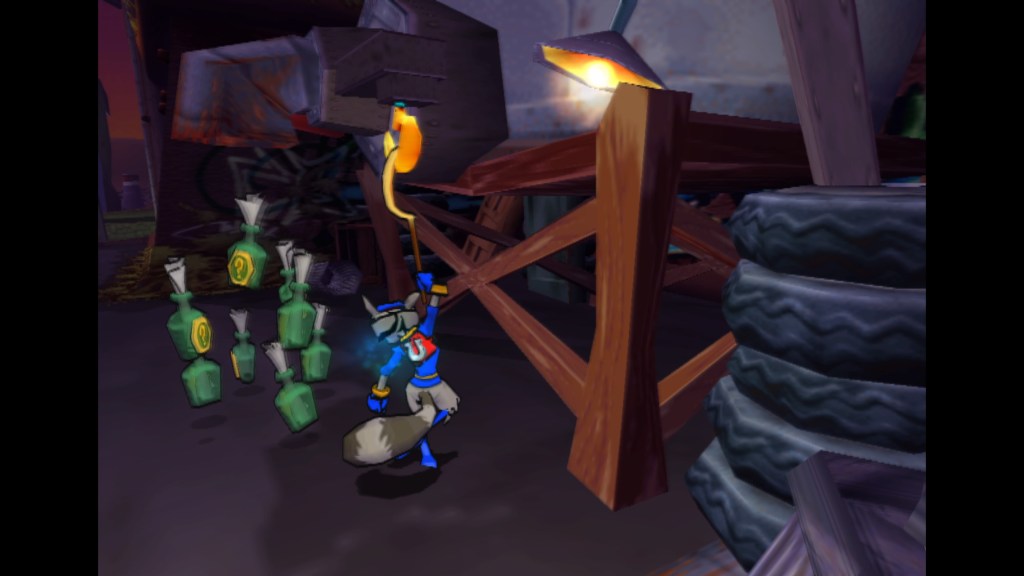
I was pleased with how well the gameplay held up. Controlling Sly was smoother than I had anticipated, and it was still so fun to slide down a spiral-shaped vine in the swamps of Haiti or leap from lily-pad to lily-pad while narrowly steering clear of rotating laser beams. In terms of the characters and dialogue, I was once again enchanted by this ragtag band of thieves and the goofy villains they encounter. As Sly sarcastically dismisses major snags in the plan like Carmelita trying to clamp him in cuffs, Bentley gets himself all worked up over the slightest prospect of failure, dropping hilarious lines of admonishment toward his even-tempered partner like, “Your ridiculous raccoon logic sends shivers up my shell.” As Sly and Bentley discuss (and sometimes argue over) the brass tacks, Murray is on stand-by for their eventual escape, doing his best Chris Farley impression when he gives Sly some extra encouragement. My perceptions of a perfectly balanced group dynamic persevered through years of aging. Almost every time characters interacted, I found myself smiling, whether due to genuinely funny utterances or displays of indifferent taunting from Sly himself. One of the best build-ups to a boss fight comes when Sly and Muggshot, a mobster bulldog who walks on his gigantic fists, finally meet face-to-face after Sly has trashed Muggshot’s casino in Mesa City. Muggshot refers to Sly as a “rat with a stick” before saying, “wait a second, I’ve seen that stick before.” To refresh his memory, Sly remarks, “maybe when my father knocked your block off with it.” When Muggshot connects the dots, he flaunts his possession of the very book Sly covets, referring to it as the “Thingus Raccamagoocus.” His cheesy, mafioso delivery had me laughing out loud, something I haven’t done when playing a video game for who knows how long. I was so glad I could still appreciate the game’s writing, since it included mature themes, witty one-liners, and gripping confrontations beneath a coat of colorful, kid-friendly paint.
The talons of nostalgia had clutched me like Clockwerk, the shadowy ringleader of The Fiendish Five. I caved in, allowing myself to get swept up in Sly and the gang’s shenanigans in 2024. What followed was a triumphant heist of childhood memories. Despite still not cracking the code on exactly what makes nostalgia tick, I successfully quenched my reminiscent urges with an excellently paced journey that I coasted through without ever becoming disappointed by how it had aged. I’m looking forward to the hopefully inevitable re-release of Sly’s sequels. In the meantime, I’m more curious than ever to revisit other nostalgic titles from my past, to see if they too are able to pull me in all over again. Until then, I’ll be following the same unpredictable gaming patterns as usual, posting whenever I’ve been inspired enough to do so. Stay tuned!
 GotMeThinkingGames
Leave a comment