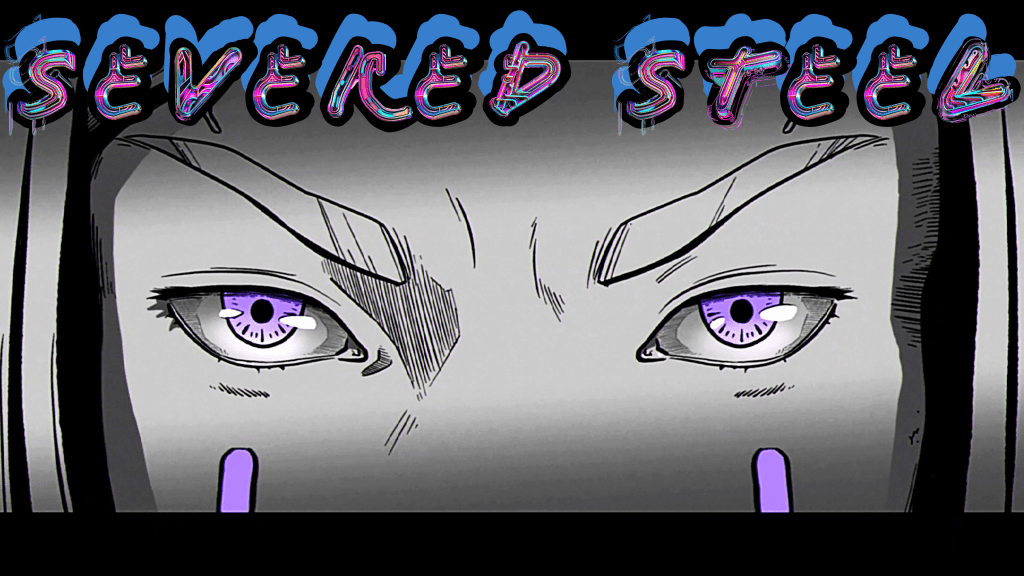
Severed Steel is a perfect example of less is more. When I first viewed the game’s trailer and marketed screenshots, I honestly wasn’t very impressed. The settings looked sleek and colorful, but also barren and blocky, lacking in detail or graphical nuance. There was a certain cheerless cleanliness to the environment that evoked the aspects of a prototype rather than a full-fledged experience. Still, the gunplay looked fun enough to entertain me for at least a few hours, and I was desperate to get my hands on a modern FPS that follows the tried-and-true philosophy of, kill everything in a chaotic manner without ever having to hide. Turns out I was right about being entertained for a few hours. And a few more. And then a few more after that. Never would I have expected to encounter what became one of the best shooters I’ve ever played, and a testament to the power of pure thrill and crisp control over visual fidelity and “proper” structuring.
The premise of Severed Steel is simple: you are Steel, a white-haired, one-armed former agent of EdenSys, yet another overtly overstaffed, oversized, underhanded corporation that shares a section of the bleachers with Skynet, Omni Consumer Products, and Weyland Yutani. Steel is out for revenge after losing her limb and being promptly abandoned by the heartless syndicate she dutifully served. Major story beats in the blisteringly paced campaign are translated via illustrated stills that appear sparingly after each chapter has been completed. You’ll infer more about what’s really going on through one-sentence objectives at the start of each brief mission and by paying attention to the increasingly deliberate level designs as Steel gets closer and closer to ending EdenSys.
Kill
Them
All
flashes on the screen one word at a time. Metallic walls brightly shimmer with neon light. A door blocks the entrance to a room swarming with EdenSys militia. One of them falls victim to broken bones and a short life as the door is kicked powerfully from its hinges, crushing the first faceless soldier and causing the others to immediately fire. It’s too bad for them that Steel is already sliding beneath a wave of bullets. She leaps toward the wall and runs across it. The world is plunged into stasis as she lands headshot after headshot until her pistol is empty. More weapons lie scattered by the corpses. Time resumes as Steel dives toward a discarded shotgun. She kicks into another floor slide, scoops the shotgun, then uses it to blast the last man standing as he stressfully screams, “F*#!” in the face of imminent death.
Seasoned gamers will settle into Severed Steel’s core features with ease, yet Greylock Games Studios accomplishes the feat of creating something truly unique by way of synergistic fusion. There is slow-motion bullet time, like in Trepang2, the responsive wall-running of TitanFall 2, Doom Eternal’s incentivized action that grants health and ammunition to bloodthirsty players, the strict punishment and instant resurrections of Hotline Miami, i-frame diving from Enter the Gungeon, Bulletstorm’s brutal melee kick, as well as the parkour sliding seen in Dying Light (there’s several more games to point to for potential inspiration, but these are the first that come to mind based on my own first-hand history). Juggling so many concepts and functions can be initially overwhelming, as each mission is meant to be met with swift intent instead of second thoughts, yet the brilliance of Severed Steel begins to reveal itself as players adapt to efficient transitions between tactics.
Don’t let the health bar fool you. Death can come so fast that it feels like a one-shot kill. The good news is, this same rule applies to enemies as well, so it’s perfectly fair. Never mind the fact that there are a lot more of them than there are of you. No, really, that wasn’t sarcasm. You’ve got what it takes to turn two freight trains full of expert gunmen into derailed blood-deliveries. Slowing time, wall-running, sliding through gaps between rooms and under tables, literally kicking the life out of someone; these are all the advantages that Steel has over her rather static adversaries. Standing still in real time will lead to an almost instantaneous restart. As soon as you’re given the next objective, whether it be “Kill Them All,” “Defeat The Snipers,” Destroy Thermal Controls,” or any other short and sweet instructions, it’s time to move. Sliding, diving, and wall-running will reduce the damage Steel takes as her desperate ex-comrades spray and pray. Slowing time as you cycle between these movements will yield the highest killstreaks, especially since each successful murder refills a notch of health on Steel’s clover-shaped health bar, in addition to replenishing her slow-mo meter. To replenish ammo, you’ll never pick up fresh magazines or supply packs, only other guns that each have a set amount of ammunition and must be entirely replaced when they’re empty. Occasionally, there will be guns in armory display cases that can be stolen without having to kill anyone, but most of the time the only way to keep firing is to keep firing. In other words, dead enemies will serve as your primary source for more weaponry. Good luck if you’re left with nothing but your foot to rely on (although I did kill a boss by relentlessly kicking it as I hovered in mid-air from the knockback). A nice immersive touch is that the ammo available in each gun will depend on how many shots an enemy already got off before dying. Expect to often snag a shotgun with only two more shells inside, forcing you to further improvise as you scan your surroundings for more weapons. In short, taking cover and lying in wait are strategies for the trashcan when it comes to Severed Steel. Quick confrontation is always the solution.
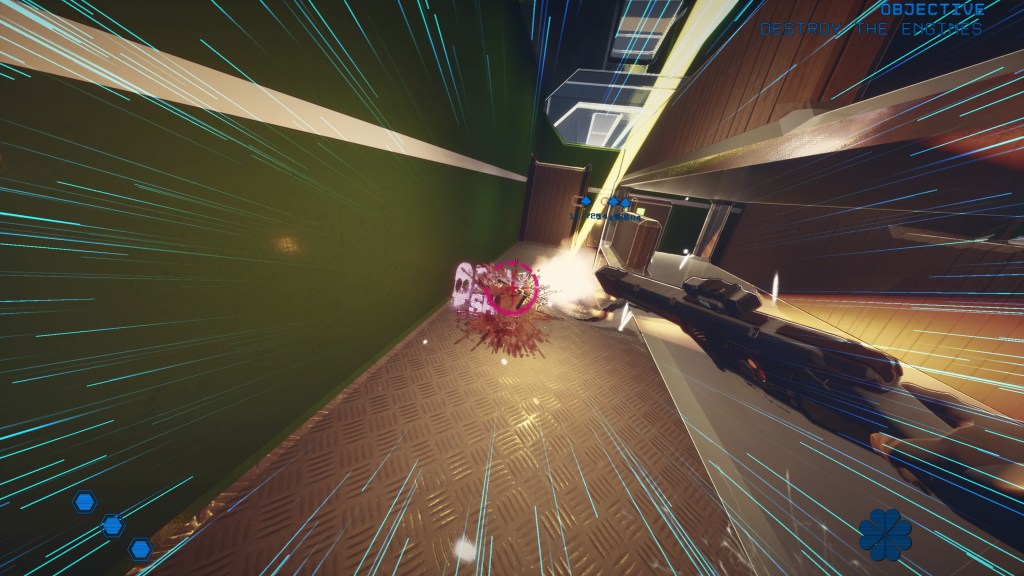
As I stated before, the atmosphere of Severed Steel is at first cold and somewhat lifeless, much like our injured and forgotten protagonist, until the steam of hot gun barrels heats things up. I began to realize that Greylock Games Studio was consciously foregoing frills and traditional sequential progression for the sake of retaining focus on extremely captivating gameplay that shares the intensity of Doom Eternal with none of the in between platforming or exploration. Everything is delivered to players up front, typically in one large building or chamber divided by doors and architectural designs that encapsulate the map-editor nature of each level where realism is unnecessary and therefore disregarded. Erratic walls and ledges bridge the gaps between Steel’s next acrobatic feat, whether it be diving headfirst through a window and evaporating foes with a laser gun before the glass can hit the ground or bouncing between nondescript blocks to reach a better vantage point (from which pesky jetpacking enemies can be sniped more accurately). As the game goes on, the developers put more and more trust in player agility. This is reflected in the escalation of level complexity. The simulation-style starkness of the game remains a visual constant, yet basic designs are superseded by unexpectedly ambitious ideas requiring player imagination to fill the graphical gaps in their presentation. I had so much fun jumping between two moving trains as I cleared one car after another, or dispatching several elite assassination targets in what looked like a loose rendition of a city block, where leaping from rooftop to rooftop provided plenty of rewarding liberty. When tasked with destroying a multi-storied building (a unique objective that’s only seen once), I gleefully hunted down several flamethrower enemies so I could steal their bulky armaments and burn everything in sight, thus drastically increasing my rate of ruinous productivity. I was repeatedly caught off guard by the intricacy of new level designs, the interesting context clues they provided for the purpose of retaining a sense of story progression, as well as the varied objectives they contained. Severed Steel is deliberately modest in the way it’s presented, yet underneath the surface lies hours and hours of awesome action-movie choreography directed and performed by none other than the players themselves.
Multiple playthroughs of the same mission should never look the same. That’s because the player and enemies are moving parts on a destructible chessboard of seamless interconnectivity. Destructible is the key word here. About one third of the way through the campaign, Steel gets her hands, or, um, hand on a piece of technology that drastically alters the way players can engage with each new environment they’re aggressively pushed into. Everyone knows Samus, right? Well, someone tell her to roll on out of the way, because there’s a new badass woman blasting hot balls of energy at her enemies via a pilfered plasma cannon capable of instantly killing members of EdenSys with a direct shot, stunning others with a near miss, and melting holes through the walls, floors, and ceilings of every map. Steel’s shiny new limb turns already non-linear mission layouts into completely non-sequential speedruns. I absolutely loved the added improvisation unlocked by the plasma cannon, as getting the jump on enemies becomes much more exciting and open-ended. Melting and then diving/falling through holes in the walls and ceilings for the sake of surprising unaware adversaries or shooting the floor out from under someone to watch them plummet to their death goes a long way in boosting the power-fantasy that already existed before the introduction of the plasma cannon. There was one moment during the aforementioned train mission where I had accidentally found myself running along the exterior of the locomotive. As the arc of my run neared an end, failure felt inevitable. However, before landing on the blurred tracks, I managed to shoot my way back into the train and immediately resumed causing carnage. I ran into a lot more of these last-second game-changers using the plasma cannon, resulting in my total adoration of the powerful prosthetic.
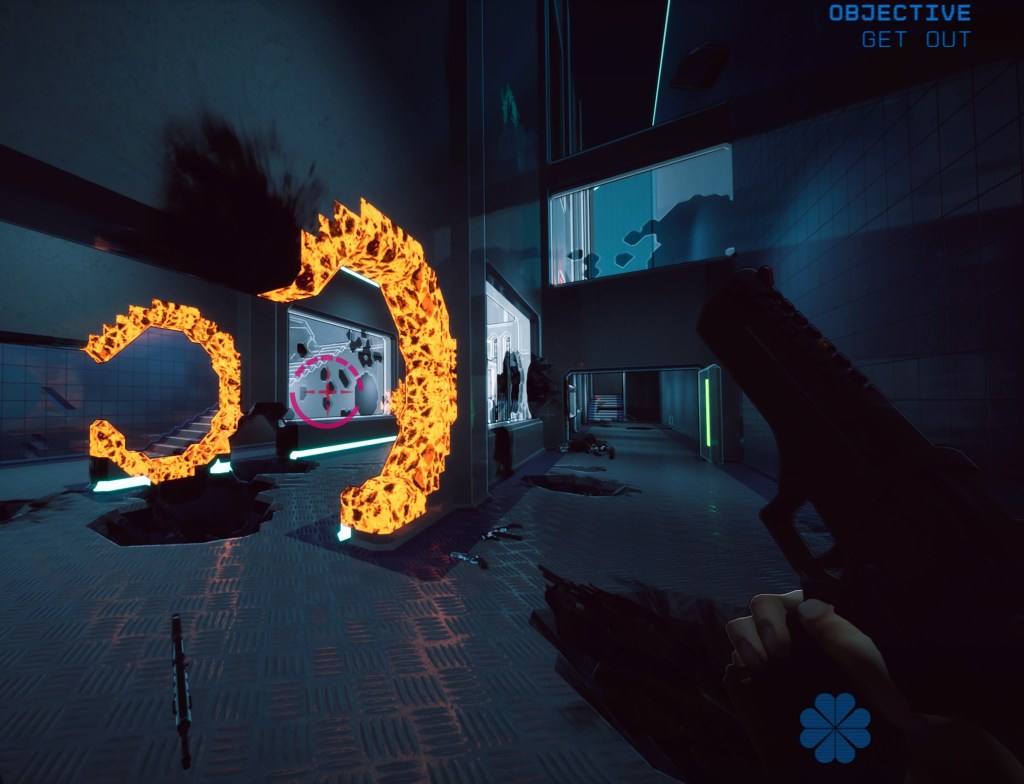
Once you’re finished with the base campaign, both New Game + and another mode called Firefight become available to play. I highly recommend both, as New Game + gives players a great opportunity to show off the skills they learned but probably didn’t master during their first playthrough, while Firefight operates as an arcade rehash of each level, featuring added challenges like killing a certain number of enemies during a singular dive or while in the middle of an airborne front-flip. Some of these challenges inspired me to test out new creative strategies that I would use from then on. As you progress through Firefight, you’ll level-up. Increasing your level will unlock new weapons to choose at the loadout screen, various plasma cannon functionalities (including a gravity cannon that can launch high-velocity objects at enemies), and interesting yet somewhat divergent modifications like “the floor is lava.” Because I was so hooked on the rhythm of Severed Steel as is, I was reluctant to experiment too much with modifiers that distracted from the core gameplay’s freedom. Still, a few trophies lulled me into using some of them, and I never regretted it. Turning the floor to lava and having to remain on the wall and in the air for the duration of an entire mission, for instance, was a rewarding challenge that tested my proactive maneuverability.
In the end, what looked to be a harmlessly barebones indie shooter at the time of discovery became one of the best shooters I’ve ever played. I can’t seem to get enough of the direct, high-octane action delivered by such games as Hotline Miami and Ruiner. Severed Steel far exceeded my tempered expectations. The mixture of mobility, precision, creativity, and awareness that I was tasked with continuously exhibiting repeatedly culminated in an incredibly self-sufficient wave of deep gratification, which is all you can really ask for in a videogame.
Before I go, I need to note how well the soundtrack fits into place. Floating Door put together an amazing project that balances high-tempo house music with laid-back, electronic ambience. Each song settles nicely into the background of Severed Steel’s cyber-dystopian environments. Tracks like “Code Heist” are simultaneously energetic, soothing, and uplifting, and . If you’re an FPS fan looking for a wonderful union between classic pick-up-and-play design and modern controls, then Severed Steel is sure to catch you off guard in the best way possible.
 GotMeThinkingGames
Leave a comment