Let’s imagine life on earth if everyone had their very own combo meter hanging over their head each day. . . The mailman speeds from mailbox to mailbox, skidding around corners to keep his 99-streak alive, desperate to hit triple digits as he hurls envelopes like frisbees and punts packages onto porches from the bottom of driveways. Car salesmen give the fastest pitches ever, hoping to hypnotize uninformed single mothers with a blown radiator so they can move on to the next customer before their meter resets. “Greatcarfourwheeldriveyoushouldbuyitwannabuyit?I’vegotthepaperworkrightheresignaturepleasedontworrythe warrantylastsfoireveractuallynoitdoesntbutyoudidnthearthat.”
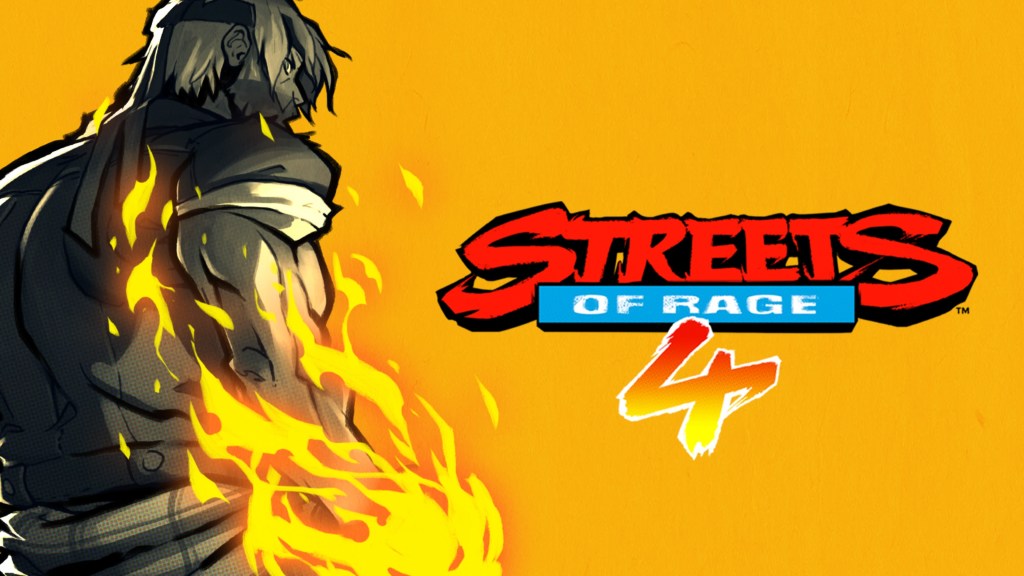
If we conveniently overlook serial killers and other undesirables trying to keep their momentum going as well, then a combo-based society could theoretically be a lot more productive. I came to this educated conclusion after unintentionally obsessing over my score in Streets of Rage 4, an overdue installment in the 90’s Genesis beat ‘em up series, with extra emphasis on the 90’s (as all the headbands, leather, denim, cool sneakers, and rollerblades can attest to). Lizardcube, Dotemu, and Guard Crush Games didn’t pull any punches with their collaborative reanimation of a genre on life-support. What began as a seemingly slow, outdated 2-D brawler with alluringly hand-crafted animation soon revealed its many intricacies, leading to over 50 hours of experimenting with distinctively designed characters, exploiting i-frames, fiending for another S-rank, and enjoying a perfectly punchy OST.
The premise of this series has always been quite simple; a really bad guy is really bad and must be beaten senseless to see the error of his ways. That’s no different this time around, except now there’s two main villains, twin descendants of Mr. X, the original antagonist of the first and second games. Together, the creatively named Mr. Ms. Y control the ragtag Y Syndicate, a band of shady crooks that are individually outmatched by our vigilante protagonists but stronger in numbers (especially if you’re playing solo like me).
With that straightforward set-up out of the way, the game commences. Axel Stone, a former member of a corrupt police department who decided to take true justice into his own hands years ago, hops onto the city streets once more, looking for a fight. Axel was my first pick due entirely to his edginess. Fingerless gloves and a jean jacket? How could he ever be stopped? Well, despite Axel’s ability to channel the flame of the dragon to enhance his spinning uppercuts and sudden flurries of crosses and hooks, I found my attacks getting consistently interrupted. Axel was slow and lacked range. Moving from one side of the screen to the other felt like a trek across the Sahara. Also, enemies continued to close in on me from diagonal angles, but since most attacks are only horizontally effective, I often whiffed a jab intended for an enemy who wasn’t quite lined up with me yet, only for them to nudge a tad closer and land a hit on me instead. The sluggish start left me initially unimpressed. Even so, I pushed on, propelled by vibrant art, fun music, and a promising spectrum of enemy designs and untapped mechanics.
Despite struggling to find my rhythm on the streets, I felt committed to improving my role as an off-the-books peace officer, as in, it’s time to piece you up, punk. The state of the city under the weight of the Y Syndicate is subtly and exclusively conveyed through visual detail. A basic hub map contains 12 stages that retain a thin layer of filth and neglect. Crumpled trash and broken bottles litter the sidewalks. Vandals seep onto the screen, some holding knives and others baseball bats or crowbars. The crime-ridden area has become a slum. During one stage, an enemy wakes up from a drunken stupor on the wet ground, immediately picks up a half-broken beer bottle, and proceeds to march my way, suddenly wide awake and willing to kill. During a stage set in Chinatown, shifty card games can be seen going down in the background, as if each parallel street invites new vices. This one fighting, the next gambling, the one after that playing PlayStation for several hours at a time. . .
Those who find a sad sense of belonging to such a self-destructive environment are too far gone to hear reason. During your trip through the underbelly, you’ll come across a host of easily distinguishable adversaries who will all give you one solid excuse to hate them, and the only way to settle the beef is with a boot to the ribcage. There are shirtless Donavon’s wearing unnecessary sunglasses, red-headed Glacia’s dressed in full denim, acrobatic Ruby’s who just can’t help but jump back and forth like catfish, biker chicks with a mean headbutt, fat dojo masters with quite possibly the strongest parry in gaming, and many more. This discordant bunch of colorfully clothed creeps and crooks somehow seems like a perfectly natural fit for each new site of chaotic 90’s gang violence. I looked forward to seeing new enemies slide, saunter, or shuffle onto the screen during each stage.
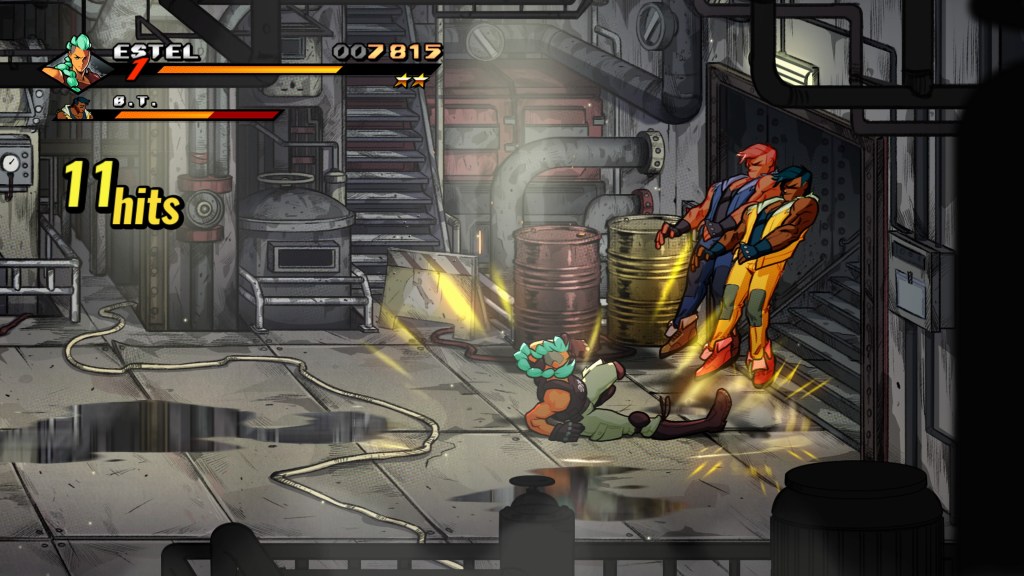
From the streets to the police station, the sewers, a bar, under-construction rooftops with wrecking balls swinging back and forth, a pristine skyscraper with its own elevator segment, and even a giant castle, Streets of Rage 4 doesn’t hold back on memorable level design that keeps players guessing. What’s more, tracks from Olivier Deriviere’s album are designated to their own stage, improving the immersive qualities already laid out by the polished visuals. The most notable marriage of sights and sounds comes during Y Tower, when the aforementioned elevator sequence begins. The track that began as a bouncy, distorted beat before boarding the spacious lift evolves into a triumphant synth melody, perfectly encapsulating the rush of ascending higher and higher toward eventual domination over Mr. and Ms. Y. Even the name of the track, “Rising Up,” matches what’s happening in the game.
After a rocky start, I was enjoying myself enough to play past stage 4, when Adam Hunter, Axel’s former partner, is unlocked. Unlike Donavon, Adam’s sporty sunglasses are totally necessary. Despite there being three more default characters who I hadn’t yet given the time of day, I had the sudden urge to take things from the top with Mr. Hunter, so that’s exactly what I did. To my surprise, I could make Adam dash forward by double-tapping the directional pad. Chaining dashes together results in making it from one end of the screen to another in the same amount of time it takes Axel to tie his sneakers. Adam’s fighting style was all about advantageously covering a lot more ground, immediately rejuvenating the gameplay.
While we’re talking about gameplay, it’s important to note that each character has access to the same variety of attack types, while the attacks themselves function differently. Sometimes these differences are somewhat minor and others they’re interestingly drastic. Your central combo is a simple string of the square button. It seems dull, but you can break this combo up into different segments of your own choosing. For instance, tapping square once results in a quick jab that stuns enemies momentarily. An optimal strategy for obtaining the highest combo possible is to allow enemies to bunch themselves together before letting loose with your fists, which is easier said than done, as they are often scattered, deciding to close in at their own speeds. However, with careful positioning on the part of the player, and by using techniques like stun-locking single enemies with the jab, thus keeping your combo alive while allowing time for others to get within range of a full combo, it’s possible to get much more bang for your buck. In other words, it’s not always the best idea to perform an entire string on a singular enemy, because as you’re busy pummeling on one guy or gal, many others are making their move, deviously planning to end your streak. Trapping groups of street fighters in your storm of flailing fists while watching your combo climb rapidly higher due to the compacted number of targets is the most satisfying feeling there is throughout Streets of Rage 4’s runtime.
Charge attacks can be initiated by holding the square button until your character flashes yellow, then releasing it. Adam’s charge is a straight kick that resembles King Leonidas’ in 300. When it lands, the kick creates space while simultaneously knocking the wind out of whatever victim made the mistake of getting a little too close. Unfortunately, the brief charge-up time can often lead to an interruption. I didn’t use Adam’s charge attack very much for this reason, but I liked other characters’ charge attacks much more, like Estel’s front-flip that launches enemies into the air from the ground, extending her combos and allowing for increased crowd control (Estel is a boss in the base game who was added as a playable DLC character. She’s my current favorite to play). More universally useful than the charge attack are blitz attacks. Double-tapping the directional pad forward or backward and then pressing square will engage one of these typically rangier maneuvers, which also provide crucial i-frames. Cherry Hunter, Adam’s rock n’ roll daughter who brings her trusty guitar along as a weapon, leaps into a useful flying knee. Her DLC alternative sees her sliding across the floor as if she’s on stage at a face-melting concert, knocking enemies over in her wake. The blitz can be somewhat tricky to nail down, because while it can be used as a get-of-jail-free-card of sorts (due to its i-frames), it also repositions your character and includes built-in frames of recovery at the end. Therefore, simply spamming the blitz may seem like a combo-hack, but when slightly mistimed or misdirected, it can leave you open to a sudden counter that kills your momentum.
Every other offensive strike is tied to the triangle button. These are called specials. Specials provide an opportunity for our characters to show off the true power they possess, at the cost of their health . . . sort of. When performing a special move, part of your health bar will turn green. The green symbolizes health that is sacrificed for the sake of a special move, but can be restored by connecting consecutive hits against an enemy without getting hit yourself. Any damage to the player will instantly erase the amount of health that has been gambled. So, why gamble this health to begin with? Well, specials come in three varieties: offensive, defensive, and air. Offensive specials are very powerful. Much like blitzes, offensive specials incorporate i-frames and usually transport characters some distance from the spot of origin. They’re slightly easier to pull off, as the double-tapping of the D-pad required by blitzes doesn’t always register with exactness. Also, they can provide more damage. Estel’s offensive special is a tackle that sends the policewoman leaping across the screen. She takes an enemy down to the ground and then smashes them with devastating downward blows, causing immense direct damage to her primary target, and also creating a small radius of splash damage for any surrounding members of the Y Syndicate. On the other hand, Axel’s default offensive special is stationary barrage of straight punches that culminate in a fiery uppercut. It’ll hurt whoever’s right in front of him, but doesn’t move Axel away from any immediate danger, or reach anyone further away.
I found myself committing to blitzes more than offensive specials. Defensive specials are what led me to sacrificing most of my health. In fact, it’s easy to bring yourself down to one nub of health by repeatedly mashing specials (given a particularly dangerous predicament). Without pressing any direction, a tap of triangle will initiate the defensive special, which shields the player with i-frames and also either stuns or damages nearby enemies. Adam can perform his “chopper” kick, which turns him into a blazing tornado hovering in the air. When he returns to the ground, Adam is subjected to attacks from enemies that barely avoided the player’s hitbox to then approach, which can lead to another heartbreaking combo-break. To avoid this, the special can be doubled, tripled, or quadrupled until there is no more extra health for your character to spare. Of course, the downside is that if you’re using the special so often to get out of a jam, it’ll be that much more important to regain the health you may very well lose. Adam’s air special is actually the same move carried out after jumping, and is great for juggling airborne foes. Defensive specials also come in handy against goons like Sparrow, martial artists who soar through the sky with their knee in front of them like a piercing beak. When you see a Sparrow poised to launch, with no time to slide out of the way, the defensive special is a lifesaver. On the other hand, I’ve repeatedly lost track of how many specials I’ve used, so that by the time a long-distance attack is coming my way, the well has already run dry. These are the kinds of dilemmas that frustrated me at the start of my time with Streets of Rage 4, before I understood how to manage my moveset, as well as why it’s so important to always maintain awareness of what’s happening at all ends of the screens.
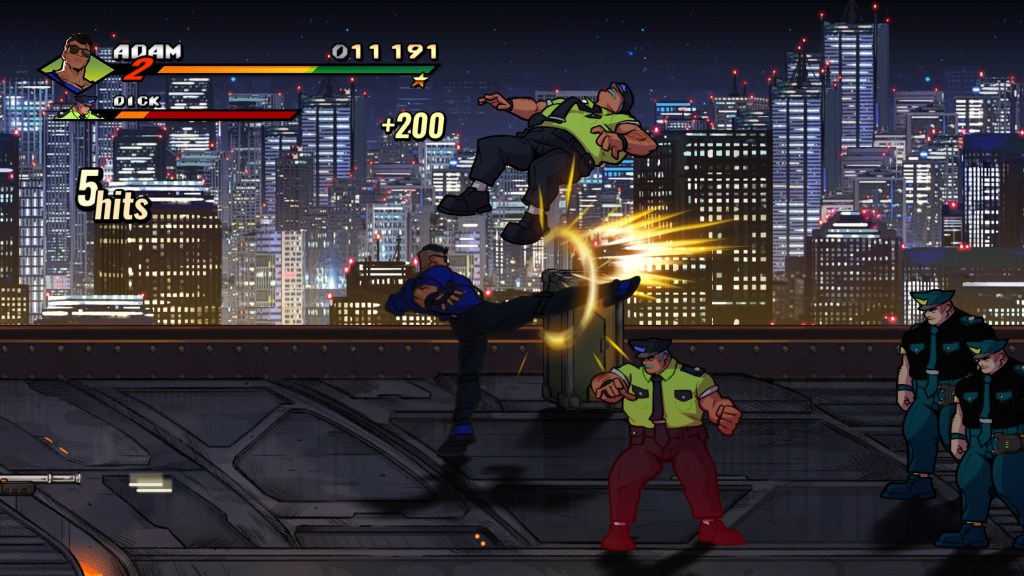
I kicked this post off by emphasizing how addictive it was to earn high scores via combos, which is the primary reason why Streets of Rage 4 is so replayable. After beginning on Normal difficulty, I ended up S-ranking each stage on Hard (for the trophy), then S or A ranking each stage on Hardest and Mania (which I’ll probably return to with the goal of replacing those A’s with S’s too). The number of enemies and their speed will increase with the difficulty, meaning there will come a point when the player is significantly slower than every enemy and must adapt to their zippy repositioning with adept inputs. As you play, a hits-counter will appear on the top left corner of the screen, changing colors as a new bracket of combo is reached. The combo ladder looks like this: Nice!, Great!, Super!, Excellent!, Amazing!!, Sick!!, and Out of this world!!! If you’re damaged mid-combo, it’s as if nothing ever happened. However, if the combo expires naturally, then the points it awards will be officially recorded and added to your final score, which will be calculated at the end of the stage. Depending on each stage, the amount of hits it takes to reach each new category of combo will differ, due to (I’m assuming) how many enemies are featured on the stage, the stage’s average length, and how easy or difficult it’s deemed by developers for skilled players to rack up consecutive hits. The first stage, for instance, incorporates many weaker, less threatening enemies, where an Out of this world!!! won’t trigger until the player has served well over 100 knuckle sandwiches. By the time you make it to stage 7, called Skytrain, an Out of this world!!! is achieved with less hits because of how short it is, and for the fact it exclusively includes a lesser number of heavier hitters rather than crowds of easily dispatched Galcia’s and B.T.’s.
I became extremely absorbed with earning as many Out of this world!!! combos as I could. When I knew the potential for one was all but certain at a specific point in a stage, I found myself pausing and restarting whenever I was hit. In these moments, I felt compulsive and almost unhinged; a madman settling for nothing less than an S. With that being said, perfection is not required for the highest rank. You can repeatedly quit while you’re ahead and allow Out of this world!!! combos to end on their own, locking in the points they produce rather than attempting to carry one combo throughout an entire stage (I’ve never been able to manage such an incredible feat, though I did make it through a stage without taking any damage during my platinum trophy run, so I’ll settle for that). Also, scores are boosted by how much health you end with, as well as how many stars you hold onto. You might be thinking, “Stars? He didn’t mention anything about stars.” Well, that’s because I cut myself off from using them once I realized that doing so is somewhat of a penalty. Stars allow players the chance to perform a super-powered move which typically covers most of the screen, essentially wiping out most visible enemies, or at least hurting them pretty bad and temporarily eliminating the pressure they’re bringing. However, I’d rather take the bonus points.
Another reason why repeating stages multiple times is an inescapable reality if you want your list of scores to look like the sound a snake makes (SSSSSSSSSSSS) is the order of appearance regarding certain enemy types. Because enemies will continue to enter the frame while you’re fighting those that already have, it becomes important to remember exactly what you’re dealing with at any given moment. If, for instance, you remain too close to one edge of the screen or another, you may be subject to a swift strike from whoever suddenly appears at your six. In The Streets (stage 1), we see an early example of this conundrum. There’s a moment when a B.T. blocks your path forward, while a Donavon comes shooting out of a manhole cover behind you. If you’re not quick enough, you’ll get sandwiched and surely hit by one or the other. Sometimes, Sparrows will leap into view already executing a flying knee, thus knocking you around if you forget to be out of the way of their arrival in advance. It’s somewhat of a cheap tactic by the developers, but these occurrences are rare enough to stick with you after a few failures, so you’ll quickly learn how important it is to be in the right place at the right time.
Now for the boss fights. I never really warmed up to these. Every stage ends with a match against a single unique fighter (or occasionally two) who spends most of the time trying to avoid the player until they’re ready to super-armor themselves for a damaging attack. The boss fights function like a game of cat and mouse, including a few ads to bolster your score. The problem is, capitalizing on what brief windows are available for the player to counterattack can feel like a buzzkill when compared to the regular tempo of the game. Bosses will force players to focus on their defensive tactics much more often than they’re used to. In fact, boss fights were the only time I ever took advantage of the jump’s i-frames. I haven’t yet mentioned the fact that, on the way up into the air when pressing X to jump, your character will be safe from harm, and that’s because I barely ever used this during regular combat, opting instead to use the defensive special and blitz attacks to avoid damage while causing some of my own. I do enjoy the concept of closing stages with a final, intense brawl, but I never found myself as fully engaged with the flow of combat as I am during the rest of the stage. Of course, I improved against each boss the more I fought them, resulting in much swifter victories than before, but these encounters are certainly not the selling point of Streets of Rage 4 (at least for me).
Streets of Rage 4 turned out to be one of those arcade-style games that I’ll always have hanging out in the regularly revisited section of my collection, much like Rollerdrome, Nex Machina, and Cuphead. Most games tend to fall in the “one and done” category, or at least sit around for years before being dusted off for another playthrough. Therefore, I’m grateful for titles that I can’t bring myself to uninstall, even after achieving every in-game accolade there is. In the case of this 2D asphalt-battler, the Mr. X Nightmare DLC goes a long way in extending its lifespan, as several more characters are added, including an addicting survival mode that features unique power-ups, enemies, and alternative movesets. I’ve written this post with the consideration that the DLC is a necessary purchase, as the variety of moves and characters are a legitimate game-changer. I’ve never looked back after unlocking certain blitz moves or specials. I even changed Axel’s entire loadout, leading to a tear-jerking reunion between me and the series’ poster-boy. I completed the game with the new and improved version of Axel, and am still on my way to completing the game with everyone else. There will most likely be a character ranking in my near future, as I think the many subtle intricacies are worth discussing. Until then, I highly recommend anyone with even a middling interest in this title to give it a shot. If you’re disappointed, come find me on the streets and try to avenge your wasted money. I’ll be the guy in the jean jacket and fingerless gloves. . . and sunglasses.
 GotMeThinkingGames
Leave a comment