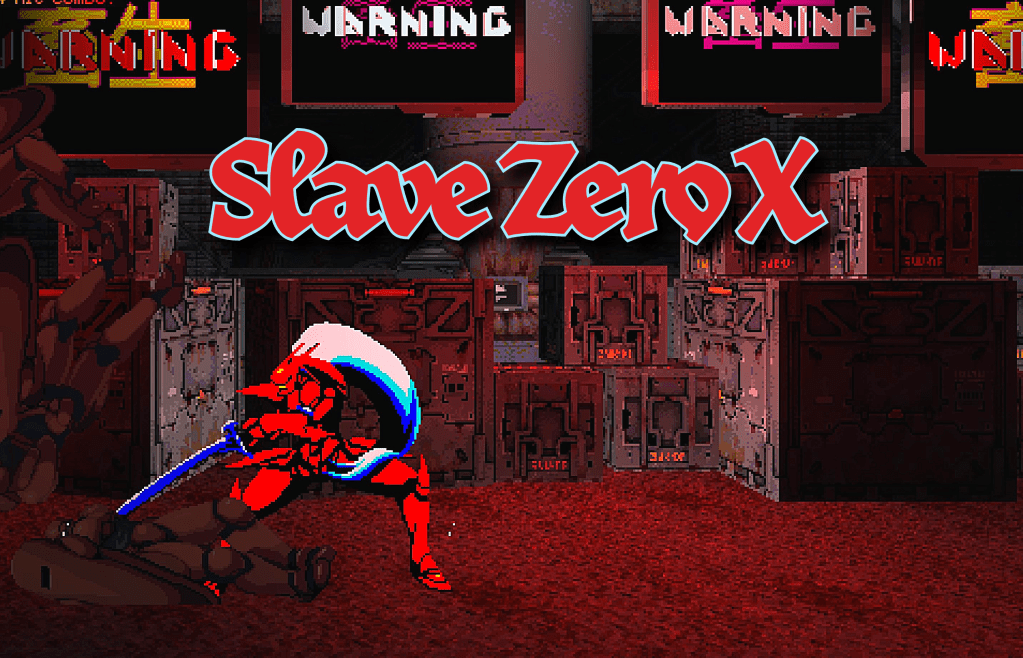
Slave Zero X got me thinking about the impact of visual health bars.
My recent experience with Streets of Rage 4 left me feeling quite confident in the context of 2D brawlers. So, when I became aware of Slave Zero X’s release, I was intrigued by its fierce gameplay, as well as its retro visuals and crisp animation, all tucked beneath the blanket of a cybernetic dystopia where mechanically-enhanced swordsmen sprint through the heartless warrens of a tyrannized city, hungry for blood. Fair warning: you better Slave Zero X-pect to be juggled to death like a helpless concertgoer, deeply regretful of crowd surfing in a sea of amped-up drunks who really hate being jumped on, because this game isn’t messing around. It’s entirely possible, likely even, that you’ll lose your whole health bar due to one mistake. On later levels, both sides of the screen with be flooded with enemies, all vying to roleplay as circus seals with a beachball. Spoiler alert: you’re the beachball. However, the pendulum of power can sway back just as easily as forth, leading to countless instances of feeling like a virtuoso in the violent arts. Slashing at an entire hoard of armored ambassadors of an autocratic regime like a hauntingly fast black widow with clutches of prey in its tensile web is the kind of power fantasy that kept me coming back to Slave Zero X for more.
But once the crowds are killed, there will be mini and main bosses with an appetite for slaughter, waiting to exploit the super-armor they’re exclusively given while they relentlessly throw out attack after attack like someone spiked their sugar cubes with something almost indiscernible in appearance, and I don’t mean Splenda. Due to the hidden complexity of Slave Zero X (the tutorials are questionably sparse without even touching on several shadowy techniques), I can’t give a fully accurate report on the game’s mechanics. There’s plenty left for me to explore in this title. Even so, I’ve had fun with the simplistic way I’ve played, satisfied with the gory feedback of my spammed combos and absorbed by the chunky 2.5D environments that encapsulate such vicious action. Therefore, I want to focus on one feature of the game (or lack thereof) that made me question how it impacted my overall perception of the gameplay. Those bosses I mentioned a moment ago? They have no health bars. This means there is no way of telling how close you are to the kill-shot, which can often cause impatience to set it, as well as deflation when certain fights feel as though they’ve been dragging on and on, only to end with your disappointing death.
As a Soulsborne alumnus, I view the health bars of bosses as exciting boosts to my motivation. Chipping away at these behemoths’ HP just a little more during each attempt can imbue players with the deranged resilience needed to spend hours facing off against the same subject. Running into the dilemma of the “magic pixel,” when bosses manage to seal your fate with only one hit’s worth of health remaining in their enormous bar, may initially shatter one’s soul, but a tiny voice whispers, we almost had him. . . making it impossible to give up and got to bed just yet. Of course, health bars have been a gaming staple for a very long time, and there are countless other examples to cite in favor of them, including the Borderlands franchise. Here, health bars more directly reflect the current strength of a player and their arsenal, as with the right loadout a boss’s health can melt in mere seconds, when during a previous playthrough or with a build less focused on exploiting their weaknesses, the same process could take ages by comparison.
Cuphead provides a unique example of post-fight health assessments rather than tracking progress during the clash itself. This is a brilliant compromise. Some of my favorite memories when playing this game for the first time with my former roommate came from both of us dying after a stressful attempt at walloping, say, Grim Matchstick, then watching in suspense as our little Cuphead and Mugman icons glided to the very tip of the progress-line, where the flag that represents victory was basically covered up, symbolizing the oh-so-closeness of our success. We couldn’t resist pointing at the screen, yelling out, “ARE YOU KIDDING ME?!” in exasperation. “Okay, we got this *expletive*” would always follow. . . we didn’t always have that *expletive*, but the point is that we unquestionably felt the need to try.
In Hollow Knight, boss health is also a mystery, though they can often be temporarily overwhelmed into a state of regenerative rest, allowing players an opportunity to wail on them without resistance. This also serves as an indication of progress as players get closer to the final phase, though due to the overall speed of Hollow Knight, as well as it’s superb control (the likes of which I haven’t encountered in any other Metroidvania) the battles happen so fast and fluently that there is barely any time to think about how close you are to the end. Besides, the game’s healing system allows player mistakes to be rectified by landing a few hits at the most propitious of times and then harnessing that replenishment in order to prolong survival.
Slave Zero X handles its absence of health bars a bit differently. Whenever it’s time to go against a mini or main boss, you’ll be waiting for a break in their super-armor. This break is a direct result of the damage you deal. Without it, bosses will continue flowing from one attack to the next in a relentless storm of pure fury. Now, although this is superficially similar to Hollow Knight’s design in that the poise of a big bad is temporarily broken, thus encouraging the player to regroup and/or deal damage, Slave Zero X’s foes don’t actually stop trying to kill you for even a few seconds. The player is responsible for taking advantage of broken super-armor by landing attacks on their obstinately aggressive opponent. Only then will the benefits of breaking that armor be reaped, as the boss will be briefly prone to a juggle-combo, whereas they would otherwise shrug attacks off their bulky pauldrons, refusing to be staggered or tossed into the air. The quick rematerializing of super-armor makes it crucial to keep bosses off the ground in Slave Zero X whenever you get the chance.
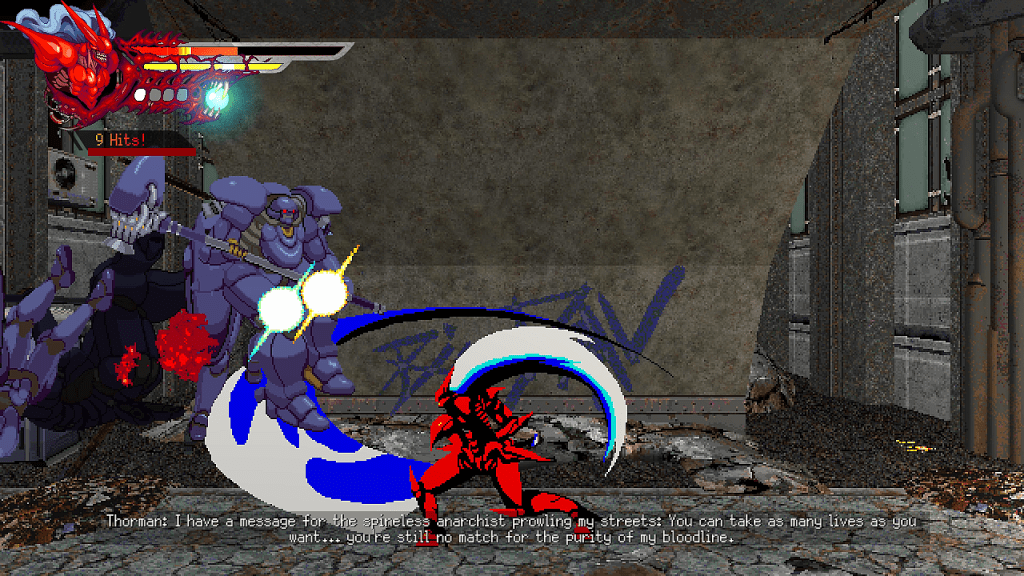
What makes this process feel tedious is that each 1v1 contender is capable of capitalizing on your every mistake, potentially erasing a significant portion of your health bar when you try to go in for some well-earned damage after smashing their poise. There’s one hammer-wielding hulk who can dash across most of the screen, then enter into a rapid rotation of highly harmful kicks, punches, grabs, and slams that just might take you out in the blink of an eye with no reliable recourse. Careful play is the name of the game, so I’m not complaining about the skill it requires to truly roleplay as a blood-lusting exo-skeletal executioner. However, some of Slave Zero X’s showdowns can begin to feel somewhat monotonous, which could be in part due to a lack of informational feedback for the player. Will this idiot die already?? Is a question I often asked myself, rather than locking in and enjoying the fight for what it is. Each time I began performing an actual combo against these dictatorial dummies, they’d buff themselves once more and abruptly flip the script. When fighting certain mini bosses, ads may also spawn from both sides of the screen, further interrupting your flow. During one fight against the love child of Megatron and Cobra Commander, rabid beasts resembling the reimagined Pinky demons from Doom 3 continuously tossed me around like a chew-toy as I cluelessly hacked at whatever I could at any given moment, hoping I was getting close to the end but having no idea where I stood.
When I finally made it to the end, the enemies simply grayed out for a moment and expired. Sometimes, they’d burst into a fun gib animation, sending sides of beef splattering all over the ruined streets, but that doesn’t typically happen to elite enemies. Instead, the duels reach an underwhelming climax of tame death. In a game as stylistically sanguine as this, I think developer Poppy Works may have overlooked an opportunity to add some intensely gruesome finishing moves or creative animations to the action. Such cherries on top of a demanding, fast-paced experience can serve as bite-sized rewards. Take a look at Doom Eternal or God of War, where in-game executions offer sweet relief to the highly pressured player. As the Doom Slayer’s chainsaw shreds through the tendons of an out-metaled demon, or Kratos’ Leviathan Axe is lodged savagely through the mouth of an exhausted ogre, players grit their teeth and pat themselves on the back for a job well done, riding the wave of their own vanity to the next virtual proving grounds. Slave Xero X never loses its daunting nature, disallowing players to linger on their accomplishments until they see their rank at the end of the stage. Leave your ego at the door, I guess. . . how dare you sit there with a smile on your face when you’re on pace for a D? Well, to be fair, there are ranks shown at each checkpoint, so if you’re playing well enough, you’ll at least be able to enjoy seeing a shiny silver S every once in a while.
Maybe Slave Zero X doesn’t earn as many showmanship points as other games, but what’s that go to do with health bars? Well, if you’re not going to monitor enemy HP, then such definitive domination as provided by finishing moves may tend to become even more subtly or entirely subconsciously important to the player’s long-term satisfaction, even or especially in the face of a true challenge. A more relevant comparison may be the way Streets of Rage 4 punctuates its boss fights, which all end in dramatic slo-mo and are accompanied by the same upbeat track that becomes synonymous with victory as the game goes on. It’s the kind of stuff that makes you pump your fist and go into the next stage with confidence.
I may be dabbling into the psychology of videogames with no definitive sources to cite, but that’s why I made my own web[doesn’t have to]site! Seriously though, when I’m suggesting a general hypothesis, I’m really going off my own responses to design choices. Maybe due to my recent Streets of Rage 4 experience, where every enemy has their own health, I felt like something was missing in Slave Zero X. It makes me wonder how I’d feel if health bars were removed from other titles, like Bloodborne. Would a nail-biter against Ludwig feel just as tense, if not even more anxiety-inducing, without the knowledge of the holy hunter’s exact status, or would the obscuration of progress feel less gratifying in the end? Of course, the core gameplay would theoretically not change, aside from hazardously pulling the trigger on hilarious Hail Mary sprints, desperate to land one last hit when the boss is on life-support, only for them to catch a perfectly timed second wind in the form of a one-shot kill. It would be a real shame to miss out on these moments, but I’m confident that the game itself would still stand tall as a gothic horror masterpiece.
In fact, the exclusion of health bars could also have an engrossing effect on players who prefer to focus solely on the boss’ behaviors rather than dwell on the value of their health. Some may see such tracking as nothing more than a distraction, preventing true enthrallment with the clash itself. With no end in sight, the only option is to dedicate yourself to mastering your skills, never letting up or showing an ounce of enervation. A glance at the health bar may reveal a weakness in your eyes, discernible to the fourth-wall breaking bosses across from you. It’s over when it’s over is the motto of those who need no health bar to guide them forth. I’ve got one foot in this camp and one foot in the other.
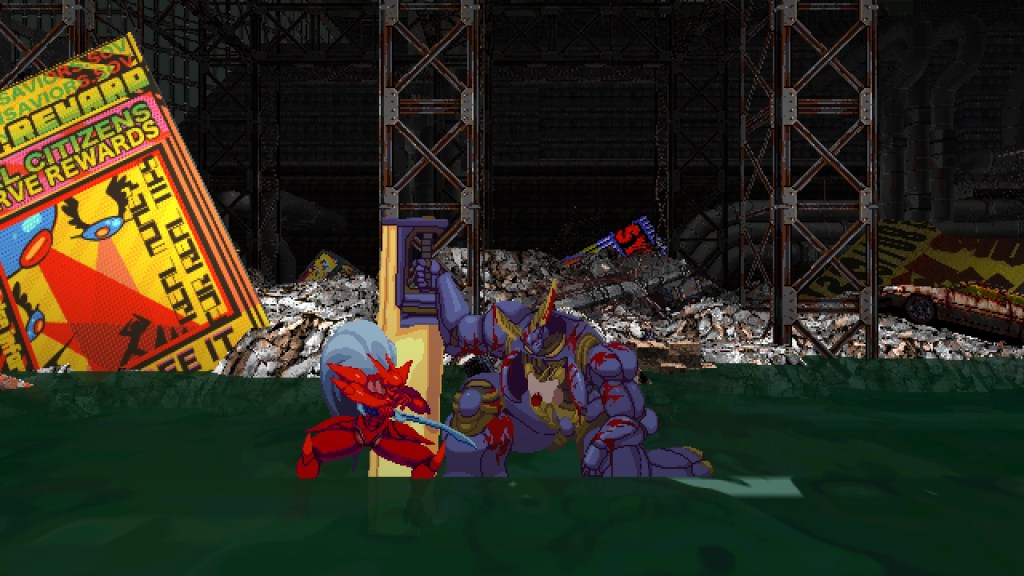
With or without displayed vigor, Slave Zero X is a quality throwback title. While not necessarily a masterpiece, due to occasional input misregistration, sluggish jumping, an obtusely inconsistent parry system, as well as a barebones tutorial that doesn’t properly prepare the player for its nuanced gameplay, slicing and spearing large groups of enemies against a nostalgically grainy 2.5D backdrop of advancement-turned-destruction is a good way to pass the time. After pondering this subject, I’ve realized that I do prefer health bars, but I still don’t know entirely why. Videogames didn’t begin with them, nor does the fun they provide depend on them, but playing Slave Zero X made me miss them a little. Still, I’d never count that as a legitimate criticism. Wait. . . what if we all had health bars in real life? Okay, now I’m taking this concept too far. . . Until next time!
 GotMeThinkingGames
Leave a comment