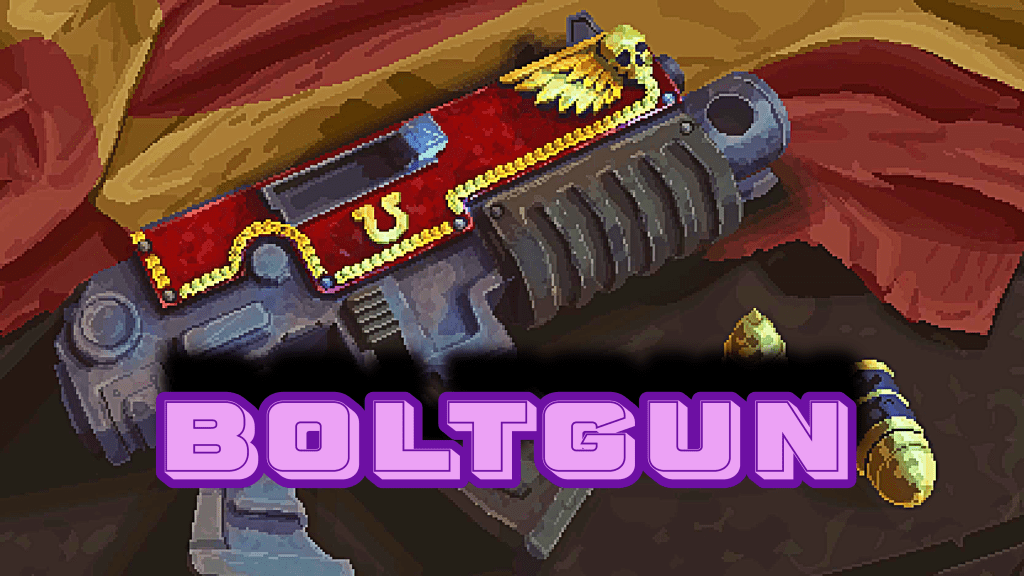
Warhammer 40,000: Boltgun got me thinking about updates. . .
The original conception of a game often goes through so many mutations over the course of its development that it can turn out almost unrecognizable when compared to the creators’ initial vision. Look at Resident Evil 2, for instance, which at first had no Claire Redfield, who would go on to become the recurring co-representer of the Redfield name. A more drastic example is the shift from an isometric horror to a then revolutionary third-person shooter that Resident Evil 4 underwent, though Leon’s fur-collared jacket still survived. What about Doom 2016, which kicked off as a dusty Call of Duty clone with demons? The Icon of Sin would have truly been victorious over the mortal realm had that iteration of id Software’s legendary lore been delivered back then. There are also all sorts of spiritual successors or even official sequels that function much differently than their predecessors, despite retaining a core resemblance. These are titles like Dark Souls after Demon’s Souls, or the Ezio-led Assassin’s Creed 2 that injected an already promising series with so much more life, before Ubisoft stopped putting the same effort into any further revitalizations, crushing the hopes of a franchise Renaissance. Sly 2 Band of Thieves blew my mind as kid, as the entire gang was now playable and whole cities were mine to explore. Even Returnal felt like a third-person rendition of Nex Machina, made from the same developers who had perhaps hoped to make something like Returnal all along. These games seem to represent the idealized version of what came before, possibly brought forth by many factors such as budgetary boons from emerging success, a team becoming fully accustomed to their engine of choice, player feedback, technology upgrades, and more. It’s fascinating to see the different phases games go through as limitation and aspiration go to war.
However, the digital age has introduced us to an unprecedented modification technique that doesn’t involve designing another game from the ground up, just to fulfill an idea’s true potential. It’s the type of modern convenience that allows developers to address their shortcomings as soon as they’re called out for them, while also taking some of the accountability off their shoulders. I’m talking about updates. Patches. New decimal-point versions of the game originally released however long ago, which apparently has more to offer the public than it first appeared. You may ask, “Why didn’t they just wait until the game was actually ready?” A question to which I’d provide the answer, “We’re living in a capitalistic world, my friend. Time is money.” To which you may respond with, “But wouldn’t they get more money in the long run if the product was impressive upon release, and not deceivingly marketed to the masses like gamers have the brains of goldfish?” Which may lead me to conclude, “Life ain’t fair.”
There are plenty of infamous offenders who have decided to just finish it later, whether due to stressfully meeting a publisher deadline or simply not being able to deliver on promises. Teams behind games like No Man’s Sky and Cyberpunk 2077 paraded their ambitious projects around the press circuit, bragging about how revolutionary they would be, only to turn out boring or borderline unplayable, respectively. Disclaimer: I haven’t played either of these games. Not only was I never really interested in the first place, I also became completely opposed to supporting that level of dishonesty, no matter how much time has passed. If you’ve followed the gaming scene at all, then you’ve already seen the thorough coverage of these two disasters. What’s also been covered is their resurgence via copious updates, finally giving each game a distinctive strand of DNA that closely reflects the duplicitous pre-release sneak peeks. But despite how much support these titles get, I can’t drag myself on board. Sure, I believe in second chances, just not really after a blatant scam. I’ll give them credit for addressing the situation rather than giving up and moving on, but they won’t get my money.
What about games that released in a respectable state, but just get even better with changes? Well, that brings me to the subject of discussion. Warhammer 40,000: Boltgun created a big ol’ blip on my radar by following the formula its forerunners so graciously blessed us with in 1993. Despite being completely unfamiliar with the extensive Warhammer 40,000 lore, I didn’t hesitate to download another celebration of classic first-person shooters founded on ferocious bloodlust. My first impression of Auroch Digital’s unexpected release was reassuring. The introduction of a badass space marine being sent into hostile territory all by himself with nothing more than an automatic chain weapon growling at his side (hmm, that sounds like someone else I know) was as straightforward as it gets. After landing on Graia, a planet apparently housing a fragment of an extremely powerful and dangerous artifact, Malum must get to work. He’s arrogantly (and rightfully so) without any guns, so the grinding destruction of flesh is the first method of murder you’ll use against hostile Cultists. The Cultists you encounter are short and stumpy compared to Malum, who stomps ahead like an armored T-rex, mutilating everything in his way. You are a force to be reckoned with, a supreme example of what the Space Marines are capable of. As you use the chainsword, a medieval torture device with a handle, enemies will be highlighted with a red outline, signifying lock-on when holding the L2 button. When L2 is released, Malum will be automatically magnetized to the unlucky meat-bag who dared fire in the Space Marine’s direction. There is also a deadly charge, activated by L1, which allows Malum to blitz through bodies, dying his blue armor red. The breezy, bloody beginning to the game gets significantly breezier and bloodier when the Boltgun is found. The game remains very aware of its title, as a heavenly choir of praise and honor accompany Malum’s first sighting of the floating tool of destruction. It didn’t take me long to understand why the Boltgun was the center of attention, as it shreds through Cultists like a long-range shotgun, leaving behind nothing but puddles of human stew.
Controlling Malum is a total treat. After making some tweaks in the fleshed-out settings menu, I was gliding around each map with incredibly smooth aim. There is sadly no auto-run option available, but once running is toggled with the left analog stick, it’s likely you won’t have to worry about it for the rest of the mission. Malum can also jump significant distances, as well as vault ledges. A lot of the time, the sprawling level design serves as a jungle gym for Malum, who can leap from one jutting chunk of stone or metal to the next. Fall from a high enough height, and Malum can splatter enemies beneath his bulky boots, or at least damage stronger foes with a thunderous slam. I was impressed by how the weight of Malum was retained without sacrificing mobility. You’ll appreciate the engineers of Warhammer 40,000’s universe, who were able to craft such protective and functional armor suits for the fearsome Space Marines.
Now let’s get to the point. . . When covering Dusk back in December 2023, I highlighted the creativity of Dusk’s creator, David Symanski, and juxtaposed his innovative twists on a classic blueprint with Auroch Digital’s unornamented approach. I had played each game almost back-to-back, so I wasn’t randomly choosing Boltgun as my black sheep, nor did I ever consider the game to be bad by any means, rather I was so swept up in the eerie magic of Dusk that I couldn’t find the same engagement with Boltgun. However, a couple of issues having nothing to do with Dusk comparisons contributed to my struggle with loving Boltgun as much as I would eventually grow to do (as this post will soon reflect, if it hasn’t already). First, Boltgun’s lengthy, winding levels quickly became tedious to navigate. Getting turned around twice or more on the same map resulted in a grating amount of backtracking. Because fanatical violence is at the core of the game, it could feel like a tease to discover a few enemies spread here and there like breadcrumbs, only to take a wrong turn and see the corpses of those who have already been dispatched. This brings me to my second primary complaint. You can decide if it’s shallow or not. Whenever I found the next major arena, enemies would spawn profusely, initiating a purge. Unfortunately, this would also initiate a red filter to appear over the screen for the entire duration of the fight. Therefore, during the most important, inescapable fights for your life and the honor of the empire, your vision is somewhat obstructed. Sure, it’s a slight obstruction, but an obstruction nonetheless. Maybe there are sets of eyes out there that are impervious to irritation, but mine are picky. I didn’t see the point of the filter at all, and wondered why Auroch Digital even decided to include it. If a screen effect was dedicated to a temporary power-up, then it would be much easier to understand (unless it’s the screen effect for invincibility from Doom. . . Okay, that’s the last bad thing I’ll ever say about Doom) but to repeat the gimmick so often is a weird call that I just couldn’t overlook.
As you may have guessed given the topic of this post, Boltgun received a significant update when its DLC dropped, which brought a Horde Mode to the table, as well as a purchasable new chapter called “Forces of Corruption.” When the DLC first came out, I wasn’t very interested, as I hadn’t even finished the game’s third and final chapter by that time. I admit that I gave up on Boltgun, a decision that surprised me, as I frequently pray for more boomer shooters to reach the PS5. Adding to my surprise was the fact that I enjoyed so much about Boltgun. The crunch of bones and bent armor plates as you obliterate Chaos Marines (ex-Space Marines who have been seduced by the toxic forces of the archenemy called Chaos. I’ve yet to research more about their origin, but I’m still playing Space Marine 2, so I’ll get there eventually), the variety in weaponry that encourages strategic ammunition expenditure influenced greatly by the type of enemy you’re facing, as well as the inclusion of fun power-ups that are hidden during key clashes (making for a hide-and-seek element during longer battles that are stuffed to the brim with extremely tough and resistant creatures), all blended nicely together to create an atmosphere of lurid intensity. Regardless, I still dropped the game and couldn’t be bothered to return. That is until Space Marine 2 arrived.
The cooperative nature of Space Marine 2 is what convinced my best friend and I to download the game, though neither of us knew much at all about Warhammer 40,000, nor had we played the first Space Marine. After well over one hundred hours spent watching our limbs shoot off in all directions in the midst of an eagle cluster bomb, we figured it was time to branch out from Helldivers 2 and exterminate alien insectoids. . . again. . . but from a different angle this time. A zoomed-in, over-the-shoulder angle, to be exact. Despite Space Marine 2 severely lacking the same replay value as its squad-based, horde-purging peer, the distinct and downright beautiful presentation of the game, as well as plenty of gritty, demanding action contributes to a satisfying story-mode that carries with it a vintage flavor, as you linearly blast and brawl your way through a series of lengthy missions till reaching the bombastic end. While I have yet to organize my final thoughts on Saber Interactive’s sequel 14 years in the making, my friend and I were at least drawn into the vivid world of Warhammer 40,000, a world that has acted as a canvas for many other titles. Most of these titles appear to be turn-based, a stipulation I tend to avoid, as I haven’t engaged with anything resembling turn-based since Pokémon on the Gameboy. That could explain why I’m not as familiar with Warhammer 40,000 as part of me would like to become. However, as my friend began to share whatever he was learning outside of Space Marine 2, I remembered a particular FPS that I had left for dead in the mountainous heap of my digital backlog. . . yes, that’s right, it was Boltgun. Suddenly, I felt far more motivated to give it another honest shot, urged on by the emperor’s will. What followed was a back-and-forth marathon of Space Marine 2 and Boltgun that saw me fly through the latter with a giant smile on my face, including its bonus DLC chapter.
So, what changed?
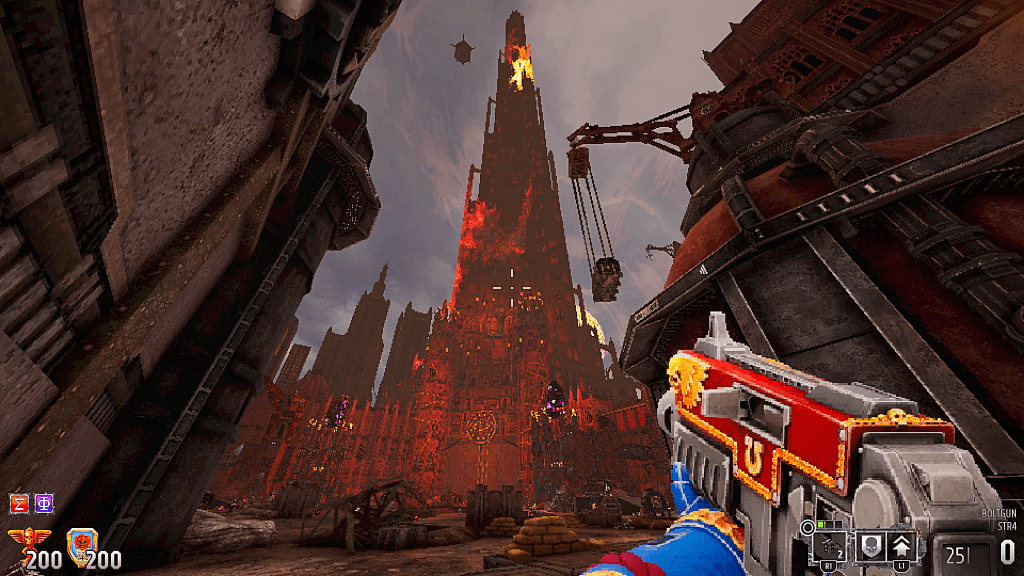
Behold! The glorious update! Just like that, the small yet irksome issues I had with the game were gone. The option to prevent the screen from flaring red during a purge had finally been so graciously gifted. Also, pressing the middle pad on the controller now activated a dotted line and objective marker to follow when lost in a twisty level, thus ensuring the player is no longer separated from the action for too long. These refinements fogged my brain with their breath and wiped it with a microfiber rag. I began to think of Boltgun as a brand-new game, one that deserved a full playthrough, completed in chunks of several absorbing hours at once. I found myself toggling the compass quite a bit as the teeth of my chainsword rumbled hungrily for the tainted flesh of Chaos. Everything suddenly clicked. Balls of icy blue plasma shattered like glass at the feet of Cultists and Chaos Marines, obliterating their bodies with radial damage. The Heavy Bolter delightfully pumped devastating rounds into the stinking, bloated bodies of Plague Toads, no reloads needed as Malum holds on tight, hunkering for the kill. The Grav Gun all but blotted out Lords of Change, the birdlike monstrosities finished off with an impact Krak grenade once the green stream of strange energy runs dry. In short, I was able to see the game for what it really is: a torrential storm of bitter tenderization in the name of the emperor! Although I continue to laud games like Dusk for their cross between inspiration and innovation, and still consider Boltgun as an appropriate contrasting example in my previous review, Auroch Digital finds success in replicating the nonstop pace of 90’s shooters that players relish to this day, wrapping it in the messianic shroud of Warhammer 40,000 lore and adding silky smooth controls to boot. The colors, sounds, and gory goodness encompassing Malum’s dangerous mission each reverberant step of the way make Boltgun an easy recommendation, especially for newcomers to the franchise who want to dip their toe into this chaotic realm without feeling clueless or completely out of the loop.
What’s so fascinating about my saga with Boltgun is how significantly my reception of the game changed with such seemingly inconsequential updates. Updates of course provide an advantage for developers to fine-tune their games post-launch, yet they might also provide excuses for developers to consciously fall short of their promotional promises, which could take months and months or even years to officially make good on. Then there are titles that, without updates, are immediately deserving of acclaim, and only incorporate future downloads as a means of keeping things fresh. The aforementioned Helldivers 2 has woven countless updates into its roadmap, using Warbonds (upgrade packages that include game-changing weapons and boosters) as a way to recapture dwindling player attention. This is the way the game was conceived, so to fault it for such a thing wouldn’t make much sense, but reviewing it can be a difficult thing to do, as with each patch also comes all sorts of other experimental tweaks to gun damage, enemy damage, equipment functionality, ect.
I suppose it can be concluded that the story of each game’s development will always vary. Certain titles are designed to be supported with updates, making it hard to permanently pin-down exactly what works and what doesn’t. Others are not tested quite thoroughly enough to catch every misstep and must be understandably reexamined and improved upon. The rest require updates to fix a blatant mess of slipshod design, which feels disrespectful toward day-one players who have unwittingly trusted predatory marketing. One thing is for sure; modern gaming is much different than what came before, as we see fluid projects transform on a dime via digital edits and new additions. In the case of Boltgun, a couple of very minor modifications have led to my investment of over fourteen hours into a fantastic throwback FPS that could have been spent doing something far less productive, like getting my life together. I’m glad I gave Boltgun another chance, but there’s an alternative universe out there where I never played Space Marine 2, and therefore never thought to give Auroch Digital’s game the time of day, unaware of its updates. That must be the Chaos-dominated timeline. Anyway, I guess I ought to finish Space Marine 2 now. FOR THE EMPEROR!
 GotMeThinkingGames
Leave a comment