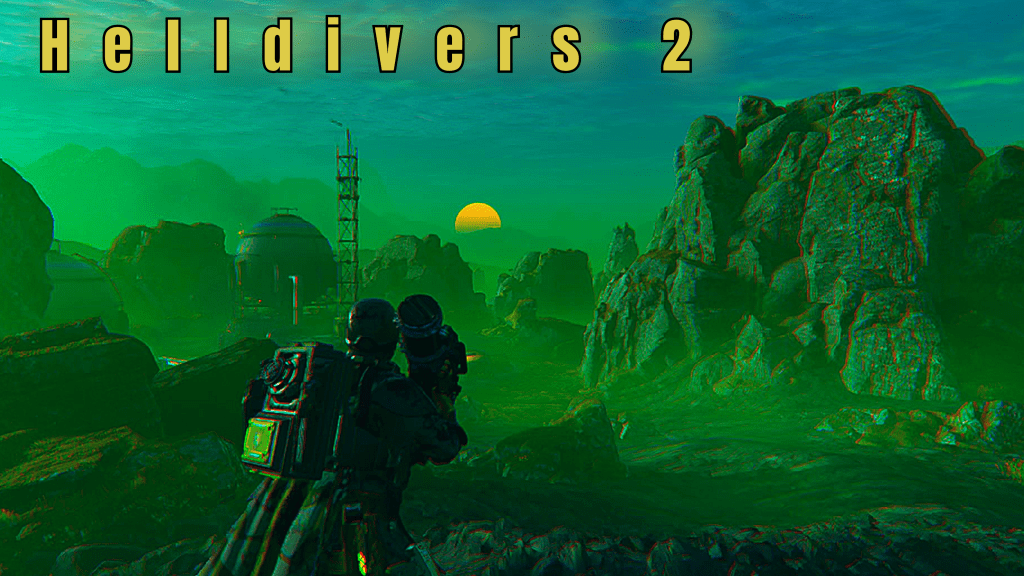
I stubbed my toe yesterday and immediately thought, “I NEED STIMS!” as I crouched in pain. The instinctive reaction was a clear result of recently pouring hours upon hours into Helldivers 2 with my cousin and best friend as a squad of three. Typically, I avoid grindy multiplayer experiences laden with repetitive objectives and deceivingly vapid cosmetic rewards. However, though live-service elements have been woven into the fibers of Helldivers 2, the game never feels too stingy with its fun. Unlocking new, potentially game-changing gear by collecting and spending in-game currency prevents the experience from becoming toilsome. You could buy everything you want outright, but then you’d eliminate the fantastic feeling of stumbling upon coveted Super Credits while on a mission. But to truly get the most out of Arrowhead Game Studios’ latest, it’s all about working with what you’ve got. Make sure you’re always deploying with the right kind of squad, one who can laugh at the guaranteed mishaps, glitches, and extreme chaos that is sure to follow each and every deployment onto the surface of another foreign planet surrounding Super Earth.
What’s Super Earth, you ask? It’s Earth, but super. Super Earth is the nucleus of the galaxy. The Helldivers fitted to protect its surface and expand its democratic reach have dedicated their lives to imperially squashing any threat against the deeply egalitarian vows that Super Earth makes to its obsequious citizens, as long as they constantly follow orders. Every day, Helldivers are launched from enormous ships that loom among the stars. They shoot down in hellpods like meteorites, landing with a thud and releasing the brave driver into the battlefield. It is then their pressing duty to complete various liberty-preserving tasks like launching rockets that target enemy territory and saving trapped citizens from certain death. Sure, some of those citizens must die to ensure the safety of the rest, but that’s a risk the Helldivers are willing to take.
At first, I wasn’t entirely impressed with Helldivers 2. That’s because I kept dying. Why are my magazines so low? Why are there 23 spider-like insects leaping fifty yards ahead to stun-lock and promptly kill me? Why did that airstrike just blow me into a thousand bits when I thought I was out of range? These are the questions I remember asking myself out of frustration. I still ask these same questions to this day, but with an exasperated smile on my face instead of a scowl. So, why the change of heart? Well, the more I played, the more I realized Helldivers 2 is supposed to be so hectic that it can feel unfair. Helldivers are expendable employees, though the Federation of Super Earth makes them believe they are all valiant heroes, purging the galaxy of tyrannical evil and dying for the best possible cause. That illusion is quickly shattered as you deploy on your first mission, whether it take place on a planet overrun by Terminids, a race of gigantic, acid-spewing bugs, Automatons, which are basically the endoskeletons in Terminator, fully loaded with all sorts of anti-human weaponry, or Illuminates, an alien race with high-tech weaponry and War of the Worlds style creatures at their disposal. You’ll notice that the odds are perpetually stacked against you (by the way, take note that there are now 10 difficulty levels in Helldivers 2. I have been primarily playing on 9 and 10 for a while now, so my perceptions are based on the most demanding difficulties. Experiences may vary given such a big scale). Dozens of bugs dig themselves out of underground hives when a Bug Breach occurs, just like dozens of robots are delivered in massive ships during a Bot Drop, while the warning of, Illuminate Ships Incoming, will hearken exactly that. Bug Breaches, Bot Drops, and Illuminate deliveries are, simply put, instant spawns of enemy forces designed to overwhelm the Helldivers, and overwhelm they do. Before you establish the proper communication required to protect yourself and your teammates, you’re guaranteed to start chucking airstrike markers at anything that moves, even though whatever bombs are being dropped may very well send your own body parts into orbit too.
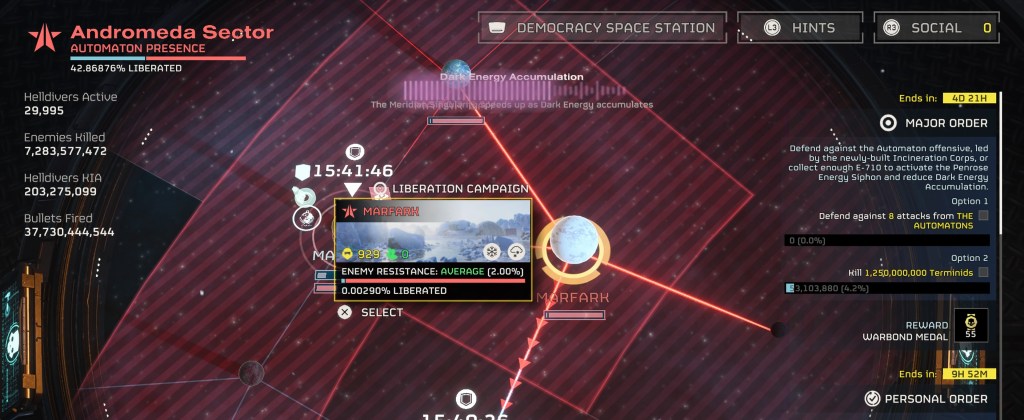
The gameplay loop is simple yet addictive. Maybe the joy of reckless slaughter keeps bringing me back, or maybe it’s the intoxicating satisfaction of enthusiastically showering all those that don’t know what’s good for them with enlightening lead, but whatever the case may be, Arrowhead Game Studios has presented players with a formula worthy of indefinite repetition. Starting a session unfolds as follows: squads will assemble on one member’s Destroyer vessel, a huge spacecraft capable of zipping from one solar system to the next at light-speed like the Millennium Falcon. There, they can high-five, exchange morale-building hugs, purchase upgrades and cosmetics, then meet at the Galactic War Table to select an operation (a series of three back-to-back missions of varying length, which take place on planets overwhelmed with one of the three aforementioned enemy types. There is no mixing yet, but I wonder if that’s soon to come). Once selected, it’s time to enter the pods, select loadouts, then launch through the blackness of space, accented by beautiful backdrops of surrounding planets. After landing, you’ll likely stop to take in the vast horizon, the glow of moons, stars, and other Destroyer vessels sending down stratagems through the artfully implemented skyboxes.
The missions will range from ten minutes of allotted time to forty, depending on what needs to be done. If, for instance, shuttles need refueling, then the Helldivers are given forty minutes to carry out the process. It’s easy losing track of time when you’re squeezing in some bonus exploration, hunting for sub-objectives that allot extra XP, and plenty of goodies like abandoned weapons, Super Credits, and other in-game currencies that can be invested in several upgrades. If, however, the only objective is to eradicate the enemy presence, then players are thrust into a short and chaotic horde mode, where bugs/bots/illuminates pour into a condensed map until you kill the required amount. Did you kill 80% of the menace, but you’re pinned down, low on lives, desperate to preserve yourself and reequip for a new task? Well, no shuttle is coming to save someone who’s content with only purging most of freedom’s adversaries. Good luck.
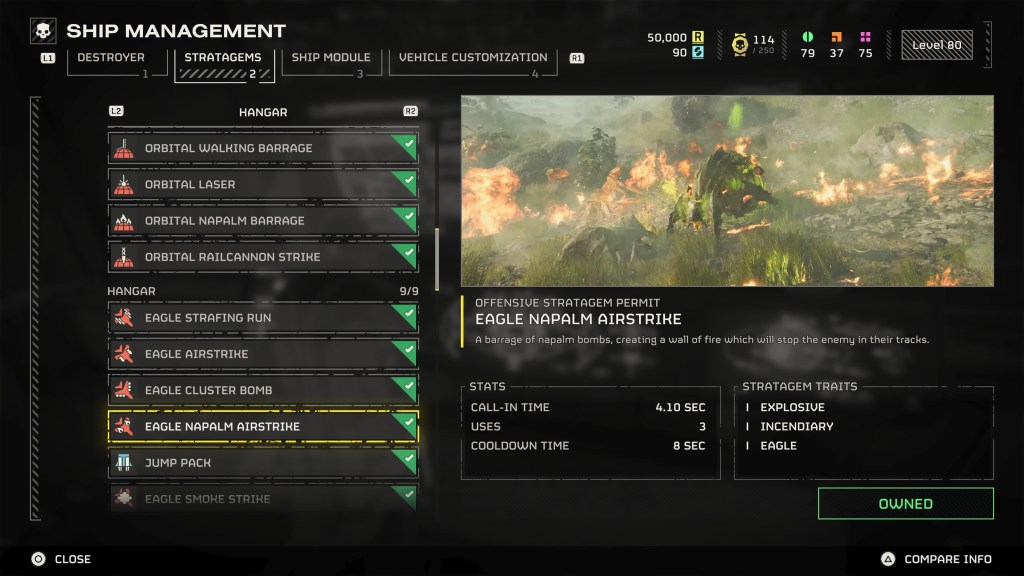
A group of Helldivers are only as powerful as their best stratagems, so please choose carefully, for the sake of democracy. Stratagems are heaven-sent. From the sky falls glorious napalm, laser-beams, turrets, railguns, landmines, ect. Each Helldiver is backed up by their Destroyer. When things get hairy (and they almost immediately will), brave freedom fighters can enter different codes on wrist devices that will activate whichever stratagems they’ve preselected before the start of a mission. After a brief delay, the Destroyer ship will graciously drop what you’ve requested. Throw a stratagem beacon in the wrong spot, however, and it may be rendered entirely useless. I can’t count the number of times I’ve thrown Eagle Cluster Bombs into a crowd of fast-approaching Hunters, only for the bugs to skitter away from the blast zone, resulting in an unproductive explosion on empty dirt as I fall victim to dictatorial stun-lock. Luckily, the Eagle Cluster Bomb allows 5 uses before it must recharge, so missing isn’t a huge deal. There is no limit to the Eagle Cluster Bomb recharges, though the same can’t be said for every airstrike. For instance, the Orbital Laser, an extremely effective blast of blazing heat that will automatically target the most dangerous nearby targets, only allows for three separate uses over the course of a mission, each separated by a significant cooldown. This requires Helldivers to choose very wisely when spending their airstrikes. . . munitions ain’t free!
Support weapons, backpacks (including the gleefully liberating Jump Pack), turrets, mines, and emplacements are all non-airstrike stratagems that allow Helldivers unlimited uses throughout a mission, with the caveat of typically lengthier cooldowns. The obvious goal of calling down carried gear like an Autocannon or Jump Pack is to maintain possession of it for as long as possible. However, after being stomped on by a Bile Titan or blown to bits by a Factory Strider, guns and backpacks will be scattered amidst the stumps of what were once your arms and legs. As the only way to return to combat as a reinforcement is to be called in by your teammates, you may not return to the same place where you lost your valuables. Not everyone can sling Hail Mary’s like a prime Aaron Rodgers, so if your comrades are busy repelling tyrannical forces on the other side of a huge map, they can only toss a reinforcement beacon so far. This will result in a mad dash back to your discarded gear. Or you could ask your friends to drop something for you in the meantime, if they have a spare that’s ready to go.
Sharing stratagems and boosters adds a satisfying cooperative element to Helldivers 2. Each Helldiver is given four slots for their loadout. Fill them however you like. Four support weapons and no airstrikes? Sure, why not? You can be the guy to equip everyone else with some extra firepower. Or would you rather bring automatic and manual turrets, surrounding yourself in a circle of heavy defense with the caveat of potentially misplacing such a bulwark in a not-so-active area of the map? That’s for you to decide. After all, this is a democracy. When your squad is focused on the same task in the same place, quick communication can go a long way in making the most out of your joint resources. It’s a shame when one Helldiver puts a Bile Titan to sleep with a perfectly placed rocket from an Expendable Anti-Tank launcher, just before another wastes an Eagle 500kg bomb on what’s already become a harmless corpse. Instead of exhibiting such rashness, servants of The Federation of Super Earth should try their best to preserve stratagem usage and ammo expenditure by keeping each other aware of what they can offer at any given moment. It’s fun to mull over who’s bringing what before beginning the next mission. “If you bring a Jump Pack, I’ll bring an Anti-Material Rifle, then we can trade later on,” is an example of such discussions. In regard to boosters (which provide passive advantages like extra health or stamina), Helldivers can select one per mission. Currently, my friend owns a booster that I have not yet unlocked. It adds a burst of speed and stamina to the whole squad’s stim uses. This allows for much better chances of escaping a seemingly hopeless situation. I love this booster but can only use it when my friend selects it, reinforcing the ever-important team aspect of the game.
Not everything goes according to plan when the dissolution of democracy looms over our heads. There is so much that the Federation of Super Earth must account for when repelling hostility. Oversights are all but unavoidable. The potential success rate of new solutions must be painstakingly evaluated and reevaluated before implementation. Dissenters may suggest that these natural challenges to our cause result from negligent supervising, but us freedom fighters understand that it’s all part of the job. In other words, Arrowhead Games Studios has deliberately (and maybe not so deliberately) added several elements of the game that provide an extra layer of inconvenience, though such inconveniences often feel inherent within the context of the universe they’ve created. For example, actively reloading your weapon doesn’t conserve and carry the ammunition over from your currently loaded clip to the next. Makes sense in real life but betrays the videogame logic we’ve been so conditioned to follow. The temptation to reload with only a half-clip left while getting chased by terrifyingly invisible Stalkers, knowing the ammo you have left won’t be enough to dispatch the one that’s gaining fast, but also dreadfully aware that reloading will also take too long to save yourself while wasting a valuable half-clip of bullets, is a recurring issue that really puts you into the boots of a disposable soldier.
Another, more obvious reflection of duty’s necessary dilemmas is the completion of stratagem codes. Each time players want to activate a stratagem, they must use the D-pad to enter a sequence of directional inputs. The complexity of the sequence depends on which stratagem is being called down. For instance, a Hellbomb (basically a mini-nuke) that can be used to complete certain objectives by shredding through the structural integrity of otherwise indestructible buildings like gunship fabricators on Automaton planets, demands many more button-presses than a much less devastating Eagle 500kg bomb. Failure to follow the directions will force Helldivers to restart the sequence. This can, of course, lead to death, as timing is often very important. The fact that Helldivers are forced to enter such codes or be left unassisted is quite funny when you think about it. But don’t worry, a mini-game called Stratagem Hero was added to Destroyer vessels, so Helldivers can get plenty of reps in (my friend has become abnormally good at it).
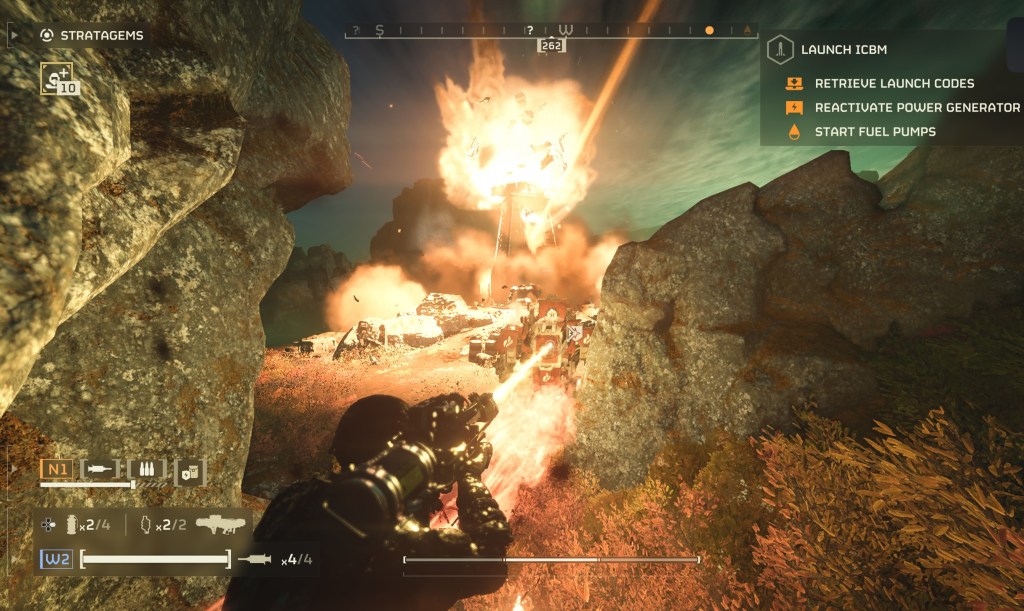
Certain objectives also demand stratagem inputs, or some other busy work that leaves players open to the angry abuse of the always active AI. At some point or another, players must interact with terminals connected to important mechanical functions, like hatches opening, radars turning on, rockets being fueled, and many more. Each function requires a different number of steps to be completed at the terminal, and each process typically ends with a final stratagem code. Sounds simple enough, right? Wrong. I can’t count the number of times I’ve gotten so close to finishing an objective, only to be driven away from the terminal by hordes and hordes of enemies. Even standing still and undefended for the three or four seconds it may take could very likely be too long to wait. Between laser projectiles, spewed bile, leaping Hunters, Meat-Saw wielding robots, and a host of other immediate dangers depending on the planet, Helldivers can easily lose their lives while trying to accomplish the most menial tasks. It would be a real shame to read the headstone of a Helldiver who single-handedly exterminated thousands of bugs in his long and illustrious career, only to be rag-dolled while trying to virtually connect pieces of a pipeline.
Here Lies Murray Cooper
Attainer Of A 678 Kill Streak
Brave Warrior
Killed At Terminal
Other purposeful and questionable mishaps include losing your footing when landing from a Jump Pack boost, getting stuck beneath large corpses when your Hellpod lands on them with no choice but to drop a stratagem on your own head so you can be called back in, being shot while holding a stratagem beacon (thus accidentally letting it go at your own feet), falling into a massive crater to your doom, losing a valuable support weapon by calling for it too close to a cliff (atop which it will then be stuck forever), among others. Again, some of these misfortunes initially felt like glaring design fumbles. However, as you grow to embrace such honorable monikers as “Free of Thought,” you’ll allow yourself to truly roleplay as a dedicated defender of Super Earth by any means necessary. At this point in my experience, running into weird glitches and slim-chance predicaments act as highlights of the mission. My squad and I will burst out laughing at watching one of us get served some horrendous fate, while everyone else must maintain their enthusiastic demeanor, shouting taglines like, “For Liberty!” as bottomless enemies fill the field.
As any modern game, especially one that’s live-service, updates roll out frequently, slightly changing elements of the gameplay. Arrowhead Game Studios has consistently released new Warbonds, where weapons, boosters, armors, skins, and emotes can be purchased each season for Super Credits, real cash, or a combination of both. The Warbond itself must be purchased in full before accessing what it offers. Then, players use medals (currency that is exclusively earned in-game) to unlock the Warbond’s inventory. Therefore, even if you only see one or two items that spark your interest while previewing a Warbond, you’ll still have to cough up 1,000 Super Credits for the whole thing.
Typically accompanying the release of another Warbond are several tweaks to extant gear and stratagems. Since I began playing, I’ve noticed several buffs and a few nerfs, influencing me to start using certain weapons or stratagems more or less frequently. I see how this could annoy some players, who have already established their favorite combinations and must now part ways with a suddenly less viable version of what they’ve grown attached to. I personally don’t mind being pushed out of my comfort zone in Helldivers 2, because there are tons of interestingly synergistic pairings to be discovered. The benefit of teaming up with partners who are also willing to experiment is that I can afford to dabble in many different methods of destruction. Depending on developer updates, mission type, or simply my own skill as I progress through the ranks of Super Earth’s finest, I’ve already noticed my loadouts changing much more consistently than before. For instance, after acquiring the Shield Generator Pack shortly after I first started, I couldn’t fathom surviving without it in the face of long-range Automaton onslaughts, or Hunters hurling themselves one hundred yards ahead to come and claw my arms off. As I began to understand the best times to engage and disengage, how to manage my ammunition, and which weapons to use against certain enemies, I realized I had officially graduated from the Shield Generator Pack, which had evidently been acting as a crutch. To shed the safety net was to spread my wings and be free. With another slot to fill, I was able to bring more firepower and less fear-numbing equipment. Since that breakthrough, I’m always willing to try something new. Sometimes, these attempts fail miserably. If I’ve mixed and matched problematically, the reality of my blunder will set in quickly. There’s a good and bad side to this. What’s bad is how quickly I can drain the squad’s reinforcement capacity (oh, yeah, you share available lives with the rest of your deployment, and each member’s deaths are kept track of and displayed at the end of the missions, so black sheep can’t escape democratic judgment). What’s good is the creativity I’m forced to employ, even begrudgingly so, when stuck with gear and stratagems that I just don’t jive with. It can still be fun to figure out new ways to survive, though hitting a stride with my favorite loadout is always a superior feeling than scrambling around, attempting to scavenge support weapons leftover from previous Helldives.
Updates may also include major additions like new stratagems. The Orbital Napalm Barrage was a nice surprise, as the airstrike immediately proved to be a devastating bug-burner, capable of turning huge patches of land into a smoldering inferno. It’s become a staple of my arsenal when dropping down into a Terminid infestation. Burn, baby, burn, I think, as my eyes light up at the sight of missiles raining down, each filled with scorching death. There have been too many new incorporations to note here, just know that Arrowhead Game Studios has kept their game alive in a more impressive manner than most live-service games I can think of, whether I’ve actually played them, like Mortal Kombat, or paid only enough attention to their coverage to scoff in contempt. After over two hundred hours in the game, I still don’t feel abandoned by the developers, a satisfying feeling that’s all too rare in the modern gaming landscape. In fact, just before publishing this post, my friend and I dropped into Automaton territory and were immediately blasted by a new iteration of Hulk enemies, which now shoot terrifyingly huge mortal shells, as well as alternate version of the Heavy Devastators, which, instead of carrying plasma machine guns, were equipped with massive shotguns that shoot flame-laced shells. Needless to say, we were incinerated almost immediately, yet still managed to complete the mission (just saying. . .).
The straightforward premise of Helldivers 2 sneakily blends itself with nuanced loadouts, alternating mission structure, bonus exploration, meaningful cooperation, and pure chaos to attain its status as a fantastic multiplayer experience. Sure, I can get tired of it, but after a couple weeks of not playing, I’m always eager to jump back in. Sadly, we’ve temporarily lost our third squad member, as my cousin is actually assisting the armed forces of the here and now in Africa while my friend and I continue roleplaying as freedom fighters in a videogame. It’s still fun with the two of us, just not quite the same. . . Still, we continue our duty, never satisfied until each and every planet surrounding Super Earth has been entirely purged of its evil, power-hungry population. For Super Earth!!!!!!!!!!!!!!!!!!!!!!!!!!!!!!!!!!!!!!!

 GotMeThinkingGames
Leave a comment