I’ve been chipping away at a few isometric indies lately, and here’s what I have to report!
KILL KNIGHT
Does KILL KNIGHT really deserve its all-caps status? The answer is yes. This twin-stick shooter starts and ends with a bang. In-between? All bangs. Your journey through Hell’s depths will cause you to think all sorts of terrible things about your thumbs as you die, die, and die again, blasted by lasers, slashed by arthropodal demons, incinerated by eagle-eyed angels of the fallen variety, and more. The concept is as blunt as they come: conquer five layers of Hell by killing everything in sight, unlocking each subsequent stage with your victory. Easier said than done.
The game functions a lot like one of my all-time favorites, Nex Machina. However, hints of an RPG are included here, as players can create their own loadouts from several unlockable items before setting out on another run. The Kill Knight himself is garbed in medieval armor and equipped with enormous guns, as well as a sword to hack the legions of Hell into pellets of ammunition. There are several primary pistols, heavy secondaries, armors, and swords to experiment with, unlocked via fun yet often tricky challenges that are listed at the start of each run. If, however, players can’t quite complete every optional objective, they can alternatively purchase locked items with the points they accumulate from failed or successful runs (successful runs will obviously award more points).
Trying to unlock each new piece of gear is an addictive commitment that fuses with the already extremely addicting gameplay. Rule number one is to never stop moving. Rule number two is to never stop shooting. In fact, the only time your finger is allowed to stop squishing the trigger is when reloading, which will automatically occur when a clip goes empty. During this brief reload period, an opportunity to activate what’s called Active Trigger will present itself, resulting in your primary weapon’s projectiles growing in size and damage output, benefits that can be prolonged for the entire duration of a mission by continuing to nail the Active Trigger timing window by tapping R2. Doing so is quite satisfying, due in part to a congratulatory sound cue, as well as the reassurance that comes with bigger, beefier bullets flying from your guns in a stream of hot red plasma. Some have standout functionalities during Active Trigger, like the set of pistols that sends the Kill Knight spinning in a circle to send out rounds in a whirl of death, thus creating space from the ever-pursuing monsters closing in at every angle. You’ll know you’re getting overwhelmed when successful Active Triggers become less and less consistent, as this typically indicates fragmented focus from so much happening on screen at once.
Secondary weapons pack a punch but cannot be used as frequently as primaries, since secondaries require ammunition and primaries do not. Ammo can be gathered only from enemies that fall to the Kill Knight’s sword. Because of the direct relationship between the sword and secondary weapon, my initial lacking commitment to melee meant that I also wasn’t using my secondary very much. Big mistake. For Kill Knight to truly fire on all cylinders and provide the intended rush of tight, hectic battle, you’ve got to treat each tool equally. The good news is, Active Trigger can also apply to the Kill Knight’s sword if players press square at the right time rather than R2. My favorite sword, a blade almost as big as Guts’ from Berserk, summons rotating shockwaves on Active Trigger, coming in especially handy when the stage shrinks and fills with suffocating swarms.
Left in the wake of each obliterated corpse, no matter how the job is done, will be little red gems that, when collected, contribute to the Kill Knight’s Wrath meter. When this purple bar fills, the secondary weapon’s special Wrath attack will be chambered. Each secondary has a different Wrath attack, which will outright kill minor demons and coat fiercer foes with a shade of purplish blue, indicating that when killed, they will now drop shards of sweet, sweet health. I’m a big fan of earning your own survival in games, as opposed to waiting for health to recharge or having it appear in an overly comforting abundance, so I like the fact that the vital resource is tied directly to strategic gameplay. Besides, firing out tendrils of seeker missiles to shatter the carapace of a charging mammoth, or shooting a giant Wrath ball that slowly slides across the stage, gobbling up anything in its path, is extremely satisfying on its own. When all the mechanics click into place, you’ll know the A or S rank is on its way.
A major difference between Playside Studios’ game and Nex Machina are its fluid stages. In the latter, each level was layered with multiple planes. After creating a clean slate, the protagonist would flip and float through the air, soon landing onto the next leg of the level. It was an entertainingly disorienting gimmick that let players wipe their sweaty palms against their pantlegs every so often. In Kill Knight, the size and shape of the stage will mutate at will, either growing large enough to get some breathing room or tapering into an entirely claustrophobic square, filled suddenly with deadly laser beams and rotating columns with harsh stone teeth. I think I prefer the momentum created by Nex Machina’s approach, but I have no real complaints about the way Kill Knight operates.
Before we move on, I must throw myself under the bus. After completing the game on the normal difficulty, called ‘Acolyte,’ I am currently stuck on the fourth level of ‘Knight’ mode. It’s been a long time since I’ve needed multiple sessions to complete a gaming challenge, as opposed to spending hours pushing through it in one sitting. I do have more responsibilities in my life now, so maybe that plays a role, but I don’t remember being this stuck since battling Nightmare Grim in the Hollow Knight DLC. Still, I am committed to victory, but that doesn’t mean I’ll be trying the even harder ‘Sever’ difficulty anytime soon . . . or will I? Whatever the case, Kill Knight is a fantastic twin-stick shooter with loads of replay value. If you like intensity, strategy, resource management, and experimentation, you’ll surely get sucked into the pits of hell when you pick up Kill Knight.
Crow Country
Staring into the flames,
I feel something…
It’s a curious mixture of hope and dread.
Maybe everything will be okay
And maybe it won’t.
This is the monologue that Agent Mara Forest recites before each player save in Crow Country, a nostalgic new addition to the survival horror genre by SFB Games. Mara’s feelings fit my own when navigating the abandoned amusement park called Crow Country (named after its founder Edward Crow), which is loaded with novelty décor and humorous detail, but also teeming with hobbling, deformed organisms that range from resembling human beings to literal puddles of flesh, blood, and organs. It’s a curious mixture of whimsical coziness and mysterious foreboding that sets Crow Country apart from its 90’s survival horror counterparts.
Mara has come to the park to find Edward Crow. It’s been shut down for years after a young girl named Elaine Marshall was attacked by an unidentified person or thing when veering off from the central attractions, resulting in a strange, uncurable infection. Edward Crow chose not to address the incident or take responsibility, electing to instead hole up in the park somewhere, ignoring legal summons while committing himself to another task, one far more self-serving. It’s divulged early on through various documents that Edward Crow has been illegally mining gold at the site of his park, in cahoots with multiple partners who also remain rather elusive toward law enforcement. Is it plain greed that urges Edward to play his cards so close to the chest, or are there other factors too?
I tried playing Crow Country once before when it first came out. However, I found myself somewhat disengaged, as kits of health and cases of ammunition were littered all over the place, making me feel like I was definitely going to survive this rather non-horrific ordeal. Therefore, I let it hangout in my backlog until I was in the mood to give it another go. Well, that mood came along recently, and I was pleased to see a new difficulty option had since been released called Murder of Crows. This option reduces health and ammo pickups, removes hints given by fortune-telling crow machines, gives Mara an aversion to digging through trash cans that provide random items on the standard difficulty, and partially cripples Mara when her health is low, preventing her from running around to avoid enemies. Although the game is still plenty forgiving, Murder of Crows added just enough tension to earn my respect.
Crow Country functions like a classic Resident Evil, including basic combat, an interconnected setting, puzzles, and a narrative delivered mostly through discoverable documents as well as the occasional appearance of another NPC to possibly provide a few answers while simultaneously spawning many more questions. What’s significantly different is the game’s tone and central narrative, as Crow Country revolves around a mystery that has essentially nothing to do with major government/military conspiracies like the members of S.T.A.R.S. uncovered in the Arklay Mountains. The vague tale of Edward Crow’s gold mine and how or why it connects to Elaine Marshall and the emergence of disgusting creatures is self-contained in a rather small and unassuming amusement park. I thought I could solve the riddle of Crow Country for so long, only to be proven completely wrong by a few notable twists and turns that put a smile on my face toward the end of the game, as I realized this story was truly idiosyncratic and worthy of reflection.
Perhaps the most alluring feature of Crow Country is its charm. First of all, the look of the game is immediately inviting. Classic blocky PlayStation character models combine with prerendered goodness to create a 90’s homage that feels slightly claustrophobic yet oddly comforting. Subtle humor is abundant in documents, Mara’s own sarcastic disposition, and even the gameplay itself. One of my favorite moments came when I was investigating the Dungeon in Haunted Hilltop, a Halloween-themed section of the dynamic theme park. Stumped at how to proceed, I regarded an iron maiden contraption at the back of the room. There was a button inside, reminding me of the statue puzzle in the original Resident Evil, which allows naïve players to release deadly gas into the room with the push of a button before proactively blocking the vents with moveable statues. Not wanting to fall victim to a similar trap, I left the Dungeon, only to pause, mull it over, and finally remember that I was in an amusement park. The iron maiden can’t actually be capable of causing me harm, I thought. Sure enough, I pressed the button and was safely elevatored to another area, laughing at the inversion of a survival horror trope. Mara can also make her own entertaining conclusions about her immediate environment. When entering one room, a rope barrier blocks off the rest of it. Pressing X on the barrier will cause Mara to say, “A rope barrier is blocking the way… although I could easily move it.” This is all it takes to proceed. It’s a nod to the logical fallacies abound in all video games, particularly survival horror, where, in real life, these characters could try one hundred other solutions to navigate their surroundings rather than follow an overtly complex series of key-hunting steps. However, those steps are what keep our minds sharp.
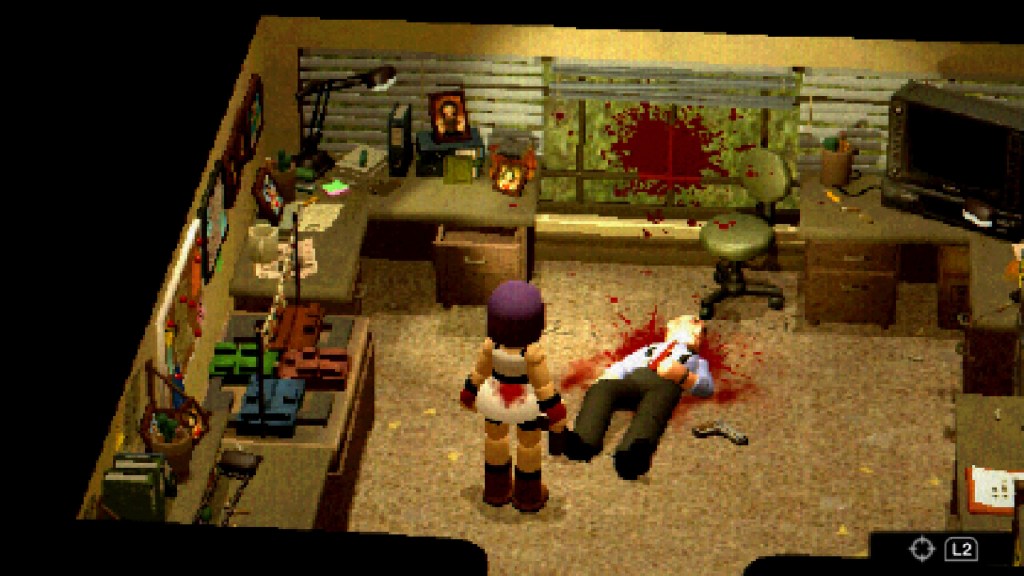
That’s no different in Crow Country. Most of the puzzles are satisfyingly simple: small conundrums that won’t sap all of your time or brainpower but feel good to steadily solve. While exploring for solutions, players are treated to a diverse collection of park locations like Haunted Hilltop and Ocean Kingdom, as well as the harsher hallways and behind-the-scenes areas that no visitors should ever be allowed to see. It’s fun collecting hint-filled documents and running into new characters along the way, uncovering more enticing information or at the very least being treated to a few funny lines.
By the end of Crow Country, I was impressed by how invested I had become in the game’s narrative. I immediately began a subsequent run, in part for a better rank but mostly so I could comb through each area once more, searching for clues to the ultimate reveal I had been quite surprised by. While this ode to old-school survival horror may not include the suffocating tension of, say, Signalis, it carves out its own spot in the genre that captivated my full attention. Caw’mon, guys, just play Crow Country.
Skautfold: Shrouded In Sanity
“Now if you are willing, I’d like you to sign this contract,” says a man in a long red trench coat, standing beside a brooding gravedigger in a cemetery at night. He flashes the contract. In exchange for our freedom, we must find and destroy the source of an ominously impenetrable fog as an agent of Waltham Industries. Sounds like a no-brainer to me, hand over the pen! What’s that? I also need to sign in my own blood? Even better.
The fog has engulfed the Berelaai Manor, a rather ornate estate on the Isle of Portland. The year is 1897. We are Veimar, a man without memories, who happens to look like the brother of Alucard from Castlevania. Lights flicker in the entrance hall of the manor where Waltham further explains our mission and will calmy await our success, one hand tucked casually into his pocket, the other on the handle of his cane. DIE is written in blood across a fallen painting behind him. Another is smeared with gore and a portrait of some unknown gentleman in the corner has been sardonically defiled with devil horns and a red grin. A king and his four loyal knights are hidden somewhere inside or on the premises. Waltham tells us to deal with knights in any order we like and then go for the king, whose death will apparently relinquish the manor from its foggy prison.
Right away, fans of Resident Evil will begin to have flashbacks as they blindly explore an eerily silent mansion that turns out to be teeming with not-so-hospitable inhabitants. However, as opposed to the cinematic reveal of the first Spencer Mansion zombie that slowly turns its decaying head from the corpse it’s eating, enemies in Skautfold: Shrouded In Sanity rush toward you from offscreen from the very beginning, setting a breezy pace early on. The first foe I encountered was a cleaver-wielding maid in a richly carpeted hallway, a servant of the manor who’d become deranged with the descent of the fog. She swung her cleaver in three broad strokes, trying to behead me, but unlike Jill or Chris at the start of Resident Evil, Veimar was already equipped to handle this little problem, and the maid was laid to rest.
One old-fashioned pistol and an Iaito Cane is all Veimar needs to complete his contract. The weapons were designed by Waltham Industries, with the cane’s description reading: An eastern blade concealed inside a plain cane. Waltham Industries imported blades from the eastern union due to their superior durability and craftsmanship. Hiding it inside a cane allows the Veimar to carry this weapon without suspicion. This hints at the Veimar as being a group of . . . people(?) instead of just one man, and though the last sentence must refer to another context, it’s funny to read when you’re already ankle deep in maid’s blood, wearing absolutely no pretense on your sleeve whatsoever.
Careful swinging that cane around because Veimar does indeed have a stamina meter. If you weren’t already reminded of Bloodborne by Veimar’s black overcoat, gun, and trick-cane, then the stamina meter, vials of health-replenishing blood, as well as a somewhat overpowered parry will inevitably reveal traces of developer Pugware’s inspiration. Although there is a dodge-roll that can come in handy when avoiding certain AOE attacks, parrying became my bread and butter during combat. After entering a defensive stance by holding L1, players can then tap R1 to deflect incoming scythes, knives, and sickles. This will literally bring attacking enemies to their knees, inviting Veimar to run them through with his Iaito Cane for big damage. Upon carrying out a successful parry, players will hear a breathy whisper, signifying their opportunity to step in and stab. If an enemy survives being impaled, they will immediately begin attacking once more, allowing for a constant chain of parries and critical hits at a much faster rate than anything seen is a soulsborne game.
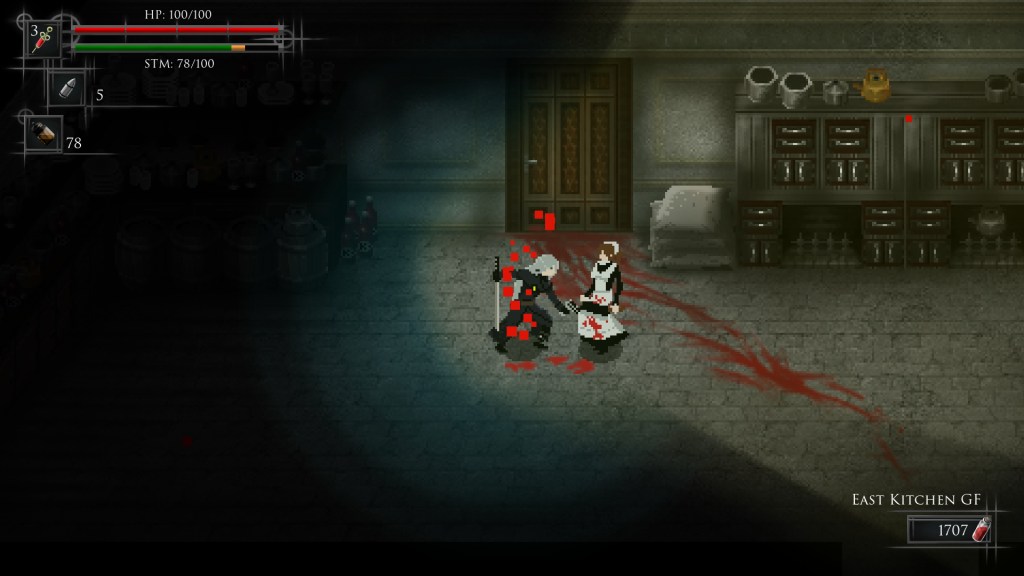
Skautfold: Shrouded In Sanity’s best elements are, in my opinion, its sense of mystery, discovery, and potential for mastery. The manor is interconnected and mostly accessible, meaning the number of locked doors Veimar will encounter are few and far between. This isn’t an item-hunt, it’s a boss hunt. The only puzzles to solve are the patterns of each boss and the layout of the manor itself. Veimar scampers through aristocratic chambers overrun with loony dwellers and otherworldly invaders, searching for the knights. There is no map. Instead, sections of the manor and its perimeter are labeled with compass directions, so if you Never Eat Soggy Worms, you’ll catch on eventually. It’s impossible to know where each knight is located and there is no turning back when you finally find them, which ratchets up the tension for players low on healing syringes. If killed, players are cast back to the vestibule. Then, it’s a matter of somewhat messily retracing your steps for another shot at fulfilling part of your contract with Waltham. Over a short amount of time (as the entire game only took me just over three hours to initially complete), you should feel like a regular guest at Berelaai Manor, zipping through fouled halls, scampering across rooftop eaves and snowy courtyards, and either killing or skirting around the increasing numbers of multi-dimensional mutants within, heading back to the knights’ domains with a chip on your shoulder.
Of course, you can always return better prepared to the site of your death, as Skautfold: Shrouded In Sanity includes several upgrades all purchasable with Yth stones. Gathering Yth stones is one of my favorite things about the game. Instead of finding these valuable little gems tucked under the Berelaai patriarch’s bed or into some other secret spot, Yth stones are only dropped by butlers, tricky little devils that appear in a halo of lantern light, throwing knives in hand. They can also teleport and summon a patch of black flame to prevent players from getting too close. Killing butlers results in the acquisition of a single Yth stone. Three stones are required to earn each upgrade. What’s great about Skautfold: Shrouded In Sanity’s nonlinear nature is that players can hunt butlers to their heart’s content before dedicating themselves to defeating the knights, thus stocking up on extra health, stamina, and damage. Or they can never bother with the restless stewards of Berelaai Manor, choosing to forge ahead without any added help from geo-artifacts.
I’ve now completed Skaufold: Shrouded In Sanity three times, always taking different routes and challenging myself by attempting faster runs with less upgrades. For a game so compact and to the point, Skautfold: Shrouded In Sanity offers considerable replay value, including alternate endings and a bonus mode that allows players to control each of the four knights. The game’s unpredictable structure, artfully creepy atmosphere, swift yet skill-based combat, and strange, unintrusive story have left me excited to check out Pugware’s next two installments in the trilogy.
Furi
If The Game Baker’s 2016 release was just a walking simulator with the exact same soundtrack, I’d still put it on this list. That’s how good the music is by Carpenter Brut, Waveshaper, The Toxic Avenger, Danger, and a few other artists. A track titled, “You’re Mine” hits speakers like an avalanche of aggressive awesomeness, while “A Picture in Motion” provides a pleasingly pensive change of pace. “My Only Chance” serves up a balance between each end of the spectrum with a melodically mellow yet motivating beat that never gets old. I feel like my discovery of the OST was worth the admission of Furi alone. As a bonus, there’s also an incredibly unique boss gauntlet to play through too!
The funny thing is, Furi does function as a sort of walking simulator at certain times, with its wonderful soundtrack playing lightly in the background. These pulse-regulating segments are wedged between the lengthy liquidations of bosses that each inhabit their own asymmetrical plane of imprisonment. You’re the prisoner. They’re the guards. The protagonist of the game, referred to as the Stranger, a barefoot, white-haired swordsman, becomes free of his limb-locking confinement to begin the game. It’s a promising start, but he won’t know true freedom until he traverses through nine floating fragments of a planet (or perhaps displaced parts of multiple planets) suspended in space above the real world.
Alongside the Stranger in his quest for vengeful escape is a man in a purple bunny mask. When I was playing a section of the game beside my girlfriend on the couch, she asked, “Is this game called Furi or Furry?” The bunny man indeed stands out, dressed in futuristically glowing garb like he’s competing with Daft Punk to be the next best mask-donning electronic musical artist. He seems to have a stake in the Stranger’s success. His informative dialogue fills the downtime between battles as the Stranger slowly makes his way across the territory of another guardian willing to dig their heels into the ground and give their lives to prevent his departure. Though the specific details of the story remain cloaked in cryptic clues, the bunny man helps to frame each fight before it starts, giving us an idea of each boss’s supposed role in our fate.
When it comes time to show these guardians what the stoic Stranger is made of, Furi spins into a whirlwind of stylistic genre-melding that I’ve not seen pulled off before. It’s often an isometric, twin-stick shooter with an emphasis on straining your peripheral vision in true bullet-hell fashion. However, putting Furi on this list also defies the guidelines to some extent, because the other half of the action is dedicated to third-person melee combat with a wait-your-turn philosophy. The first confrontation against a rather arrogant sentry sets the tone of adaptation, as you’ll initially be auto-sprinting and dashing away from projectiles, shooting your own blue orbs of plasma back at the roving target. If you find an opening, you can close the distance and strike with your sword as well. After enough damage is dealt, the boss loses his gusto, crumpling to his knee as an orange radial symbol around his feet indicates the invitation for a more personal duel. When struck in their stunned state, bosses will be ironically reinvigorated. A blue circle outlines the limited space we’re suddenly confined to, forcing us to go blow for blow with each captivator. No longer will the right analog stick control our pistol. Instead, it’s used to charge a powerful slash. During these duels, sequences of attacks can be parried to regain health, as well as leave a boss vulnerable to a full retaliatory combo.
The constant alternation of strategies and gameplay requirements never ceased to impress me, especially as the complexity increases with the Stranger’s every step of descension. Each boss has multiple refills for their health bar. So do we. These refills are depicted by little squares that go hollow when spent. This system lends itself to survivability, which seems to be a very conscious decision by The Game Bakers. This is a challenging yet forgiving game. You won’t be instantly squashed beneath something like Smough’s hammer, trembling at the possibility of being cheaply one-shotted with every reattempt at victory. However, it’s also no walk in the park to keep up with Furi’s high tempo. The Game Bakers allow players to learn what’s expected of them without the frustration of starting from scratch due to one or two mistakes. This makes sense, since so many surprises are thrown into the mix that can’t possibly be accounted for. At one moment, I’m just barely dodging the skin-bubbling heat of a laser-beam, and the next I’m playing a game of hide-and-seek as the sword-wielding seeker. Then, I’m the one hiding from the deadly precision-shot of a merciless sniper. A boss may clone themselves without warning, while another turns the game into a side-scrolling one v. one on a narrow dock.
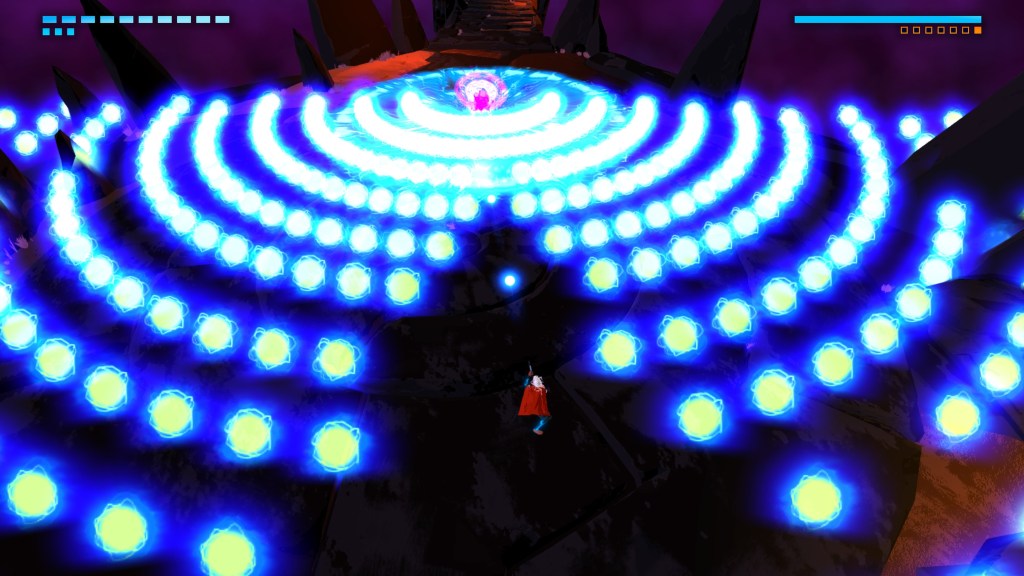
One boss stands braced behind an oversized shield, reflecting my bullets back at me. He’s introduced by the bunny man as being the one who brought us down in the first place. Apparently, he surrounded the Stranger with hundreds of men, dead set on extracting a surrender. He taunts us with reminders of this day during the fight, and I became so invested in the Stranger’s redemption that when I eventually conquered my former conqueror, I muttered to myself, “Yeah, you can take us down after siccing hundreds of other guys on us first, but you just got destroyed on your own, loser.” That’s when I knew I had become invested in seeing the Stranger’s journey through to the end. I remained excitedly curious about what else would come, both in terms of gameplay as well as boss characterization and visual level design. I’ve run through the game a few times, earning myself an S-rank and preparing to tackle the DLC, as well as the hardest difficulty. In conclusion, I will be FURIous if more people don’t play this game.
There you have it. These four isometric indies were breaths of fresh air, each showcasing their own rare degrees of unfettered creativity, distanced from an ever-homogenizing world of major modern releases. The developers behind these titles worried not about accommodating the masses. Instead, the passionate imagination on display proves there are plenty of teams still willing to create whichever type of game truly calls to them. I love finding unabashedly niche additions to my diverse catalogue of games and these did not disappoint. Until next time, Jayemg out!
 GotMeThinkingGames
Leave a comment