
Warhammer 40k: Space Marine 2 Got Me Thinking about the value of a game.
Space Marine 2 didn’t quite feel worth the money post-completion. After purchasing the game strictly for the allure of a cooperative PvE campaign, my friend and I breezed through each mission together, cleansing our palettes that been dripping with Helldivers 2 for months on end. Given the similar mission statement of each game’s playable armed forces (infiltrate alien planets and graciously show them what it means to be truly free), Space Marine 2 might have served an ironic purpose, but it’s purpose was served nonetheless. The game’s mid-length campaign focused on a straightforward storyline containing well-crafted sequences of intense warfare set on visually stunning stages. Lumbering Space Marines fight with a mixture of melee combat and truth-enforcing gunfire, gleaming in their colorful hulls of armor as they charge Tyranid swarms and Thousand Sons heretics, Chainswords growling, plasma pistols humming tunes of destruction. It’s a captivating spectacle, but a short one too. With the campaign finished at about ten hours, my friend and I transitioned to Operations, a collection of eight supplementary missions (currently nine after a recent update) following a squad of Space Marines running parallel to the main story’s. Another eight or so hours of formulaic fun passed before it was time to head back to Helldivers 2, where the possible configurations of each deployment’s progression are endless and experimentation between weapon loadouts and stratagems respects the player’s potential for troubleshooting.
Then something happened. . . I craved more Space Marine 2. I couldn’t wait any longer for the upcoming horde mode to arrive. I needed to step into the enormous greaves of a Space Marine at once and stomp across the face of a foreign planet rife with xenos and ripe for conquest. Having already experienced and enjoyed the campaign, I was drawn back into Operations for the ability to select any mission I wanted, as well as choose my own customized Space Marine class member and improve their unique perks and gear, as opposed to playing as Titus, a rather badass Ultramarine who can only use whichever special abilities and weapons the current mission deems appropriate. I knew that the enemy variety would be limited, and that I’d be covering the same sub-story beats again and again, but I didn’t care.
The mission begins. Three Space Marines, each from their own Chapters and therefore operating within a different Primarch’s sphere of command, gloriously unite on the Imperial planet of Avarax to find and kill the Hive Tyrant, a gigantic, bipedal beast. Only then will the Tyranid swarm have no master, thus dispersing aimlessly without any internally broadcasted directions to follow (the Operation is fittingly titled, “Decapitation”). Our first goal is to lure the creature across a massive bridge that has been rigged with explosives, then detonate the bombs and watch the atrocity crash down to its beautiful death.
The way to the bridge is beset by a seemingly endless resistance force of filthy xenos. I am the Vanguard of the group, a Space Marine capable of shooting a grappling hook at enemies and pulling myself up close and personal from a distance. Equipped with a rumbling Chainsword, a hunk of black steel called the Melta Rifle, and a Plasma Pistol capable of firing a continuous beam of blessed heat through the exoskeletons of my enemies, I trudge forth, accompanied by two other class members at random. One of them is the Assault Marine who scans nearby enemies to de-buff them against our piercing fire. The other is known as the Heavy, an Asartes tank with a gatling gun and rechargeable shield. But these are no strangers. These are my brothers. Although there is an option to play with two AI Space Marines (I have no complaints about bot behavior, but it would be cool to trigger their abilities on my own), I’ve elected to carry out repeat playthroughs of each Operation with other players. They spawn sporting all sorts of different armors. Warriors from the Imperial Fists clasp clanking hands with Blood Angels like me. Our only communication is almost exclusively reserved to tagging items and declaring our unwavering dedication to our cause. “FOR THE EMPEROR” one of us cries out, raising our gauntleted fist into the flak-speckled air. “FOR THE EMPEROR” yell the others.
We rendezvous with a resistance force of non-Astartes soldiers, holding out on a platform with a perfect view of the bridge. A battle against a relatively small swarm ensues before the Hive Tyrant can be seen slowly tramping toward the blast zone. BOOM, the bridge shatters at the middle. One of the several decorative statues that run parallel along the sides of the bridge collapses directly on top of the repulsive Hive Tryant’s head, bringing the oversized bug back down to the surface in a cloud of smoke. “ITS NOT DEAD!” Captain Titus warns over the vox, cutting our celebration short. “But we blew it up,” responds Decimus, the Vanguard I’m controlling. Not good enough. The monster survived and the Tyranids continue their sweeping rush toward the Imperium’s Astropathic Relay. It’s time to chase the now crippled leader of the Tyranid to the stage of our final fight. We end up in a large courtyard ringed by huge stone pillars. The cornered Hive Tyrant lashes out, putting up a dual-phase fight before being put of its misery with the righteous detonations of bolter rounds and burning Melta slag.
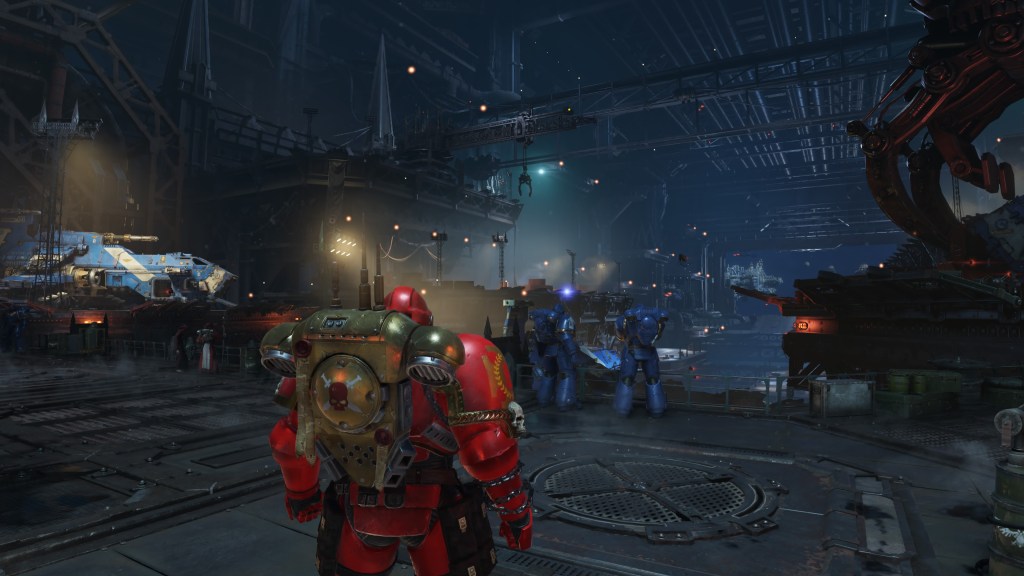
After being congratulated with a big ol’ VICTORY printed across the screen, we’re flown back to the Hangar for mission prep, where we can tweak our loadouts, customize armor, and select another adventure. The Hangar is concept-art come to life in the best way. While the area that Space Marines can actually explore is small, the scope of the ship itself is remarkable. In the background sits a stormbird being prepped for flight beneath a spotlight, standing out in lurid detail. Various crew members tinker with tools across the deck, hooded figures analyze functionalities, and beyond the protective, transparent forcefield in the distance looms open space. Preparing for the Astartes’ next task within the vast and lively Hangar promotes a sense of belonging to an important cause where various cogs in a greater, galactic machine are performing conjunctive duties.
I have completed the aforementioned “Decapitation” Operation, and each of the others, maybe five or six times by now. Along the way, I realized that I had become invested in the goals of a Space Marine. I cared about the context of my brutal actions, as repetitive as they were, and the success of my mission alongside teammates warring for truth. Before Space Marine 2, my only exposure to the Warhammer 40k universe was the boomer shooter called Boltgun, a brilliant storm of Chaos-purging persistence that I wrote about in February. Despite becoming borderline addicted to that game as I obliterated innumerable Chaos Marines in fast-paced, sprawling levels, Space Marine 2 provided the last bit of convincing I needed to further probe the franchise’s lore. I’ve since read my first Warhammer 40k novel (Horus Rising by Dan Abnett) and purchased the Eisenhorn Omnibus. What I’m trying to get across is this: I haven’t been nearly as lured in by a game’s contextual world-building in a long time. Space Marine 2 provides a comforting escape into grim-dark galaxies where the real world is forgotten and all that matters is honoring the Emperor. It’s the epitome of a roleplay power fantasy.
I play lots of indie titles, masterpieces of exquisitely creative gameplay and artistic visual design like Severed Steel, Rollerdrome, Sifu, and RUINER, just to name a few that I’ve already written about. It’s ironic that I find myself much more immersed in these modestly funded projects with limited presentational scopes than I do in big-budget blockbusters stuffed to the brim with an apparent abundance of things to do. That’s because the industry currently expects way too much money for flashy but ultimately hollow adventures. I’ve been quite disillusioned with the full package promises of AAA developers/publishers for years now, only ever coughing up major coinage for something I can’t miss. Disappointingly, a few of those can’t-miss titles have been remakes capitalizing on the weakness of nostalgic fans, such as Resident Evil 4 and Dead Space, highlighting how creativity at the top of the food chain sits at an all-time low. Am I supposed to buy the new Call of Duty, which either plays out almost exactly like the old Call of Duty from fifteen years ago or “Fortnite for Adults?” Do I take a chance on a random and totally unappealing attempt at cheap fantasy like Forspoken? I loved the grounded take on a zombie apocalypse in The Last of Us, but do I really want to watch what was once a boldly simple tale of survival through the perspectives of a man with nothing to lose and a young girl still clinging to hope become a convoluted mess of shock value and contradictive moral grumblings in The Last of Us Part Two? Or maybe I should turn to Ubisoft, a company leaking endless Assassin’s Creed entries without any of the heart that existed when Ezio Auditore led the flagship series all those years ago. Origins, Odyssey, and Valhalla have pivoted toward bland characters and boring tasks, performed for no other reason than to earn XP. A vast majority of shoehorned dialogue attached to each of these so-called side missions will be instinctively skimmed or skipped altogether. It’s assumed that with a big enough space to explore, standardized gameplay appealing to the largest common denominator of mass consumers, and forced RPG mechanics, players won’t be able to avoid becoming completely immersed! Sorry, Ubisoft (and others), but that’s not how it works. When your game is so large, your environments so sparse, your characters so devoid of any notability, then you lose the right to demand top dollar for your title, priced under the justification that players can be manipulated into dedicating copious hours to the same monotonous objectives amid the “beautiful” backdrop of an empty replication of real-life territory. It’s a bit of a trick, is it not? To tell a story that’s been barely thought out and filled to the brim with anachronistic bull, only to distract from that story with loads of auto-pilot activities? To re-sell the same game over a dozen times as if it’s a brand-new idea?
Unfortunately, the baseline for major releases is currently $70. Deluxe, legendary, definitive, and whatever other buzzword editions immediately launch on day one as well, which can skyrocket costs to well over $100 for the sake of cosmetics, downloadable soundtracks, pre-ordered extra content, and more excuses to violate wallets. Space Marine 2 is guilty of this too, though that’s not surprising. Saber Interactive does thankfully allow for a significant amount of organic grinding that doesn’t test players’ patience to the max. In other words, lots of gear can be unlocked naturally, while all character and weapon perks are, to my knowledge, available for anyone to earn by playing the game. This of course prevents the DLC from feeling overly invasive, as only the most hardcore Warhammer 40k fans will feel like they need to drop more dough for certain skins. Also, an additional Operation mission has already been added for free, and the teased horde mode will soon follow suit.
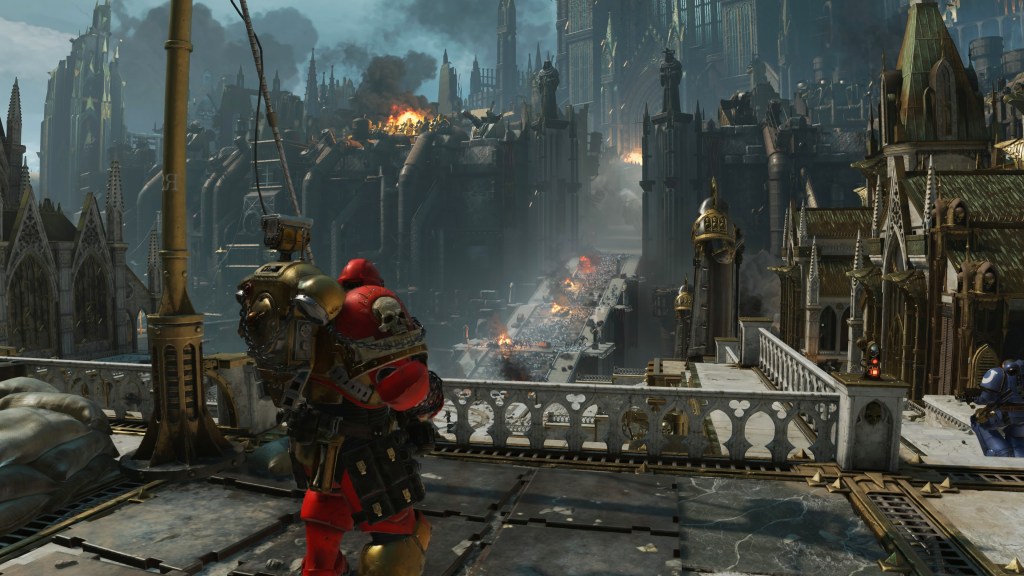
Though I refuse to exchange cash for cosmetics, I have become incredibly invested in turning my Space Marine into a total badass via Operations grinding. Adding chains hanging from the Vanguard’s crimson plate and huge pauldrons bearing skulls and legendary insignias doesn’t change the gameplay at all. However, because Saber Interactive has done such a fantastic job bringing the Warhammer 40k universe to life, I’ve found myself invested in the reputation of my Space Marine. I want him to be powerful. Regal. Feared. I want my belief in the Emperor’s will to be illustrated with Imperial flair as I slaughter Tyranids and Chaos Marines, badges of rank and Oaths of Moment adorning my plate. The wrath of the Blood Angels must be known to all invasive forces, and all noninvasive forces that resist invasion! In other words, what may feel annoyingly arbitrary in another game is at least relevant to the greater experience here.
As I mentioned at the very start of this essay, Space Marine 2 seemed to initially under-stay its welcome with approximately twenty hours of fresh experiences for $70. Helldivers 2 has meanwhile entertained my friend and I for almost 250 hours. I’d say that’s worth the $40, so much so that I’ve even dropped a few bucks here and there to instantly access new weapons, something I’d only consider with a massive amount of respect toward the developers. I’ll never make it to 250 hours in Space Marine 2, but I did recently reach the 50-hour mark without even realizing, as I continued to repeat Operations so that I could hit max level with my Vanguard. The ratio of hours played to spent money pales in comparison to Helldivers 2. However, the immersion of Space Marine 2 has lingered in my mind, resulting in my seeking out of cross-media Warhammer 40k content. Mission accomplished, guys.
But is this some kind of cheat code for Saber Interactive? I mean, with such a long-running series so primed for further virtual interpretation, is this title’s value at far less risk of feeling faultily appraised by the industry than, say, an original IP’s? Space Marine 2 is not only a direct sequel, it’s an addition to an enormous library of lore with dedicated fans clinging to the pages of books and the painted helms of figurines like barnacles. Newcomers are susceptible to being entranced by the depth of it all, curious to learn more. My purchase was mostly influenced by the game’s co-op PvE previews, though my recent blitz through Boltgun also had me intrigued to see the same universe from a different angle. Sure enough, I grew to want more of this world and was therefore willing to engage in the same missions over and over, until I had doubled my playtime and scrubbed away any hints of buyer’s remorse from my conscience. Would I have felt the same way playing a full-priced, foundling IP with plenty to prove? I can’t say. With so many affordable indie IP’s out there, it’s much less of a risk to check out an original idea for $10 to $30 instead of $70. Sure, you may miss out on “next-gen” graphics and theatrics, but you’ll also dodge bloated and bland cutscenes, over-worked engines, poor, mainstream writing, and predatory advertising popping up all over every menu. Space Marine 2 runs well. It plays like a classic with a cinematic edge; an edge built into the game itself instead of only appearing in pre-rendered scenes. It’s a refreshing taste of what modern gaming has been missing: a compact storm of fun mechanics that also delivers a garnish of advanced graphical quality representative of the polished technology expected of a major release.
Even after hitting so many of the right notes, Space Marine 2 still almost failed to sell me on the validity of its price-tag. That’s not a problem with Saber Interactive’s game, it’s a problem with the industry at large. Only after a second wind, significantly influenced by Warhammer 40k’s dense atmosphere, did I squeeze enough hours out of this title to feel like I hadn’t made a totally irresponsible purchase. I still want more, such as additional operations and that Horde Mode I’ve been hearing about, but what we’ve got already is clearly a labor of love. A game with no appeasements made to the masses, no major distractions from the addictingly gritty gameplay loop, and no blatant attempts to rip players off has sadly become an almost inconceivable possibility in today’s mainstream market, which is why I frequently recommend wonderful indies on this website. If you’ve read the description on my home page, then you’ll know I’m never given review copies, nor do any developers or publishers even know of my existence. I use my own money to purchase what I play and money is tight, as I’m sure almost anyone reading can attest to. I’m lucky to be able to buy the games I do, but the idea of a game’s value, especially when sold for $70 or more, often lingers in the back of my head as I play, trying to decide whether I’ve made the right call. Thankfully, Space Marine 2 has provided an experience I deeply enjoyed, which has also functioned as a gateway to more Warhammer 40k. I could have invested that $70 in something more important, but I also could have blown it on something far less responsible, like anything released by EA.
 GotMeThinkingGames
Leave a comment