Beats the alternative.
WHAT THE HELL IS THIS?! I asked myself as the Doom Slayer mounted a turret to mow waves of demons down at the end of the first mission in Doom: The Dark Ages. Had mid-2000’s pseudo-innovation really come back to plague Doom, of all franchises, in 2025? With each pre-determined step taken by the massive demonic Titan that needed to be put down with laboriously charged-up shots from the turret, an uninvited sinking feeling in my stomach gained potency. Pair this moment with an elongated cinematic opening that paled in badassery when compared to both predecessors, and you have a recipe for my true fear that id Software had officially lost their oomph,and no, that’s not an attempt at typing out the sound of an imp dying in the original Doom.
Okay, maybe I’m exaggerating a bit, but Doom: The Dark Ages doesn’t exactly come out swinging. The loss of Mick Gordon is immediately noticeable here, his absence far more glaring than it was in The Ancient Gods parts 1 & 2, as Andrew Hulshult brought his own A-game to the DLC’s, retaining Gordon’s unique flavor without copying it verbatim. A synth-infused distortion has accompanied the Slayer since 2016, mirroring the atmospheric blend of an ancient hell with a futuristic mars/earth. Raw metal riffs represent fire and brimstone, while a dash of bubbling synth symbolizes the UAC’s technological advancements toward a new age. This time around, it’s all fire and brimstone. The Dark Ages is a prequel taking place on the medieval planet of the Night Sentinels. Therefore, most of the levels’ visuals go hand in hand with the rather generic music, featuring stone plains, crags, castles and fortresses that don’t excite me in the same way the overrun city levels from Eternal did, or reflect an interesting sense of corporate corruption like the UAC missions from 2016.
The Dark Ages made me question my own standards for bells and whistles. I like to think I’m a simple gamer, one who prefers to jump in and play rather than admire a bunch of small touches that don’t make much of a difference to the overall experience. . . but surely that’s not always the case. Enter The Dark Ages. When I laid eyes on the rather bland main menu, with none of the customization options Eternal introduced, I was immediately underwhelmed. Something felt lacking here, creating a perception of discreet regression that only became more and more validated as the game unfurled. Also absent (for the most part) are glory kills. Glory kill animations were a risk since day one, as they threatened to continually interrupt the gameplay for the sake of theatrics. However, id Software implemented them in such a smooth way, while also adding practical incentives to performing them, that glory kills became a standout feature in Doom’s revival. Though we get a few cool animations with the shield saw (if finishing a demon from above) a new melee system replaces the swift, head-splitting brutality from before with punch, punch, kick, giving further credence to the notion that id Software might not have had as much fun making The Dark Ages as they did with 2016 and Eternal. It’s almost as if the Slayer’s fate in this game as a slave to the Makyrs is an allegory for id Software’s operations under Bethesda. I could be totally wrong, but it feels as though id Software didn’t really want to make another Doom just yet. The distinct personal touches that went into the other games are either regurgitated here in a more slapdash manner or have simply vanished.
As you can see, my first impression wasn’t great. I wanted to be just as pumped for this game as I was for Eternal, but it hardly ever works out that way. Just look at Doom 3. That game was supposed to be a major comeback for the series, a new iteration of the Doomguy’s death-dealing in full 3D. As it turns out, Doom 3 wasn’t too bad, but it also wasn’t very reminiscent of its straightforward siblings. Opting for graphical fidelity, horror and a more present storyline, Doom 3 stands as an unintentional bridge between boomer shooters and the following wave of FPS games including health regen and constant reloading. When I played an updated version of Doom 3 years later on console, saving me from switching back and forth between guns and my flashlight as was originally required (thank goodness), I felt as if I were playing an elaborate mod or demo for what Doom might look like through a more “realistic” lens. In other words, the ingredients were there but the heart was missing. The same sadly goes for The Dark Ages, to an extent, though the title of this post alludes to a closer comparison that I’d like to discuss. A comparison with the real Doom 3, as I like to call it.
Doom 64 served a similar purpose to The Dark Ages: toss the Slayer (who was still Doomguy at this point) into dank, dark castles and caves, allowing for the same addicting carnage to ensue within a dense medieval atmosphere. Because of console limitations, Doom 64 was a bit more methodical than its PC cousins that came before. Slightly slower combat and a creepier, less frenetic soundtrack gave the game its own flavor. Players en masse would overlook the confusingly titled Doom 64 as a legitimate sequel until its resurgence as a port on modern consoles. That’s when I discovered this gem while also discovering that I could decipher more Doom from its DNA than was ever in Doom 3. It goes down in my book as a very fun entry that scratches a different itch than Doom and Doom 2.

Let me make this clear; The Dark Ages is not a bad game by any stretch of the imagination, and I don’t regret any of my twenty-four hours playing it (well, maybe I regret those mech missions a little bit) but it doesn’t do quite enough as a full package to earn its place at the top of the totem pole. Chronologically, this game is a prequel, but it also feels as though it should have also been released before Eternal and not after. In my somewhat recent analysis of The Ancient Gods parts 1 & 2, I touched on the idea that Eternal’s formula had reached its absolute capacity and was probably better left alone from here on out rather than molded into something else entirely by a lack of meaningful and/or relevant new additions. I honestly didn’t expect another Doom for a much longer time, as I figured id Software would start work on a Quake reboot or even an original IP. Maybe that’s what they truly wanted to do. . . but here I am, blasting through The Dark Ages and wondering why I’m not smiling and headbanging nearly as much as I remember when playing through the Slayer’s other adventures.
The non-gameplay changes that The Dark Ages makes to the formula often fall flat. The story is relegated strictly to cutscenes instead of allowing for more information to be delivered in-game, like during Eternal. The clunky mech missions are downright gimmicky. Dragon flight and exploration is fun at first but ultimately too linear and repetitive to invite eager revisitation. Boss fights are still drawn-out to a disengaging degree, maybe even more so here (minus The Ancient Gods) and arenas glaringly lack an interesting aspect of verticality and navigational challenges. That last part refers to my own love for Eternal’s platforming as the perfect kind of palette cleanser between battles. While some of the platforming could become frustrating, I never understood why that element of the game was so widely frowned upon. The Dark Ages does away with it almost entirely. While the Slayer moves a bit faster now, entertainingly bashing his way through cluttered objects that flip and clatter against his charge, you’ll be flat on the ground for most of the game’s duration, yawning as you jog from one end of the map to another for a secret you missed instead of jumping, swinging, and climbing around like Spider-Man . . . or maybe Venom is the better comparison.
Speaking of level design, The Dark Ages’ battle arenas are typically vast, with wide-open plateaus of volcanic rock serving as the foundation for contingents of demons. Working with a lot more room can be fun, as players may choose to zig-zag from one edge of the fight to another, prioritizing the obliteration of certain demonic entities in whichever order they see fit, while having to watch their back for flanking attacks. Unfortunately, many of the showdowns in The Dark Ages are indecipherable from one another. The same structure is typically presented, including rows of shieled enemies that decorate the area with steaks of orange steel or blue plasma, only to be destroyed in seconds by one ricocheting throw of the shield. Meanwhile, elite demons will take up separate stations from which they fire on the Slayer, establishing a rather formulaic routine that lacks memorability. I can describe various arena layouts and surprisingly creative demon spawns over the course of Eternal, which tested player instinct and on-the-spot problem-solving, whereas I struggle to remember very many notable details in The Dark Ages at all, including the functionality of the environment or the interesting introduction of specific demons at comically inconvenient moments. If I genuinely try to reflect on Eternal right now, the first thing that comes to mind is the spawning of multiple Whiplashes during the artic level where red mines have been placed in the snow, challenging players with slowing the Whiplash onslaught by using the mines carefully, without falling off the close by edge of the cliff. This might not be the most profound example, but I thought of it instantly, whereas a recent playthrough of The Dark Ages has left my mind swarming with blended images of very similar fights and settings.
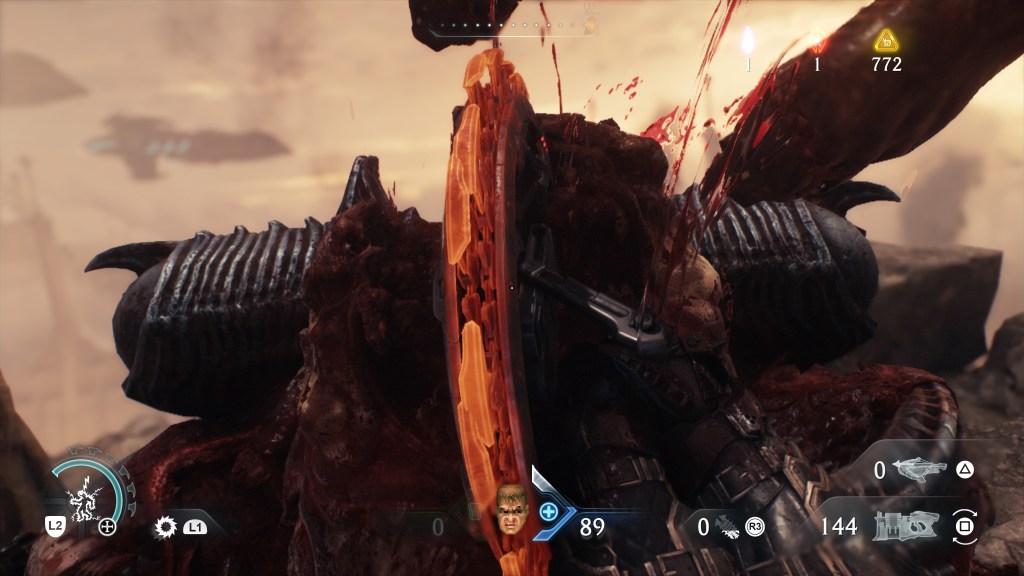
I haven’t addressed the core gameplay loop yet, and that’s because it felt somewhat overshadowed by the minor missteps of everything else. But with everything else out of the way, I can report that the core combat loop of The Dark Ages is pretty cool. It’s much different than 2016 and Eternal, and successfully so. Innovation is a good thing, hence my stance on The Ancient Gods. Although The Dark Ages isn’t my personal favorite, it’s still an easy recommendation for FPS fans, and maybe an even easier recommendation than Eternal for its less complicated dynamics. The Dark Ages gives less reasons than Eternal to rapidly cycle through the Slayer’s arsenal of weaponry for the sake of exploiting enemy weaknesses, giving it a more classic feel. However, there is still a stronger incentive to experiment than in most FPS games I’ve played. Badass gun designs like the skull-smashing Pulverizer and Chainshot flail serve as creative standouts that are also fun to use, especially when you purchase upgrades like the Chainshot’s ability to smash enemy armor apart with a single charged shot. The spectacle of armor shards flying back at the Slayer’s steamy visor as you pummel them to death with Pulverizer skull shards is teeth-grindingly sweet. Also, the addition of the shield itself is impressively unique. I appreciate its multifunctionality, such as parrying, blocking bullets until temporarily broken, throwing to break armor or become stuck in a demon (thus stunning them while the rotating saw rips through their damned flesh) and being used as an activator for other weapon skills, like detonating the Shredder’s needle projectiles that get stuck into the belly of a Mancubus, only to blow back out at the surrounding soulless.
Overall, I enjoyed The Dark Ages in a similar way to Doom 64. The gameplay is solid and there are plenty of demons to slaughter. However, I don’t see myself picking The Dark Ages up when I’m in the mood for modern Doom. I’ll do so when I’m in the mood for The Dark Ages specifically. The same goes for Doom 64. Two great games that act as stepsiblings to the rest of the franchise. Or maybe Doom 3 is the stepsibling and these are half-siblings. Yeah, that sounds better. This time around, I could sense id Software’s fatigue, despite their impressive ability to once again deliver a truly innovative addition to the FPS genre. Am I being unfair? I don’t know. I do consider Eternal to be my favorite shooter ever made, so keep that in mind. Anyways, time to go unlock the classic Doomguy skin . . . wait, what? . . . That’s disappointing . . . Yes, I know you can’t even see it unless you’re in a cutscene. . . Well, how do you unlock those other skins, then? . . . Oh. . . that’s depressing.
 GotMeThinkingGames
Leave a comment