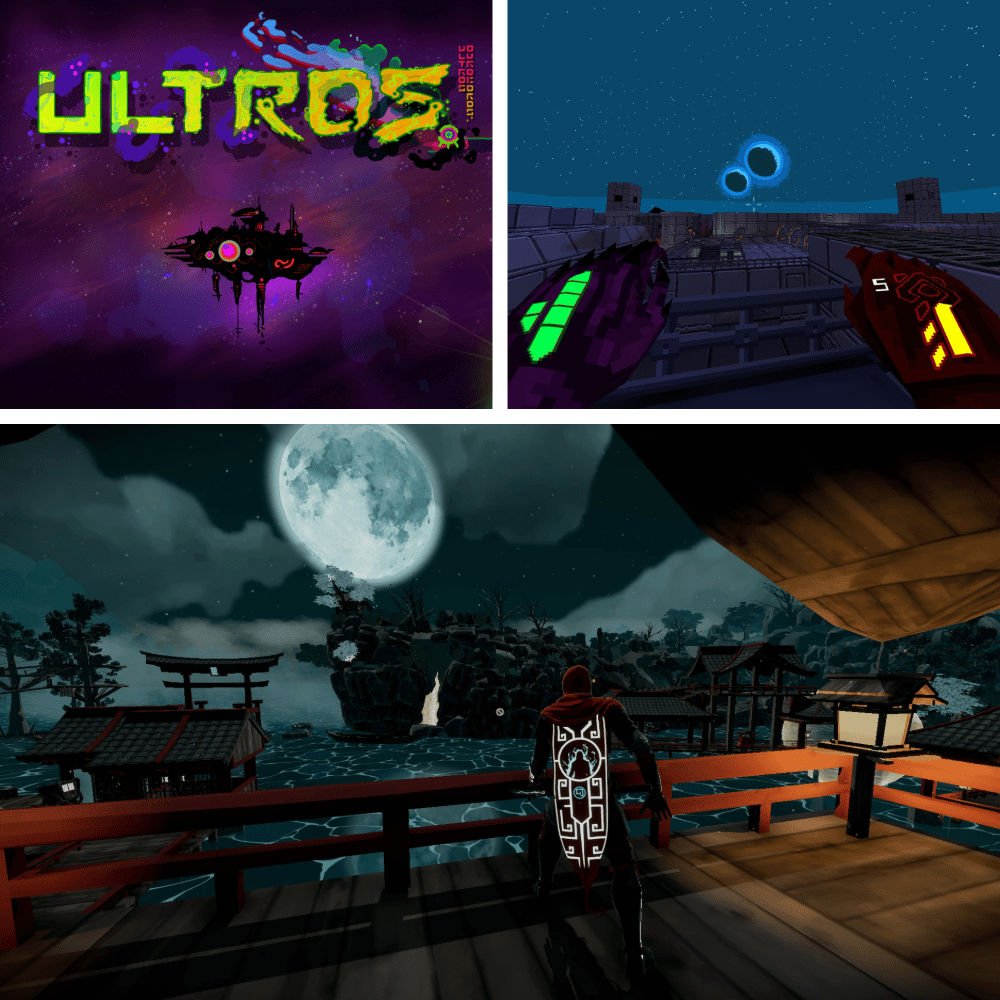
It’s been a relaxing summer. Super chill. Three games I’ve recently brought back from my backlog reflect this sentiment. None of them have been very difficult nor boringly trivial, opting for straightforward gameplay that doesn’t take any arthritic mashing to master. Their vitalized art styles remained easy on the eyes, alongside soundtracks that were equally as easy on the ears. I’ve decided to label these titles chill-ish games, ideal for players who want to relax and cleanse their palettes without shutting their brains all the way down. If any of these indies are stashed away in your backlog, take a load off and give them a chance. Otherwise, you won’t be breaking the bank to try them out, as they’re all affordable too!
Aragami
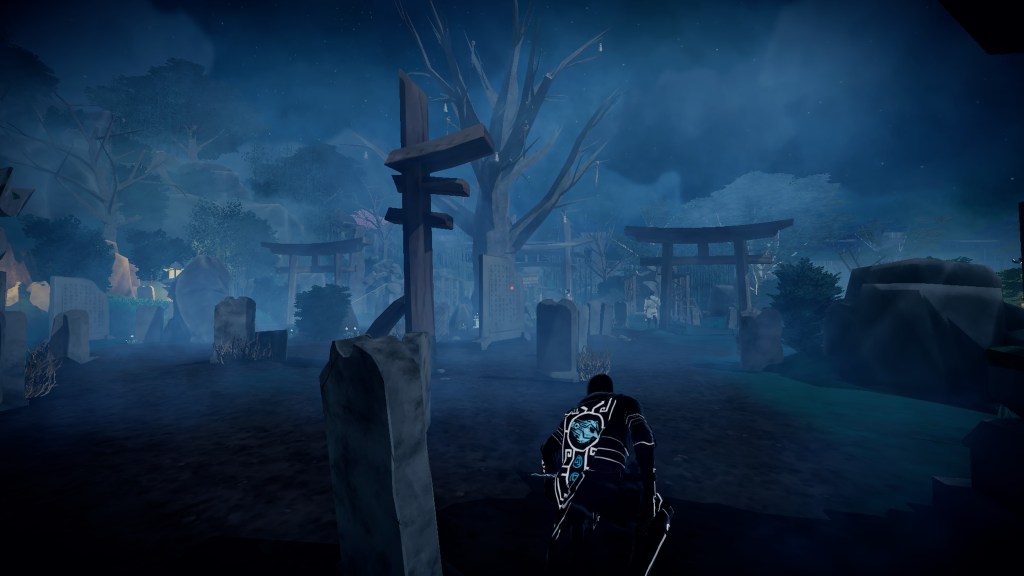
A magnificent moon takes its place in a cel-shaded sapphire sky as a vengeful spirit known as Aragami carries out his violent (or pacifist and totally silent) mission to release a young woman named Yamiko from Kaiho captivity. The Kaiho is an army that has weaponized light itself, while Aragami is composed entirely of shadow. Age-old tales of light versus dark typically illuminate the hero at the center of it all, though the Kaiho are depicted as imperial brutes while the justifiably resurrected Aragami remains soaked in the shade of trees at dusk, or hidden beneath overlapping eaves of a pagoda temple as he inches closer to an unassuming guard on patrol.
Aragami is a 2016 indie stealth title developed by the since-decommissioned Lince Works, a small studio that tried to keep their budding franchise alive with a sequel in 2021, to no avail. That’s truly a shame, especially because Aragami shines as a shadowy stealth game unhampered by the crossbreeding of genres or overambitious attempts to revolutionize a basic concept. You’ll slink your way through 13 Kaiho-controlled territories within a twilit Japan, dealing death and holding your breath.
After calling upon Aragami, Yamiko uses a projection of herself to guide players toward magical artifacts that must be used in conjunction with one another to unlock the door to Yamiko’s cell. The storyline is more present than I expected, though far from obtrusive. It’s clear that the team at Lince Works wanted to present something with gravitas while ensnared by a limited budget. I enjoyed the unadorned interactions between Yamiko and Aragami as revelations began to unfold on the way to a rather predictable climax. I also took note of the following line that comes from a guard, which instantly became a new favorite of mine: “Even with my eyes peeled like potatoes, I can hardly see my own nose.”
The game’s biggest bright spot (I’d say no pun intended, but that’d be a lie) is Aragami’s mastery of the shadow arts. Remember blink in Dishonored? No? Then go play Dishonored right now. For the rest of you, Aragami gives players unlimited access to a short-range teleportation functioning almost the same as blink, except instead of using consumable mana to power it up, players must linger in the shadows to make the embroidery on their narrow cape glow with phosphorescence, indicating that they’ve harnessed enough shadow to be spent on abilities in the actual dark arts.
The cel-shading (literally) lends itself to the depictions of shadow falling over lush green grass or gray flagstones, making it easy for players to identify a safe place to warp if a guard starts getting suspicious. An ability tied to the right trigger can also be used to create a patch of pitch black (except in the bright radius of often conveniently placed torches and light sources), opening possibilities of progression through each stage and allowing for satisfying speedruns.
Aragami’s cape being used as an in-game U.I., much like Isaac Clarke’s rig in Dead Space, supports immersion in a major way. I wish more titles would make an effort at cleverly feeding information to players. Part of the reason why Aragami felt so chill to complete is that I was fully connected to the experience, never distracted by health bars (as Aragami dies in one hit upon being discovered), ammunition totals, consumables, or anything of the sort.
Once I finished the main story, I jumped right back in for a platinum attempt, something I haven’t even considered in quite some time. What lulled me in were the three types of medals that can be earned on each stage. One is awarded for never being detected, one for never killing, and one for killing everyone. This is nothing new, as most stealth games give players the option to either be a homicidal psychopath or the patron saint of restraint. Of the three options, killing everyone is by far the most tedious, especially when you miss a single guard and can do nothing but mourn the absence of autosaves while you stare defeatedly at the level recap stats. Also, there is no combat outside of stealth, nor much fluidity between Aragami’s available offensive arts (this is, understandably, no Dishonored where you’re chucking grenades, chopping off heads, and shooting people in the face). As a result, passively embracing the darkness felt like the most rewarding way to play.
Earning medals will unlock skins and trophies but the incentive of confronting the game’s central challenge is what enticed me to pursue them. When no parameters are put in place, the game is very forgiving. Its NPC’s could probably use an eye exam, and they struggle to keep up with a get-of-jail-free card that turns Aragami invisible long enough to escape any hotspot, as well as a kunai ability that can target an archer from absurd distances (players must first find enough scrolls to acquire these skills). I’m not complaining. I enjoyed the ridiculous range of the kunai and had a bunch of fun sprinting head-on at a guard who couldn’t see or hear me coming right before being impaled, though the illusion of invincibility gets boring if it’s not broken up by ghost runs.
Is Aragami an intensive experience where one wrong shift in your weight can lead to alarm bells echoing throughout the entire site of infiltration? No. On the flipside, can fighting your way out of discovery end with a pile of bodies testifying to the questionable necessity of stealth in the first place? Also no. Aragami strikes a balance between both extremes. I liked laid-back shadow leaping through lambent landscapes just after dusk, improvising as I went and rarely losing momentum for more than a couple of minutes. Some sequences still tested my ability to remain unseen, and one level introduced a temporary trick that was fun to overcome with a slightly different strategy. At about 16 hours of gameplay, Aragami crawled its way out my backlog’s towering shadow to preach the timelessness of doing only one thing and doing it well. I wonder what the sequel has in store. . .
Exodemon
Exodemon is proof of concept. Indie games work that way. Some are released in their final form, like Dusk, where dauntingly vacant farmlands and creepily geometric cultists look like something straight out of an impressionist nightmare. Could a better-rendered version of that same nightmare exist? Sure, but it wouldn’t be nearly as memorable or unsettling. Then there are titles like Exodemon, a boomer shooter with novelty ideas wrapped up in a rather basic package that makes you already wonder what a sequel could bring to the table before you’ve completed the story.
That introduction might make it seem like developer Kuupu should have held out for more funding before Exodemon’s 2019 release. But Kuupu’s rather humble execution of a creative idea deserves credit as a chill experience reaching back to more rudimentary 90’s firearm fests like Wolfenstein 3D, except that the firearms here are the literal limbs of a parasitic alien.
Sterilized levels of white tile provide the setting for one unlucky scientist’s attempt to escape the lab she works within. A bio-organism has broken containment and symbiotically attached itself to our panicked protagonist, giving her the ability to shoot and slice through other aliens also tasting freedom for their first time. The scientist’s inner monologues at the start of each stage don’t belong to a gun-toting force of nature like Doomguy. Instead, she remains terrified of her fate throughout, reluctantly killing her parasite’s kin as she desperately hopes to survive.
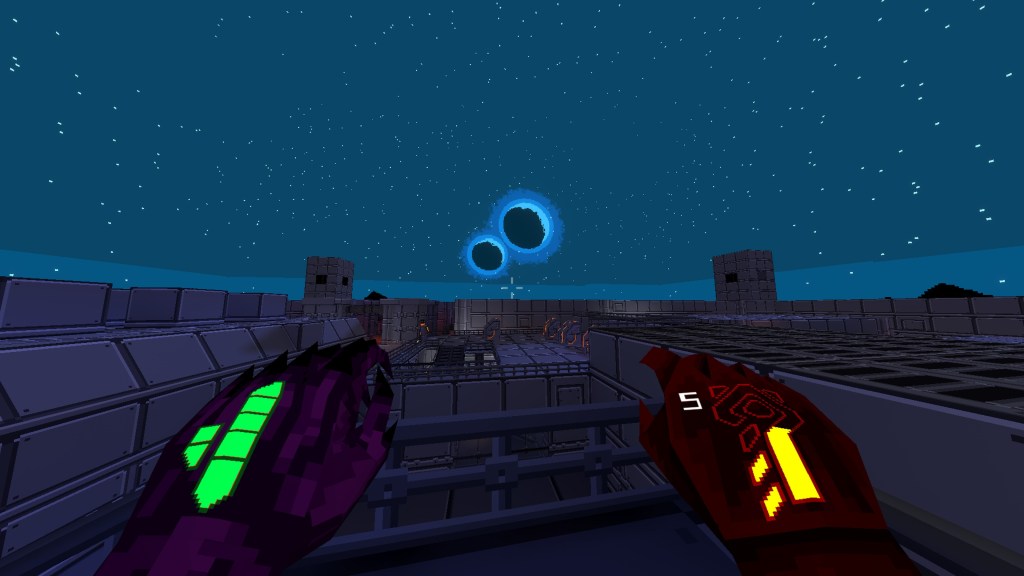
Exodemon’s central innovation is its combat. The scientist’s colorful new claws remain onscreen as her only weapons. One is permanently sculpted into a lethally sharp mitt of mutilation, while the other can accept modifications to its DNA, transmuting into several shapes with their own gun-like functions. A red claw serves as a close-range shotgun, while a slender yellow version packs the map-spanning punch of a sniper rifle. You can probably guess the rest. Limited ammunition will require players to cycle through each of their “guns” during encounters (there is no weapon wheel), giving the combat a grab-bag element as you scramble to zap enemies with whatever is loaded. In a pinch, melee comes in handy (seriously no pun intended) and is used most effectively against enemies that relentlessly charge at the player. Due to Exodemon’s relatively easygoing pace, the improvisational aspect to clearing a room never became frustrating. The weapons, complete with dazzling firing animations, all work well enough.
Purging sudden alien spawns will unlock security doors throughout each of the game’s 18 levels, which begin as a series of enclosed, interconnected corridors and then branch out into more spacious designs during the final third of the game. By the time I was roaming around on the surface of the planet, I was grateful for a change in scenery. There is also some unexpected platforming sprinkled in that helped break up the monotony, though the scientist’s jump can feel heavy and somewhat unresponsive, as if the alien only attached itself to her top half, leaving her lab coat flapping against the back of her knees.
Exodemon’s stages aren’t very complex or distinct from one another. Every enemy type is composed of the same two colors. It’s got a catchy, yet singular musical track stuck on repeat. The runtime is plenty shy of double digits and still feels almost too long. However, blasting and slashing my way through compromised laboratories with a pair of jagged alien paws provided me with a couple of peaceful summer evenings that I don’t regret. After completing Kuupu’s debut, I imagined more intricately morphed gun-claws in the next installment. I thought of diversified mobility using our parasitic pal to stick to walls or swing from poles, of extra melee attacks and defensive capabilities, better feedback than blinks of white light when landing shots on enemies, a wackier story that pits our protagonist against friends and allies, and a range of other ideas that I consider Exodemon to be the perfect canvas for. Give it a try if you feel like you’ve already exhausted the best boomer shooter console ports available.
Ultros

I got lost and then I quit. I tried again. I got lost again and then I quit. I tried one more time and found the way.
Does that sound like a hippie’s psychedelics-induced life lesson? Good, because that’s basically what Ultros is. In this game developed by Hadoque, you play as an explorer named Ouji who has crash-landed onto a derelict spaceship rife with lush vegetation that glows and shimmers with hallucinatory color, as well as a handful of creatures that feast on such vibrance. However, total Zen has been prevented by an evil entity called Ultros whose shadowy tendrils have spread all over the ship, sentencing several mysterious shamans, who presumably had control over the spaceship before, to a dark slumber. To purge the demon and escape, Ouji must free each shaman by bending the rainbow environment to her will. Luckily, a friendly gardener will assist Ouji in discovering the green thumb she never knew she had.
Indie metroidvanias are a dime a dozen, so why did I choose 2024’s Ultros from so many other options? Could I have really fallen for all its pretty colors like a kid in a candy store? You know, the kind of candy store with those giant swirling lollipops that seem to hypnotize you if you stare too long. The answer is yes . . . but don’t get it twisted, Ultros is no one-trick unicorn. The dreamy combination of polychromatic backgrounds (smartly tempered by accents of black) and a woozily serene soundtrack serves as a tie-dyed lullaby that indeed promises something different. As advertised, the game delivers exploration that often feels one-of-a-kind.
Ultros brings two things to the table I haven’t seen done in a metroidvania. First, it adds a rougelite layer that brings players all the way back to the place they first started. Not when they die, but when they successfully liberate another shaman. Therefore, Ouji reawakening at her quiet crash site is not a repetitive punishment for failure but rather a necessary part of the trippy cycle she’s been locked within. As someone who has recently experienced a bit of roguelike fatigue, it was refreshing to see the formula flipped on its head, allowing for a traditional save system while also challenging players with keeping track of the changes they experience and create throughout the ship with each revival.
The second thing is botany as a puzzle-solving device. As you explore the ship, you’ll find various seeds that bud into different plants with their own functions, such as a tree that grows a leafy platform at its top, allowing Ouji to reach new heights by climbing on, or a bed of vines just begging to be swung on. Seeds can either be planted gently into the ground or backflip-kicked up onto the dirt ceiling and walls. As the obstacles get more complicated, you’re bound to spend most of your time planting and replanting different seeds in different spots just to learn their effects on the world around you. Unless you find compost, a limited resource that should be used sparingly, you’ll often have to wait an entire cycle to see plants at their full potential, as they won’t immediately bloom into their final forms whenever a seed is buried. This adds an anticipatory element that tasks players with making intelligent choices in advance of activating a new cycle.
Later in the game, the Living Network is introduced. This is a source of purification that manifests as a squiggly line of light attached to Ouji whenever she comes close to one of blue flowers that harnesses it. The Living Network can unlock doors and eliminate purplish clouds of corruption, opening plenty of necessary and optional paths. If, however, Ouji gets too far away from a Living Network flower, then the line of light will become gradually thinner until it finally disappears. Because of this, a proper chain reaction is needed to keep the Living Network, well, living. Luckily, every plant can grow blue flowers in addition to their primary features, allowing players to span huge sections of the map by choosing a sequence of plants that will both allow for dynamic traversal and the maintenance of the Living Network on their way to an area blocked by darkness or a terminal that controls a locked door.
A dronelike machine called the Extractor makes things even more interesting, granting Ouji various abilities like removing misplaced seeds from their beds of soil to be replaced by something else and influencing the direction of plant growth. The Extractor is the bane of linearity, as luring plants to unfurl in a specific way makes a huge difference when solving environmental puzzles. I can’t imagine that my chaotically cluttered technique of preserving and spreading the Living Network looks exactly like a lot of other players’, since several combinations of plants can be pulled off with a clever enough approach. In these moments, as I shaped the world around me like Michaelangelo if he were a gardener, I felt almost meditatively invested in succeeding. I can’t recall the last time experimenting with a game’s systems was so gratifying, which secured my recommendation of Ultros before I had even finished the story.
Ultros really can be a captivating metroidvania that shakes up expectations and gives a satisfying degree of choice to the player. While there are a few bosses and enemy types to engage against, combat is definitely not the main attraction. This is a relaxing adventure that someone might imagine themselves embarking on while staring into the tapestry hung up in your old hazy dorm for far too long. It’s got a lot of neat ideas, a lot of colors, and a little repetitiveness brought on by its rougelite twist. Also, while the rich art style is what made Ultros stand out in the first place, its colors do begin to blend over time, as there aren’t many refreshing aesthetic changes throughout. Even so, at about 13 hours, Ultros kept me intrigued till the end.
After such a chill trio of games, I’m feeling renewed, as if I visited a mental spa to forget all about the existence of BS final bosses, horrible hit detection, and never-ending spam. But as Ultros teaches us, life is a cycle, so I’m ready to get my blood pumping again. I’ve got a few ideas for my next game. Only time will tell what that ends up being . . . Anyway, I hope everyone reading has enjoyed their summer as well. It’s almost time for the season of playing Resident Evil games all over again for the hundredth time. Hell yeah!
 GotMeThinkingGames
Leave a comment