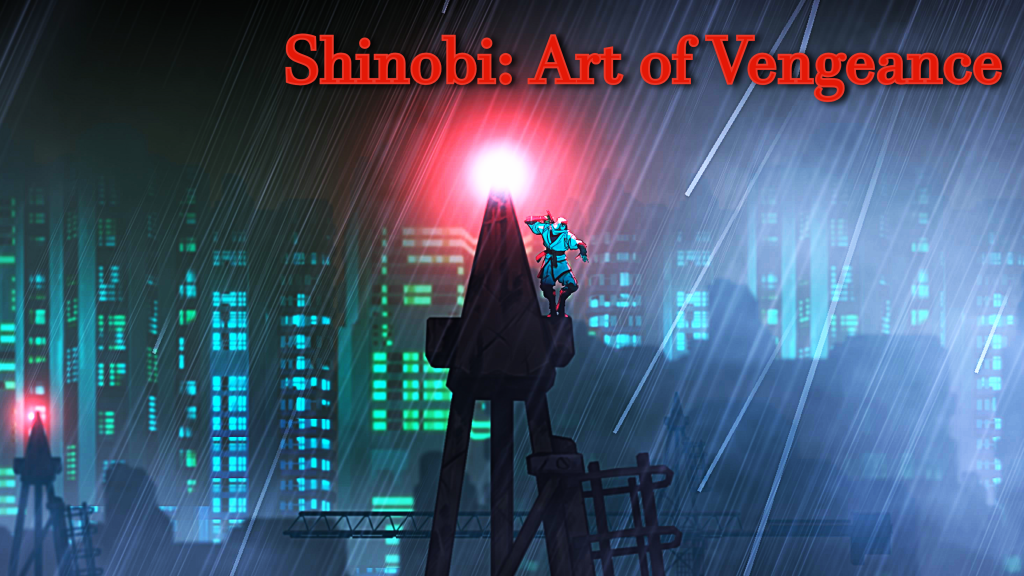
Shinobi: Art of Vengeance Got Me Thinking about a game’s specialty.
Q: What’s the best part of [insert video game title here]?
A: Killing aliens.
Q: Okay, what’s the best part of [insert video game title here]?
A: Killing demons.
Q: Rock on. But what’s the best of [insert video game title here]?
A: Killing people
Q: Is this the beginning of a discourse on video game violence?
A: Hell no! Look, there are plenty of games where the “best part” has nothing to do with punching, kicking, shooting, chopping, ect. Shinobi: Art of Vengeance is not one of those games. The best part of it is, without a doubt, juggling hostile ninjas in the air with a katana, kunai, and a few magical powers for good measure. However, despite being developed by Lizard Cube, part of the team responsible for the awesome Streets of Rage 4 that I unexpectedly fell in love with when I played it last January, Shinobi: AoV is not a beat ‘em up. It’s a 2D action platformer with beat ‘em up tendencies, modern sequel to the classic Sega Shinobi series, including a combat system with bone-crunching complexity that gets cut short in favor of standard navigational challenges and secret-hunting. As I reached my thirteenth hour with Shinobi: AoV, I felt like I was at a steakhouse where the portions come out predetermined for the sake of preserving vainly fancy presentation. The filet was delicious, but I was still hungry. Shinobi: AoV dangles its extremely fun fighting mechanics on a fishing line for the duration of the game, forcing players to hop, skip, and jump through trite hoops before settling in for another engrossing showdown. Let’s talk about it.
In Shinobi: AoV, you’re not just any Joe Schmo. But your name is Joe. Joe Musashi, that is. It’s an interesting name for a ninja. . . maybe not the most intimidating one there is, but Joe sure does overcompensate by wearing a white zukin that only reveals his piercing eyes, refusing to speak, and supplementing that refusal with an occasional tough-guy grunt. Therefore, Joe the Mailman . . . err, I mean, Joe Musashi acts with the kind of brooding assuredness that speaks (pun intended) to his long, disciplined career as an Oboro clan ninja master. His skills are once again put to the test when Ruse, a corrupt leader of the military corporation called ENE (who refuses taking up the mantle of the Grim Reaper only to become 100 times worse and more death-obsessed than the Grim Reaper anyway. . . at least I think that’s what happens) burns Musashi’s village to the ground. Joe escapes and immediately pursues Ruse, leading to a veritable adventure.
During the very first stage, Shinobi: AoV was already oozing with potential. The controls? Smoother than the flat side of a shuriken. The art style? Akin to the wonderfully illustrated and colored Streets of Rage 4, with an even greater scope shown off by beautiful, beckoning backdrops. The combat? Fast yet weighty, like a trusty katana, including a fantastic pairing of physics and sound design that injects extra enthusiasm into every execution. As a result of so many captivating qualities, it was easy to quickly consider Shinobi: AoV as a title worthy of the hype it’d been receiving. . . then that feeling of excitement began to fade, and eventually, it was Joe-ver. I wanted nothing more than to embrace the action, not chase it. I wondered why the best aspect of the game was avoiding me as I completed platforming sections sprinkled with easy enemy encounters, instead of getting the chance to flex my skills against waves of Ruse’s lackeys on a satisfyingly consistent basis. This is a fault ironically created by how much fun combat can be, and therefore an arguably unfair one to point out. Still, if the content that surrounds Shinobi: AoV’s combat was comparably intriguing and well-executed, then I’d have no problem switching back and forth between each type of gameplay. Unfortunately, that’s not the case. While combo-centered swordfights shine with the glow of fantastic flow, Shinobi AoV doesn’t offer any real innovation to stage design and mobility.
When it comes to fighting, many moving parts come together in a natural way that never feels overwhelming or rote. You’ve got a sword, kunai quickly fills enemy stun meters, opening them up for an insta-kill, and a collection of Ninpo powers tied to their own rechargeable green bars, or Ninpo Cells. Light and heavy attacks can be combined to rack up combos, while dodge roll and air dash mechanics are cleverly implemented to allow for longer juggles. Early on, an ability can be purchased that allows Joe to throw a flying knee at the tail end of a dodge roll, which is incredibly useful for continuing to pummel enemies you’ve sent flying toward one side of the screen. Combine this with a mid-air, hedgehog-style heavy attack that sees Joe crash-land like a sharp blur, and you’ve got yourself one of many discoverable bread and butter combinations.
The momentum created by rag-dolled bodies and Joe’s penchant for catching said bodies in another storm of slices and dices will urge you to attain the highest combo you can. Experimenting with Amulets and Ninpo powers will help you in your quest. Combo Amulets are my favorite idea in Shinobi: AoV, and one I wish was utilized even more than it is. The bonuses they provide only become active after a certain combo has been reached, and last until you’ve been struck. The first one you’ll unlock is a damage boost to basic attacks, contingent on a 15-hit streak, showing how benefits must be earned with careful yet aggressive play, demanding more focus from players while also giving new credence to the obsessive acquisition of combos in general. However, I wish Lizard Cube had taken this concept a step further by giving us more unique modifiers to pursue, like Joe becoming invulnerable to one attack per every 20 consecutive hits, or a powerful area-of-effect attack being activated after 50. As it stands, most Combo Amulets are relegated to predictable functionalities, like improving healing.
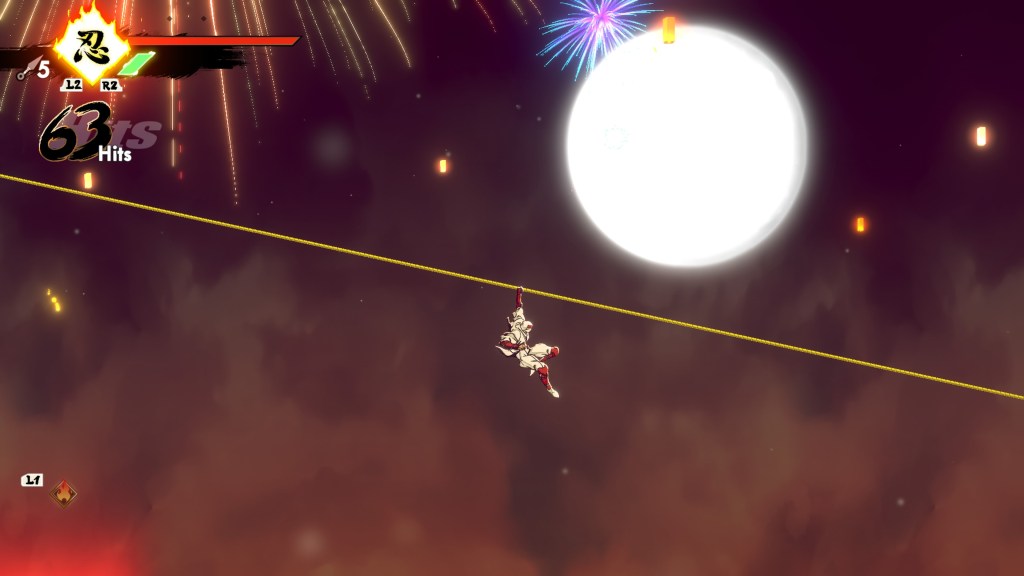
Passive Amulets, on the other hand, are tied directly to Ninpo powers, of which there are several kinds. The Water Ninpo creates a parry with generous timing and even automatically damages enemies in return for a thwarted attack, while the Bomb Ninpo can be tossed from above to deplete armor, allowing for staggers. There is also the Great Serpent Ninpo that summons a shadow dragon to chomp health bars in half like a Hershey’s, though its activation is quite delayed, resulting in a high risk/reward timing challenge. Since Ninpo Cells require successful hits against enemies to recharge, whiffing a bomb against an armored swordsman or wasting a Great Serpent on nothing but air are critical mistakes that might result in Joe’s demise. Passive Amulets come into play when Ninpo powers with latent potential simply aren’t cutting it and need to be buffed. Therefore, Passives may give new merit to an otherwise obsolete ability. In standard form, Wind Ninpo is used while in the air to send a scything wave of energy cutting across the entire screen, which isn’t very impressive when compared to the alternatives. However, its enhanced iteration sends out two of the bow-curve projectiles, causing considerably more damage. If you wait to trigger it until Joe’s feet are almost back on the ground, the surges prove just long enough to hit enemies high and low, potentially clearing out an entire group at once. The Ninpo nuances I was able to uncover kept things feeling fresh throughout the experience, and I always kept an eye out for new Passive Amulets to try.
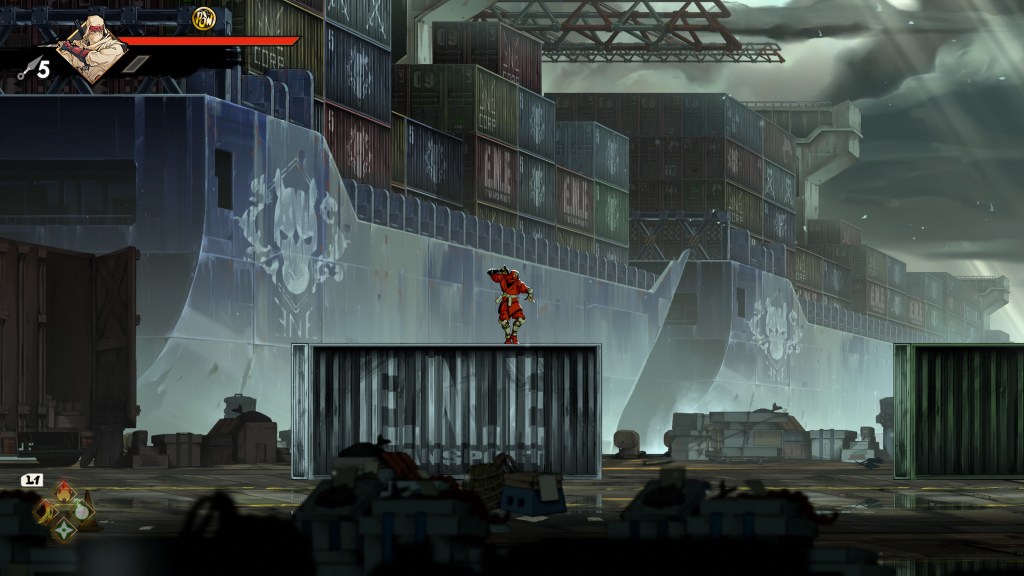
Aside from killer action, Shinobi: AoV offers up an old-school platforming philosophy that sees Joe travel through mostly linear stages, encountering inconveniently placed enemies along the way. What I didn’t expect is a metroidvania slant that requires players to repeat stages once they’ve unlocked the means to fully explore them, but only if they want every upgrade. Because of this, players will regularly hit roadblocks as they progress through the story, which is somewhat strange to see in a stage-to-stage title as opposed to a metroidvania, where the world is designed to be naturally interconnected. Luckily, a much-appreciated checkpoint system exists to ensure players aren’t wasting exorbitant amounts of time trying to 100% each level. Fast travel to any shrine is available via the main menu, allowing for swift cleanup. Still, I found this design choice to be more distracting than entertaining. I would rather have had to fight for my upgrades in a game like this than go back to the same somewhat bland locations, knowing I’d never discover new bosses or entire unique optional areas like I’d expect from a true metroidvania.
All the classic traversal tools are here. Ninja Claws allow for the scaling of certain wall textures, a parachute can be used to ride random updrafts, and a grappling hook zips Joe across huge gaps of nothingness. They are never used in a particularly interesting fashion, and I rarely had to pause and consider how I might get from one place to another. Pair this with the fact that stage design also incorporates everything you’d guess from the get-go, including disappearing platforms, harmful spikes, and crushing stone pillars, and you’ll most likely be wondering when it’s time to get back to brawling again. Of course, most of these elements are staples of the 2D platforming genre itself, so it’s no surprise that they’re here, but when half of Shinobi: AoV is imbued with addictive raw energy, while the other half unfolds in a far less inspired way, a glaring mismatch is created that I simply can’t unsee. Par for the course platforming that pulls me away from tense and engaging throwdowns becomes more offensive than it otherwise would feel, given the present dichotomy. The game’s most intricate platform challenges are optional, yet even those do not require the same level of skill or planning required in Celeste, for example.
After 13 hours in Shinobi: AoV, I was left to wonder how much better the experience might have been if it were more committed to its combat. Marvel: Cosmic Invasion just came out, so I caved and bought it, nostalgic for the classically costumed, bright colored interpretations of the heroes I’ve grown estranged from since my teens. The game is an unadulterated arcade beat em’ up distilled down to constant experimentation with dynamic synergies between incredible characters. Should Shinobi: AoV have been a beat em’ up or something more akin to one? Maybe. If a game is half great and half just fine, is it fair to harp on how it could have been better? Maybe not, but the 17 hours I’ve spent smacking A.I.M. agents with Beta Ray Bill’s hammer or firing lightning bolts down with Storm on the Bifrost while Wolverine hacks away at evil bugs like a psychopath seemed to melt away so much faster than the 13 hours I invested in Shinobi: AoV. I don’t regret those hours by any stretch, but I was hoping for more replay value. Unfortunately, it seems as if the developers lost sight of what their game does best. Obviously, honoring SEGA’s original series with a modern installment requires the inclusion of the original series’ trappings. In other words, maybe all Lizard Cube wanted to do was hold up their end of the bargain by breathing new life into Shinobi, something they’ve certainly accomplished.
Regardless of any possibly suppressed potential, a few equivalent hypotheticals popped into my head once I’d completed the game. I thought about how the perception of Cuphead might change if a run and gun level was required before being allowed to fight the following boss. Sure, the run and guns serve their purpose as fun palette cleansers, but crazy, lively, and enjoyably torturous boss fights are the selling point. What if, in Space Marine 2, every other mission included the kind of vehicle segment we saw in the first Gears of War, Resident Evil 5, and many other early 2000’s action games; driving down a straight road while shooting stuff with a turret for what feels like twenty minutes? There are practical reasons why developers detract from the core value of their games, such as filling time or hopping onto trends like cinematic set-pieces, though Shinobi: AoV’s issue isn’t arbitrarily introducing drastically different gameplay directions during its runtime. Instead, it errantly believes that its platforming and combat pull the same weight, while the reality is an undeniable imbalance between both elements that ultimately left me underwhelmed, especially when a title like Marvel: Cosmic Invasion comes along to reiterate the power of a single dedicated focus.
Until next time, folks! Oh, and if your name is Joe, no offense. Especially if you’re a master ninja. Then definitely no offense, good sir.
 GotMeThinkingGames
Leave a comment