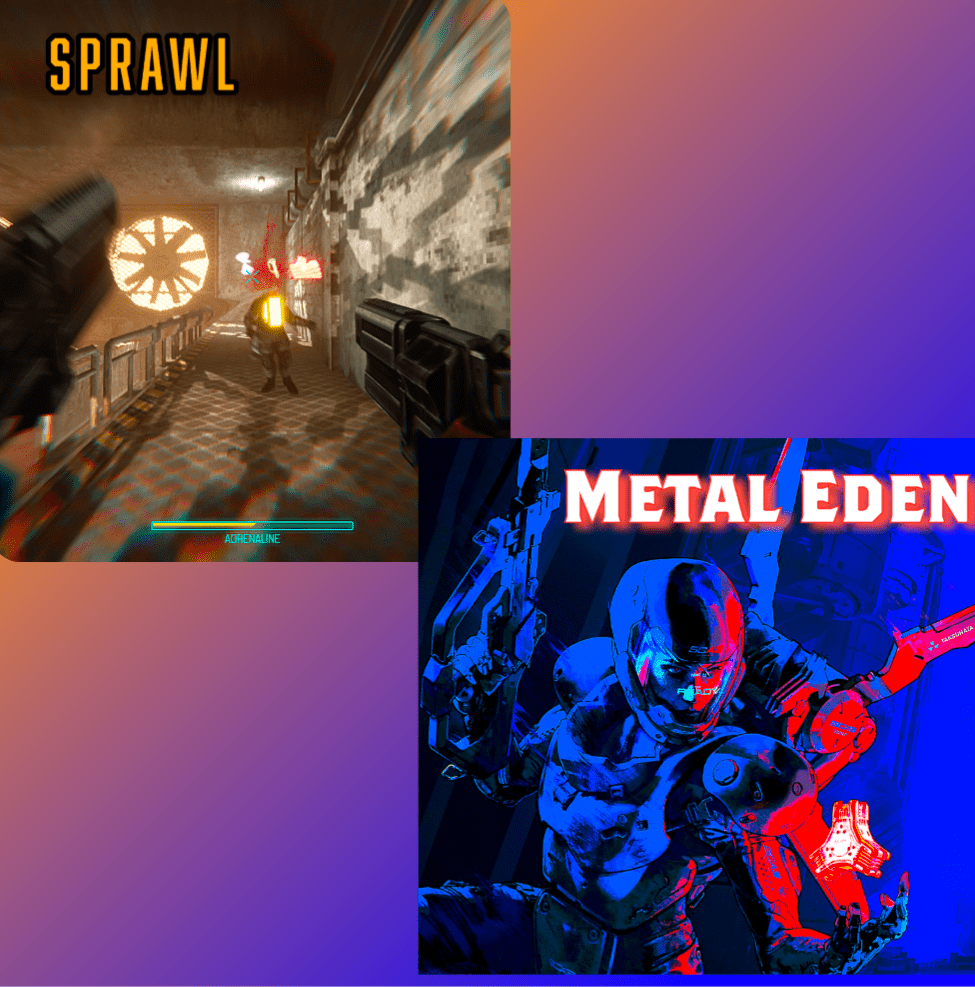
The smothering, shimmering drudgery of sci-fi dystopias often feels not so far off from what we’re living. Maybe that’s why the genre is so popular. It’s easy to buy into the idea that mega-conglomerate corporations will eventually have a stranglehold over society via technological advances that leave no room for rebellion. Endless, snaking lines of bloodshot-eyed commuters carrying chips embedded into their skin that shock them like dog collars for even a moment of inactivity once they officially scan into their daily worksites full of deafening steel presses and whirring saws seems to be the natural next step for the disgruntled, helpless employees of the here and now. Besides, we all constantly wonder who the hell is making the important decisions anyway. . . it might as well be a robot. . .
There are two kinds of dystopian sci-fi. Okay, there are a lot more than that, but for our purposes there are two: the kind that turns the surroundings of giant company skyscrapers into a total slum, where high-tech meets a universally low will to live, and the kind that colors everything chrome, transforming the world as we know it into some silver fortress of steel. I recently completed two indie FPS games that present a virtual version of each style. Sprawl, a 90’s inspired (at least graphically) shooter with a spotlight on slo-mo puts players into, dare I say sprawling, urban settings full of abandoned buildings and augmented enemies, while Metal Eden sends its android protagonist ziplining through structurally improbable levels of sleek platforms and shiny rooms. While I ultimately enjoyed each game, one emerged as the clear victor. I’ll be splitting this post into two to make sense of why I liked one better than the other. The categories are as follows: gunplay and immersion. Let’s see what happens. . .
Gunplay
We’ll start with Sprawl, a title that demands and rewards precision. If you’re not utilizing the slow-motion mechanic, activated by spending adrenaline whenever L2 is held down, then you’ll get shredded pretty fast. Adrenaline is relegated to a generously sized meter at the bottom of the screen that can be replenished by successfully head-shotting (or jetpack-shotting) enemies, whose obliterated areas burst into a shower of ammunition, health, and blue adrenaline hourglasses, all at once. This essentially means that Seven (the time-bending, super soldier protagonist) can indefinitely pop in and out of slo-mo at will, if enough shots are consistently hitting their mark. Combine that feature with a trusty wall-running ability and you have an addictive formula for creating colorful confetti with enemy insides. The rush of toggling between slo-mo and real time, scoring sick shotgun kills in such a manner that could justify a combo meter, is like creating a highlight reel that Seven can’t wait to show her friends later. Even when Seven is not at her airborne flashiest, a boots-on-the-ground approach can feel just as satisfying. The second level incorporates a maze of stone pillars, which allows for a whack-a-mole style confrontation. Peeking out of cover with a shotgun to say, “oh hello” – BAM! had me feeling like John Wick in the first movie’s nightclub scene.
On console, the level of accuracy required to succeed initially turned me off from Sprawl. It was slow going as I played around with my sensitivity settings to find the right balance between functionality and freedom. I died a lot during the opening level. Trying to land headshots at full speed was simply not happening. My initial lack of respect for adrenaline was making me pay. You really need this stuff. Instead of spending it in small doses, I was burning through it like paper as I clumsily attempted to target glowing craniums. Once I found the right analog configurations, practiced using slow-motion at varying intervals, and simply built up such bloodlust that I refused to be denied my savage due, Sprawl revealed its flow-state potential. From there on out, I could enjoy the kickback of a railgun as I blasted a giant mech from across a vaulted chamber, the health-melting potential of a haphazardly drawn SMG, the splash-damage destruction of the rocket launcher, and, of course, the pounding obliteration of the shotgun. It’s also important to partially credit the game’s smooth weapon wheel for its console functionality, as recently playing Turbo Overkill without the ability to rebind its wheel from the directional pad (a highly questionable choice) essentially ruined the impact of the entire game for me. Kudos to Sprawl’s developers Hannah Crawford and Carlos Lizarraga!
Now for Metal Eden, whichmarches to the beat of a different drum (kind of). The game also includes wall-running, optional slo-mo, and peek-a-boo buck-shots, yet Reikon Games, the developers behind the crimson-wrapped RUINER, seek to implement a chessboard approach to combat rather than allowing for a laissez-faire flow to be established. In Sprawl, it doesn’t matter what weapon you’re using or enemy you’re facing, as long as you’re moving swiftly, slowing time efficiently, and chaining kills together at regular enough intervals to replenish resources. Does this result in an over-reliance on the over-powered shotgun? Yes. But what matters is that the formula remains fun. Metal Eden, on the other hand, ensures its players will be consulting their weapon wheels more frequently, as resource management and enemy vulnerability are handled differently.
Armored enemies are established as the primary obstacle for ASKA (the cybernetic gunwoman, or HYPERUNIT, that players control) to overcome in battle. In theory, there is nothing wrong with this, though there’s something about breaking and rebreaking armor that just doesn’t hit the same as hewing hit points. As a wise man might have said, there is no moral victory awarded for shredding digitized shields, only for pumping holes through flesh until your enemies perish. In Metal Eden, destroying defenses is almost always a prerequisite to harming them. The bottomless SMG you start with isn’t very good at this, and the pistol and shotgun, while both fun to use, run constantly low on ammo. Luckily, plasma weapons are introduced rather early. Plasma is capable of quickly vaporizing armor, and for this reason the rifle that shoots it became the crown jewel of my arsenal as soon as I discovered it. The grenade launcher and some other alt-fires are also capable of leaving enemies vulnerable with a rather brief barrage, but plasma retains the advantage for its ease of use. When you’re out of ammunition in the most appropriate firearms (a recurring issue), making do with what’s left just isn’t very rewarding. In Doom Eternal (likely one of the inspirations for Reikon Games), the most ideal strategies for purging the forces of Hell are of course not always at hand. However, each of the Slayer’s backup plans feel viable and sufficiently entertaining, whether that’s earning a blood punch with easy glory kills on fodder, or hunkering down with the chaingun to destroy an Arachnotron’s turret once your sticky bomb supply has run dry. The action never slows to a crawl, and the Slayer himself controls so smoothly that the occasional retreat can still feel exhilarating. Metal Eden will instead force players to jump around looking for ammo, health, or armor that appear as holograms in predetermined locations during arena fights, each with their own respawn timers, meaning resources are essentially unlimited at the cost of patience. But patience and intense FPS action don’t really mesh. . . ASKA isn’t stuck in the mud by any means, yet her overall mobility feels limited by Reikon’s rather basic level design, resulting in periods of hopping and dashing around a crowded room in search of more bullets, which feels downright disengaging.
While ASKA’s body can be fitted with upgrades like Major Kusanagi’s, many of the available options come across as underdeveloped, such as being able to freeze enemies or slow time. These extra abilities feel less tied to the fundamentals of the game and more tacked on for the sake of ostensible diversity. Where Sprawl commits to a concept like time manipulation, Metal Eden only dabbles. As it stands, I decided to pour all my points into improving the impact of core usage. From what I understand, cores are essentially flash drives for human DNA and neurological activity. Each enemy contains a core within them, which ASKA can yank from their bodies whenever she has enough power to do so. This is the gimmick that separates Metal Eden from the pack. A dislodged core has two uses; players can either propel them toward enemies like mini-missiles or absorb their energy to enter a Super Punch state, where ASKA holds up her fist with “lemme-at-‘em” flair. The Super Punch will decimate armor, making it a great tool to use against elite enemies. However, if ASKA lacks enough ammo to immediately exploit such vulnerability, then that armor can return, creating a vicious and often annoying cycle. I did have fun extracting and hurling cores, though I wish I could have done it more often, and I imagine there is plenty more to be done with this concept if a sequel ever gets the green light.
Metal Eden may be tedious at times and a bit vapid (more on that soon) but there are some silver linings. I think most of the guns are fun to use, with slick animations and palpable recoil. A charge-shot from the laser pistol made for a particularly enjoyable strategy against flying droids with explosive death-animations. With enough foresight, players can also create some intense sequences, such as stealing a core, blasting a goon, consuming said core and then Super-Punching another goon right afterward. I craved more of these sequences but was repeatedly stunted by the game’s reluctance to give ASKA a bit more oomph.
Immersion
Sprawl is Grimy. Hollow-eyed buildings line streets filled with trash. Billboards hang high in the heavy air, relics of manipulation with no more audience, fit only for kicking across as Seven takes to the rooftops to escape her enemies. Back on the ground, the deep innards of factories exude the stench of burning oil as gunshots clatter against catwalks and cement walls. Sprawl is set in a vast city infused with technology but preserved as a mercantile landmark of greed’s toxic stain on the earth. Cheap tenement towers and barges loaded with old shipping crates come together with flying cyborgs and flashing holograms in a bizarre infusion of despair and a supposed age of advancement.
As Seven, players navigate a convincing dystopic world where almost nothing is left. From the streets to the rooftops, dirty rivers to imposing vaults of churning machinery, Seven pushes forward, desperate to survive and purge. I was impressed by the game’s scope and variety, especially for such a small, under-the-radar project. What could have been a short campaign composed of disconnected stages turned out to be a wonderfully paced story that seamlessly weaves different environments together to maintain a sense of cohesion and progression throughout.
The driving force behind the story is a voice in Seven’s head, called Father. Father impels Seven to fight back against the menacing Junta force that believed their former (expendable) super-soldier to be dead. This leads to a gradual expansion of the lore as Seven’s cloudy memories begin to clear up and the inner workings of Junta are uncovered. The story reminded me of a narrative from an indie artist called CyberScion, who released a short self-titled album that also follows a stoic cyborg obeying orders from a mysterious “father figure,” albeit far more questionable ones. Anyway, a sense of tension and drama between Seven and other villainous characters who seem to be old allies of hers adds an extra sprinkle of intrigue atop fantastic environmental storytelling.
If Metal Eden stumbled in the gunplay section, it skids, slips a disc, and somersaults in the immersion department. Any real depth to the setting seems absent, as ASKA (while also listening to her own far more invasive and meandering voice companion) surges through clean interconnected arenas that seem to function as controlled training rooms rather than an actual, livable environment. If each room was dynamically constructed, this wouldn’t be an issue, however it’s all very rudimentary; a few raised platforms bisected by a wall-running surface with a wide-open middle is what you’ll mostly see. The developers seem to have recognized this, because they shoehorn in a Metroid ball ability that Starshine uses to roll through a volcanic valley. Yes, the city is apparently intertwined with a volcano somehow, though the geography is never very clear. While this switch-up is at first entertaining, no further development of the ball ability or the outside environment comes into play. These are simply palette-cleanser segments that only slow the action to a halt and feel obtrusively linear.
Aside from the repetitive level design, Metal Eden doesn’t give players any reason to care about its story, which is painstakingly spelled out by a whole lot of one-sided dialogue during snooze-inducing zipline transitions between arenas. There is no real antagonist, just faceless bad guys, leading to a final boss battle that was not only boring, but also lacking the impact it clearly yearns for. While the graphics are quite commendable, the game is missing a memorable trademark. In fact, I found the stylized title cards between levels to be the most interesting visuals in the game, exposing the absence of color or creative depth in the levels themselves.
I don’t want to be too hard on Metal Eden, especially as it compares to Sprawl. After all, the games do not seek to represent the same kind of dystopia, as I discussed in the intro to this post. Therefore, it is perfectly valid for Metal Eden to explore an eerily sterile world instead of a more layered merging of the past and future. However, I’m not sure this ambitious project had the proper funding to really pull off the kind of colossal vacancy it wants to portray while also offering enough exciting gameplay and encouraging level design to justify it. Metal Eden feels rushed in many places, serving as a promising proof of concept rather than a fully-fledged shooter. Overall, Sprawl takes the cake in this cybernetic FPS clash, yet both titles are worth checking out. I recommend snagging Metal Eden on sale for a quick fix, while anyone with an interest in fast-paced shooters that embrace the old and new should play Sprawl right away!
 GotMeThinkingGames
Leave a comment